The Endeavourers’ Reveal Day, November 2025 — Sashiko
It is time once again for our online group to reveal projects in response to a quarterly theme. This time it was “Sashiko,” which is a traditional Japanese craft, often done with white stitching on indigo cloth. I had never done any, so I went through all the books I got in a Blockbuster Book Haul last year, looking for resources.
I found four books:
Sashiko: Traditional Japanese Quilt Designs by Nihon Vogue. Along with charted traditional designs, this book includes some ideas of stitching modern motifs in multicolors.
Sashiko and Beyond: Techniques and projects for quilting in the Japanese style by Saikoh Takano. This books has full-page charts of the traditional designs, and also a huge section on combining sashiko with applique.
Sashiko: Easy Elegant Designs for Decorative Machine Embroidery by Mary Parker. This book explains how to replicate the sashiko look, by using a sewing machine. It involves using photocopies and a iron-transfer pen to mark the design on the wrong side of the fabric, and then using heavy thread in the bobbin to achieve the effect. There are a lot of tips for achieving precision, and instructions for 25 projects.
The Techniques of Japanese Embroidery by Shuji Tamura of The Japanese Embroidery Center. This book does not have any sashiko in it, but some of its geometric designs are similar, and I wanted to try some of them.
Looking for a base fabric, I came across this:
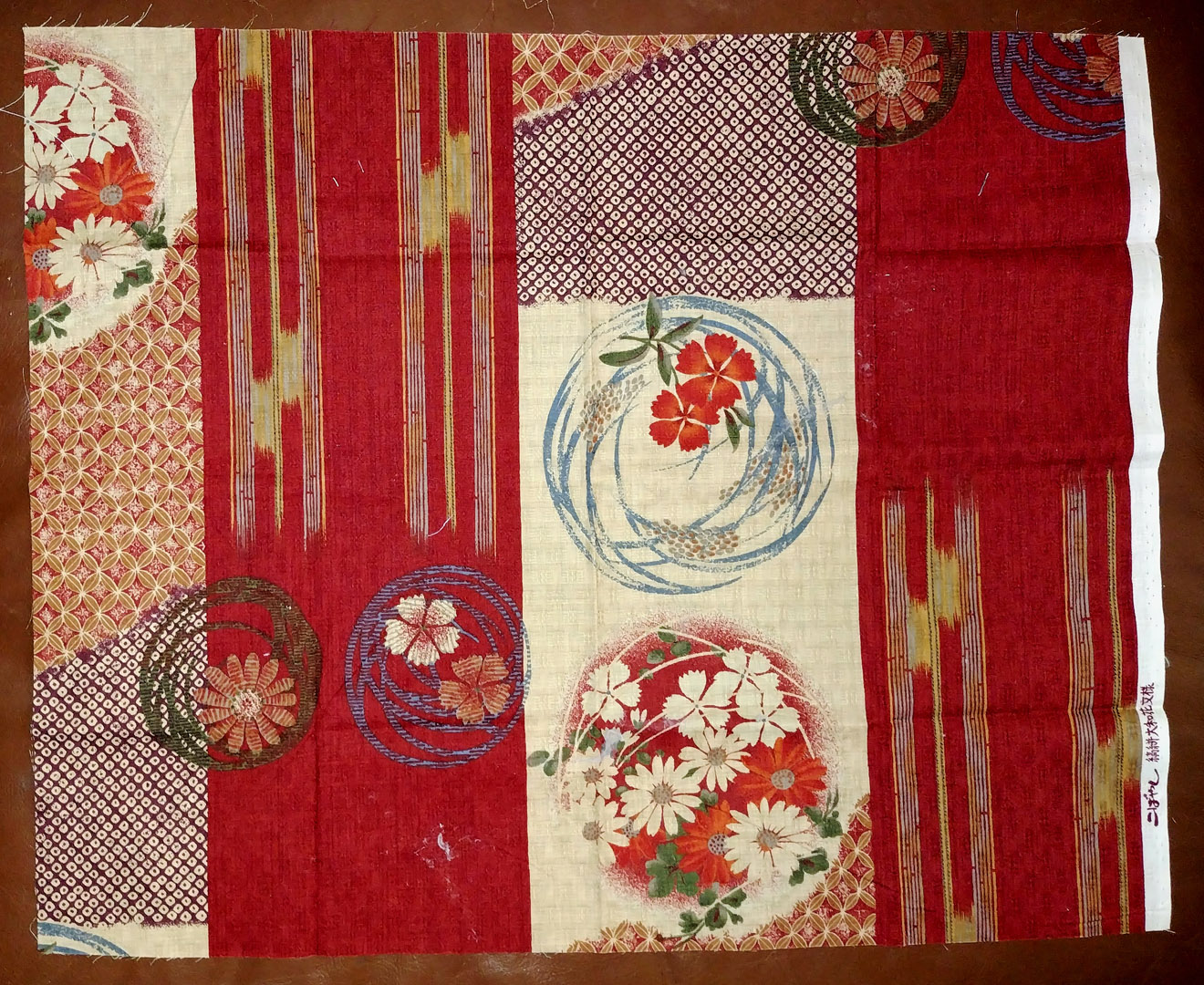
A piece of Japanese silk.
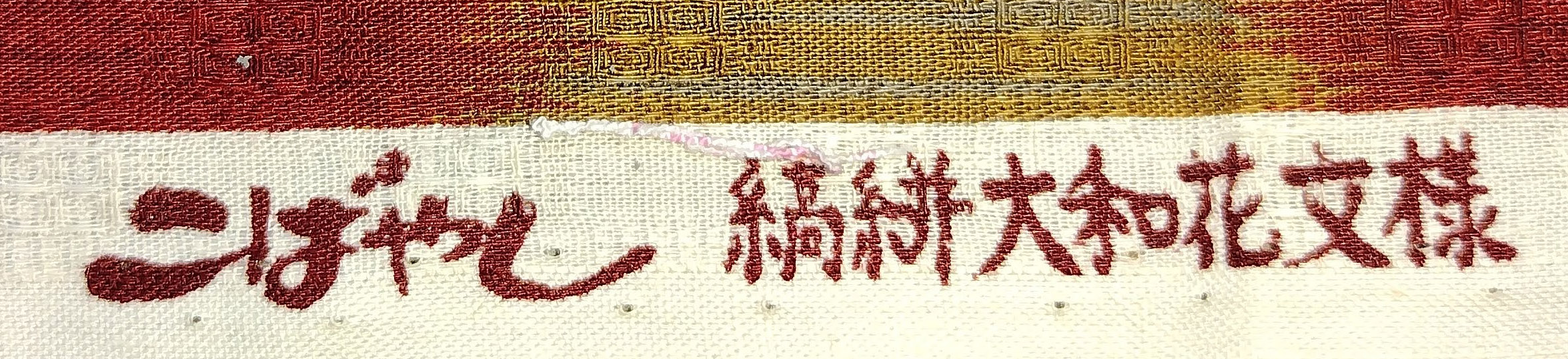
Close up of the label.
I put these images in Google Lens and was given the following information:
This image shows a piece of Japanese fabric, specifically a type of textile known as kasuri. The text on the fabric identifies it as “Kobayashi Kin-kasuri Yamato Hana-monyou” (Kobayashi silk kasuri, Yamato flower pattern).
-
Kasuri is a Japanese weaving technique similar to ikat, where the threads are dyed in a specific pattern before the fabric is woven.
The characteristic blurry or feathered edges of the patterns are a result of this resist-dyeing process.
This particular fabric is identified as silk (kin-kasuri) and features a “Yamato” or traditional Japanese floral design.
Kasuri textiles have been produced in Japan since at least the mid-18th century and were traditionally hand-woven.
I did not want to try the machine-stitched technique. I knew hand-stitching would take a lot of time, and I decided to just embellish the design on the fabric (saving myself time on marking stitch patterns). I experimented with different threads — embroidery floss, machine embroidery threads, even thin gold thread from Japan — and with the recommended techniques from the different books — working with and without a hoop, with and without a backing cloth. I got the best results working with no hoop, and no backing cloth, and my favorite thread was Wonderfil Razzle which is rayon.
I also stitched a version of this pattern on a separate piece of fabric.
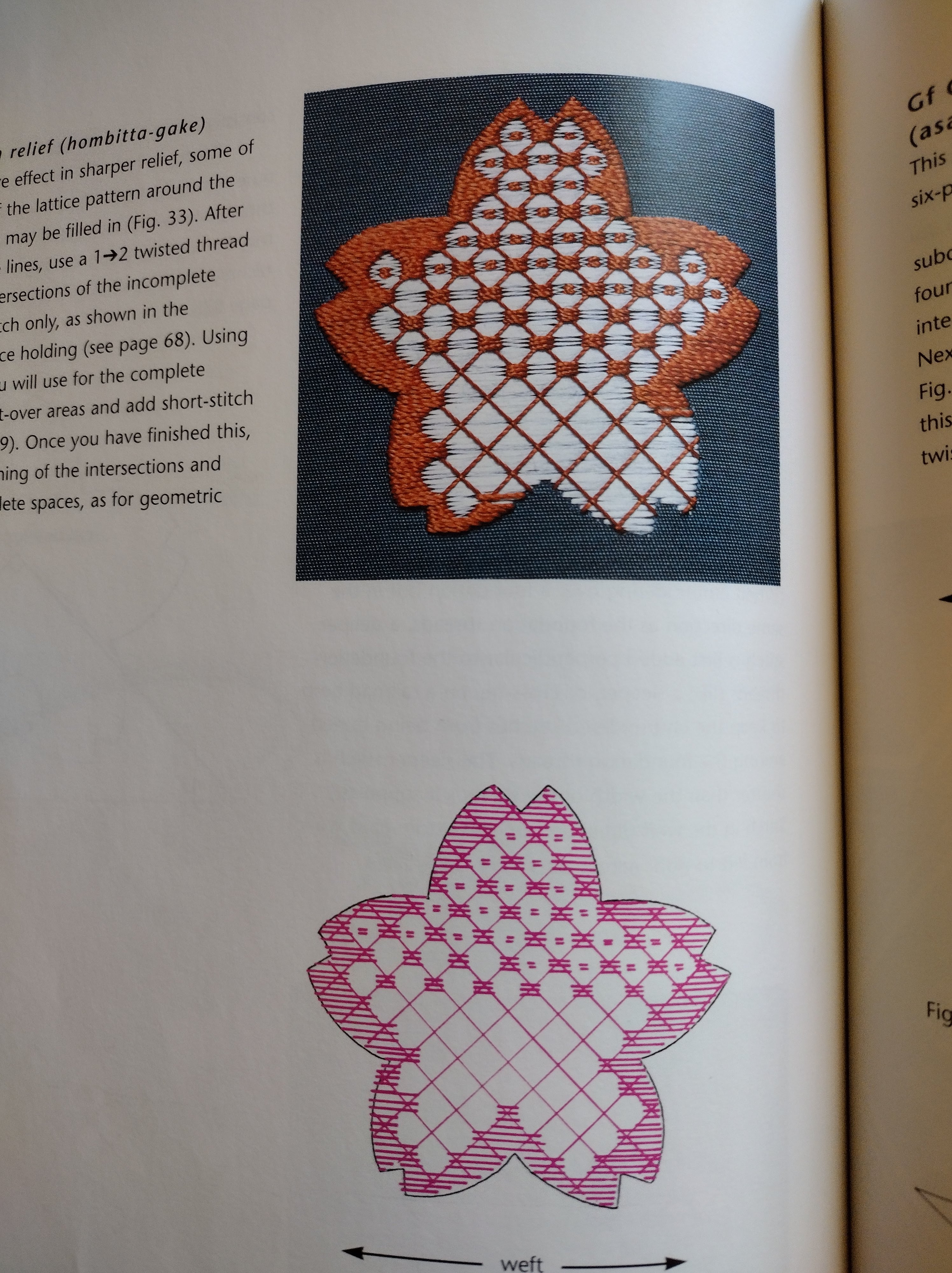
I attempted this embroidery pattern from the book The Techniques of Japanese Embroidery.
I stitched along the light lines, and along the circles surrounding the flowers. I used thin gold thread on the orange peel pattern, but it doesn’t show up. The white flower was done separately and attached with a lot of machine stitching around the edges. I enjoyed the hand stitching, but the hours of work really don’t show up in this piece.
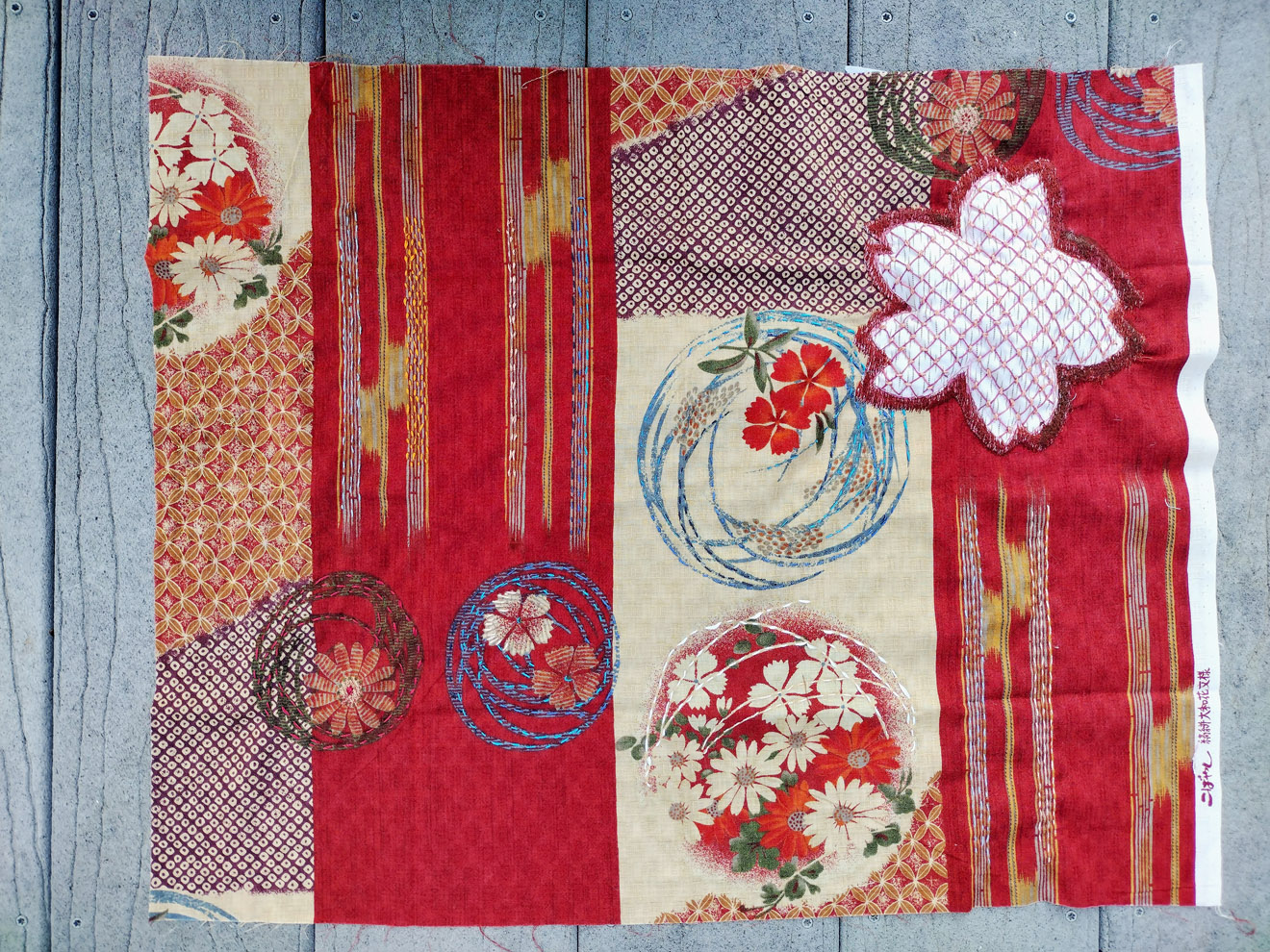
The silk fabric with some sashiko embellishment, and a stuffed, embroidered flower.
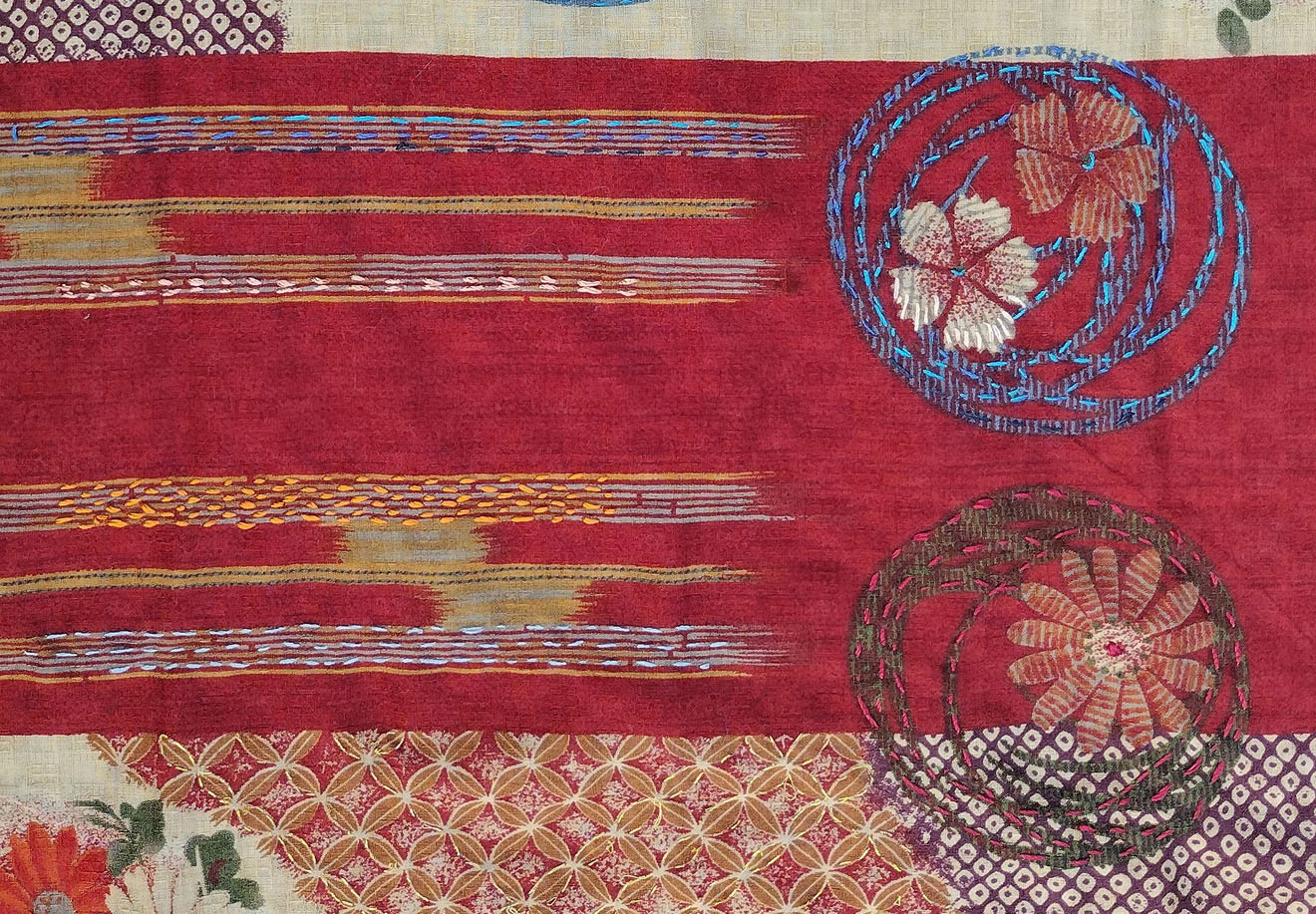
Details showing the stitching a little better.
And in a departure from the group’s rules, I didn’t make this as a stand-alone piece. Back in February I started a sampler quilt with Asian fabrics, and I want this to be one of the blocks in it. Here is what I have so far:
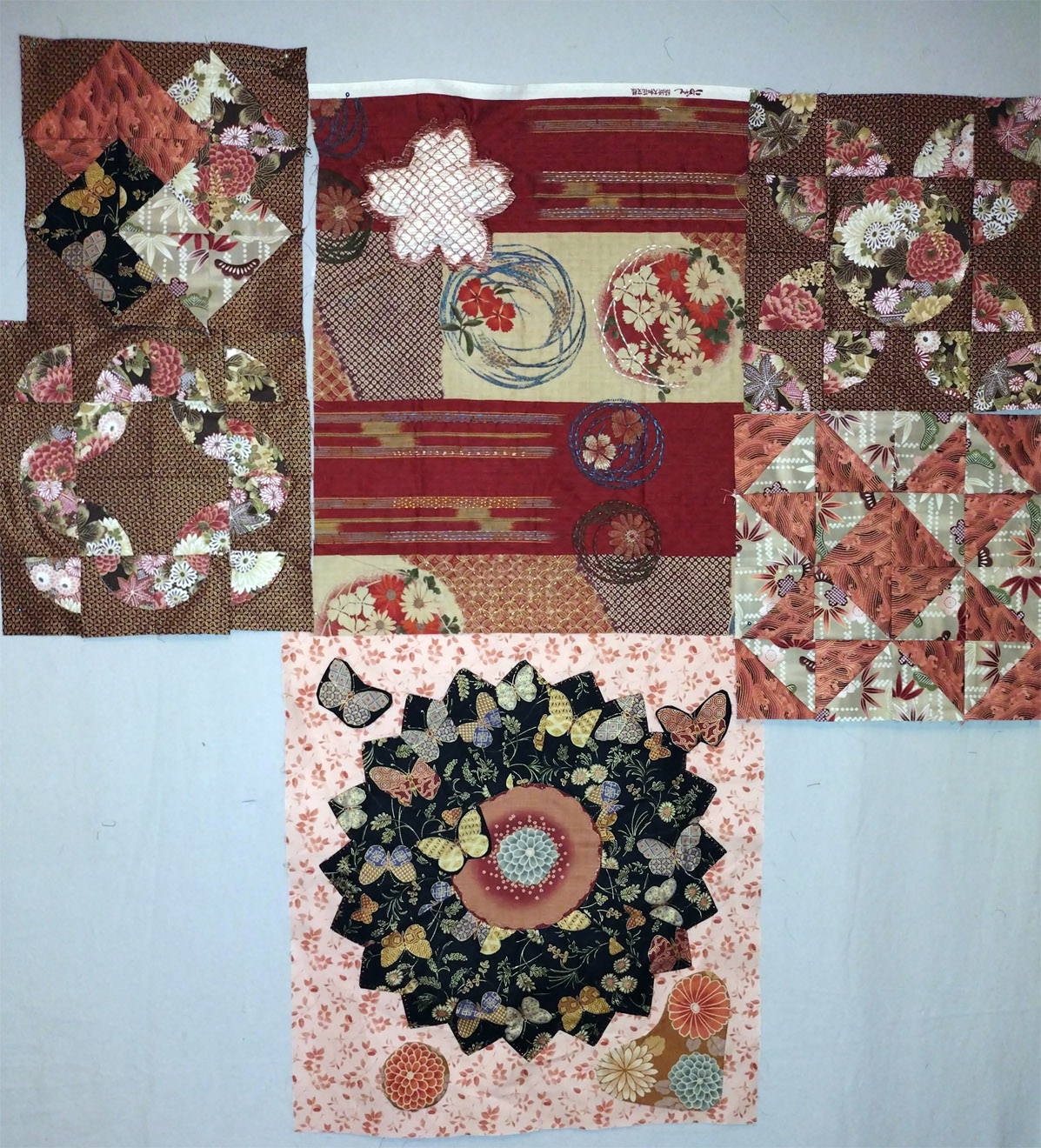
My sashiko piece is in the center of these blocks that will someday be a sampler quilt.
I don’t think I will ever return to this technique, but I did learn a whole new respect for it! If you would like to see what the other group members accomplished, you can check out our group blog, The Endeavourers.




I love that you spent so much time learning about the technique and tried so many different methods!! I purchased a Sashiko sampler piece at Houston several years ago and have enjoyed working on it, but I can’t figure out what to do with it!! I recently saw a lightweight jacket made with sashiko blocks and that is appealing to me. Maybe I will pick up my needle again!!
Thanks, Frances. From the other participants, I learned that there are sashiko stencils to make the marking go quicker! That’s one thing I love about these challenges — even if I am not that enamored of the technique, I always learn lots of new things. 🙂
I agree that it is cool that you did some research on this technique. I like your fabric choice. The stitching is not as simple as it looks, right! I think you met the challenge well!
I agree about the stitching not being simple. I have done a lot of embroidery in my life but this seemed to go so slowly. I think you did a great job of using the stitching to highlight your composition!
You just blow my mind with your artwork. I like that you did research on something you’d barely heard of. Perhaps it was only an experiment but it definitely is impressive!
Thanks, Claudia! I hope you go visit The Endeavourers blog to see what the other participants came up with, because I think you will really love their creativity! So many different takes on the theme.
I was interested to read all your research. I think your stitching is a very nice addition to this beautiful fabric and it probably shows up more than you think. I also really like your white flower. I shall look forward to seeing more of this sampler quilt 🙂
Thanks, Janine, and when your piece is on the cover of a magazine, I will say I knew you when!! 🙂
Oh, tricksey fabric for sashiko! But you got it. how nice to have your own personal library LOL
Thistle be a beautiful day!
While there is tea there is hope!
Yes, I am surprised my house has not sunk into the ground from the weight of all the books I have acquired. Thanks, Susan!
haha
Thistle be a beautiful day!
While there is tea there is hope!
Hah! It is SO you to have multiple sashiko books in your stash! And I especially like your stuffed flower.
I got them all in that one auction. I have often wondered about their original owner, and if she ever had time to actually create anything, because she owned so many books and marked so many projects she wanted to try! 🙂
I, too, love the way you researched and experimented with a new idea. Even if you never do any sashiko again you have given your brain a wrokout! And your finished piece is very pretty.
That is true, one of the biggest reasons I quilt is just to give my brain a workout! I love the process more than the finished project.
It’s always interesting to test the waters of a new technique. I’ve tried lots of different things, some more successfully than others. Some become a long term favourite, others I’m just happy to have made one thing, done it well and then put it aside. I’d love to try Sashiko, but I feel I’d need to devote more time to doing it than I currently feel I have to spare.
I agree, sometimes you know you and a technique are not going to spend a lot of time together. Years ago, one of my weaving friends said, “It’s just as important to know what you DON’t want to do, as what you do!” But it would be great to have enough time to try all the techniques we want to.
More time would be great, I agree, but being the age I am, I don’t want to spend a lot of time investigating something I suspect will not give me as much joy as the things I do spend time on! I haven’t made all the quilts that are in me yet. So much fabric, so little time!
You put a lot of thought into this, and though you’ve discovered it’s not your thing, you’ll have a wonderful square for your developing quilt, along with a story to tell. I’ve always admired Japanese art and craft, but I’ve never explored it in any depth. I look forward to the next quarterly installment.
Thanks! Those quarterly deadlines get here fast but I always enjoy thinking about them! 🙂
It’s fun. I look forward to the monthly ScrapHappy posts. They stimulate the creative juices.