Dust Off a Book Blog Hop
I buy a lot of books in auction lots, which means I don’t even look at each one before taking them home. So I was glad to sign up for the Dust Off a Book blog hop from Beaquilter, and take some time to dive deep into one book.
The one I selected was Making a Sampler Quilt by Lynne Edwards, Reader’s Digest Books, 1996. I have been quilting as a hobby since 2000, and in all that time, I have used mostly squares and rectangles in my quilts. I thought it was time to branch out and improve my skills with other shapes!
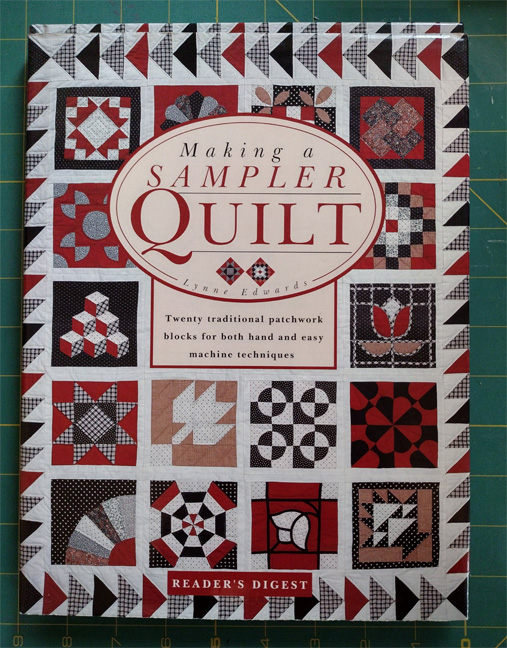
Making a Sampler Quilt, Reader’s Digest Books, 1996
This book is really lovely because 1) it is aimed at beginners and 2) it alternates between hand- and machine-stitched techniques. It includes simple strip piecing, hand applique, Hawaiian quilting, curved piecing, flying geese, and many more techniques, for 19 in all. The techniques are not all ones that I myself would choose to teach a beginner, but the directions for each block are very detailed, averaging 5 pages of instructions for each one.
Every chapter also features a finished quilt made by one of Lynne’s students, so you can see the blocks in different arrangements and colorways. There are plenty of blocks that I didn’t think appealed to me, until I saw one of the student interpretations. The pink and gray sampler below is one I found especially interesting.
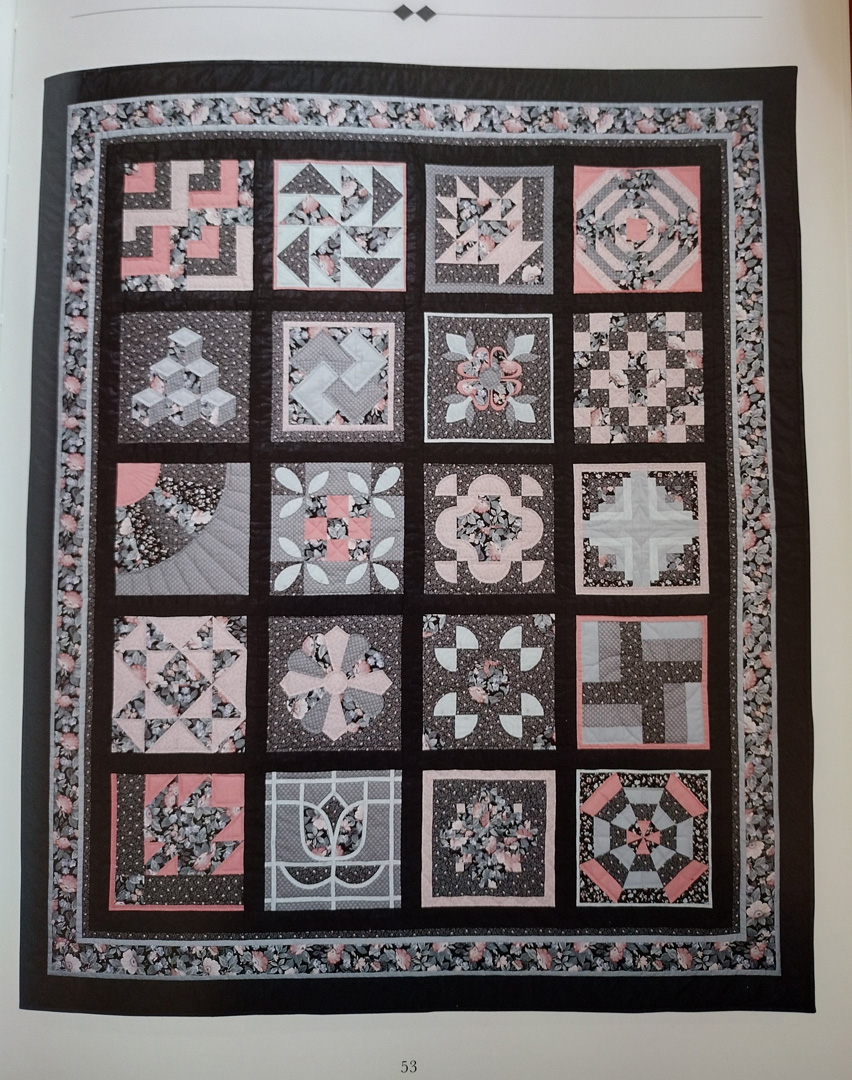
A finished sampler quilt by Dot Sidgwick.
I decided to make just a few of the blocks, using beautiful Asian-themed fabrics that I have collected over years, but never allowed myself to use.
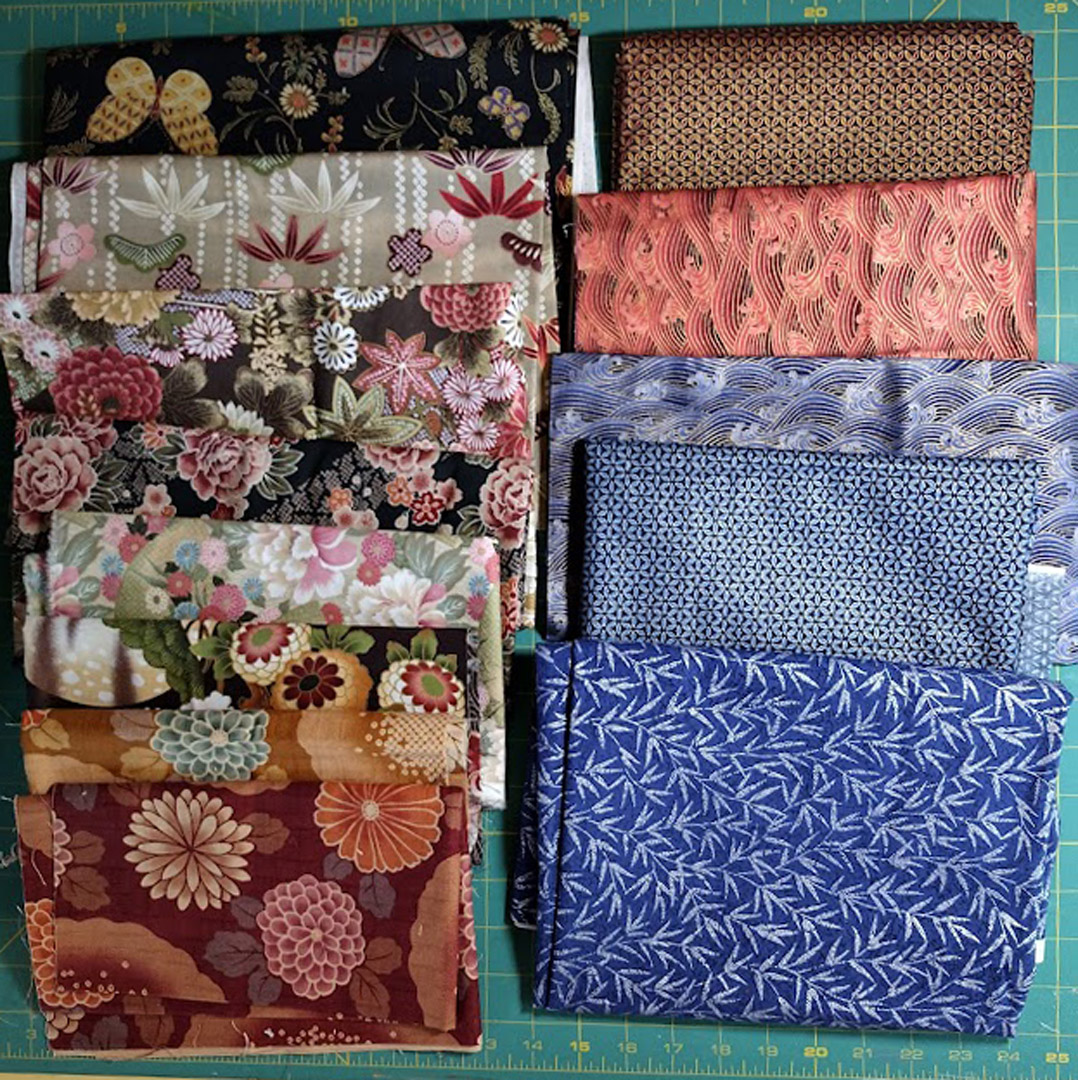
Asian-inspired fabrics.
I didn’t follow all the instructions in this book religiously, I used it more as a jumping off point — if, after reading Lynne’s directions, I remembered seeing a short-cut version of the technique, I looked for the short cut in other books and YouTube videos.
The blocks that I made strictly by the book’s instructions were Card Trick, Wild Goose Chase, and Triangles. Each block took me over 2 hours. They turned out fine but I didn’t love them, mostly because I felt like I had to pay too much attention to which little piece went where, and I had to constantly trim the block components before joining them.
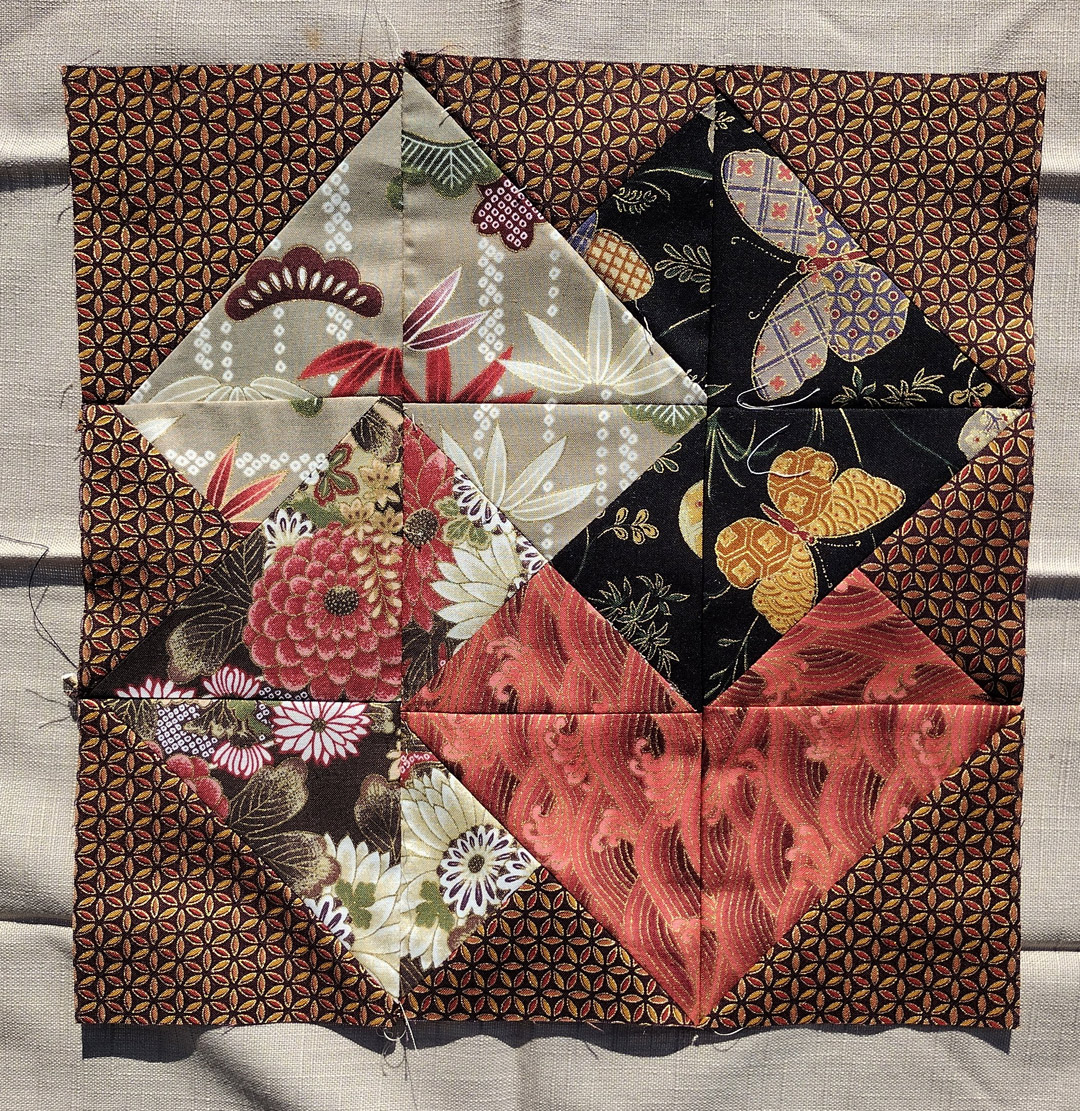
Card Trick block.
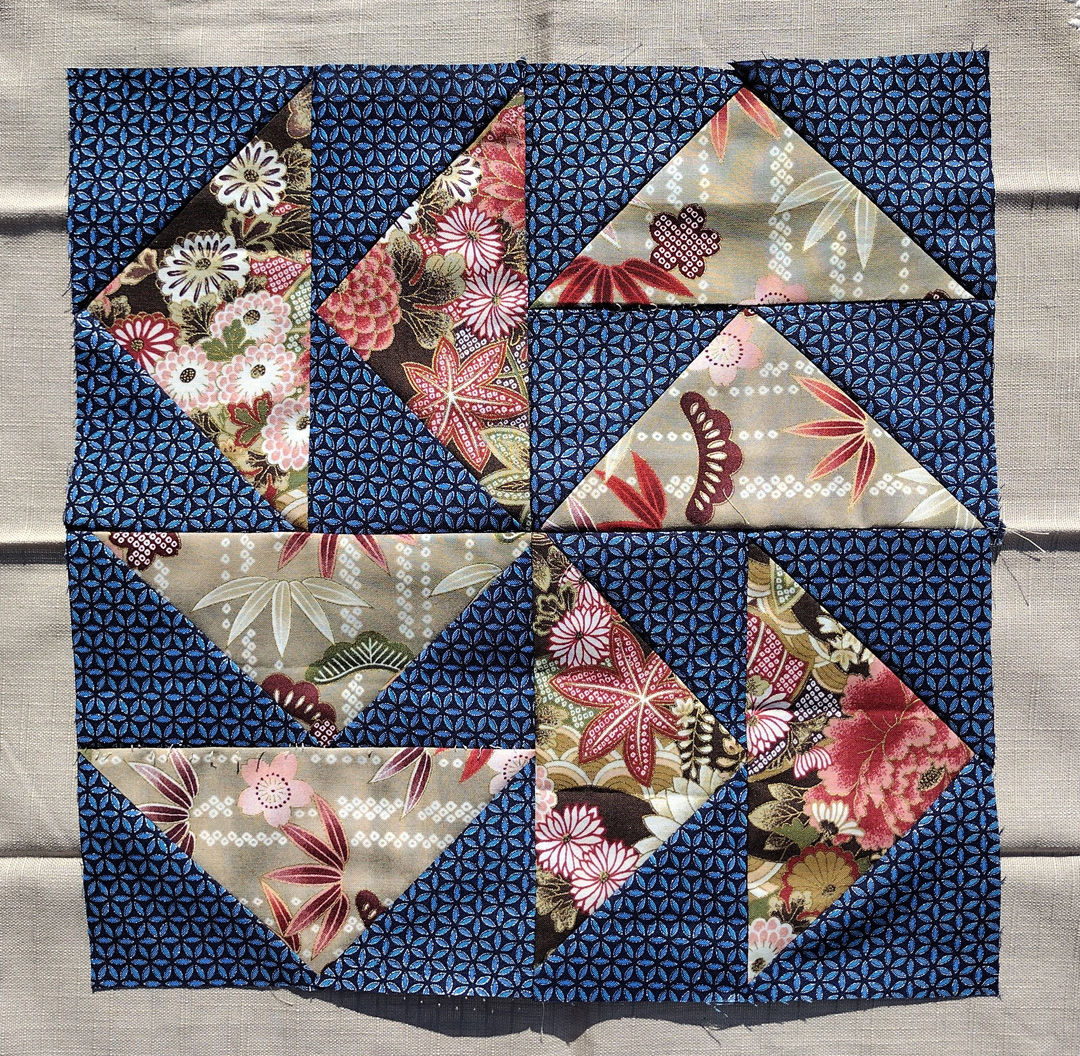
Wild Goose Chase block.
I made the Triangles block twice, one time following the author’s suggestion to draw guide lines on the back of large pieces of fabric, then stitching, then cutting the half-square-triangles apart. All my little squares came out different sizes and I had to do a lot of trimming. So I did it again, using foundation paper to mark the stitch lines, but the results were not much better.
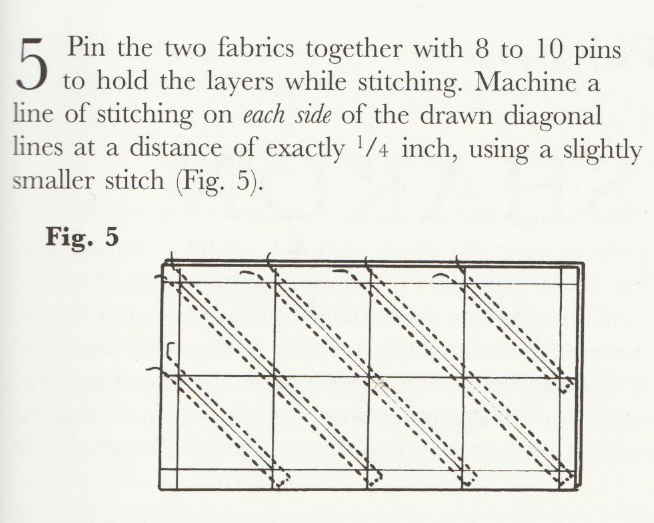
Book’s method of marking and stitching multiple half-square triangles.
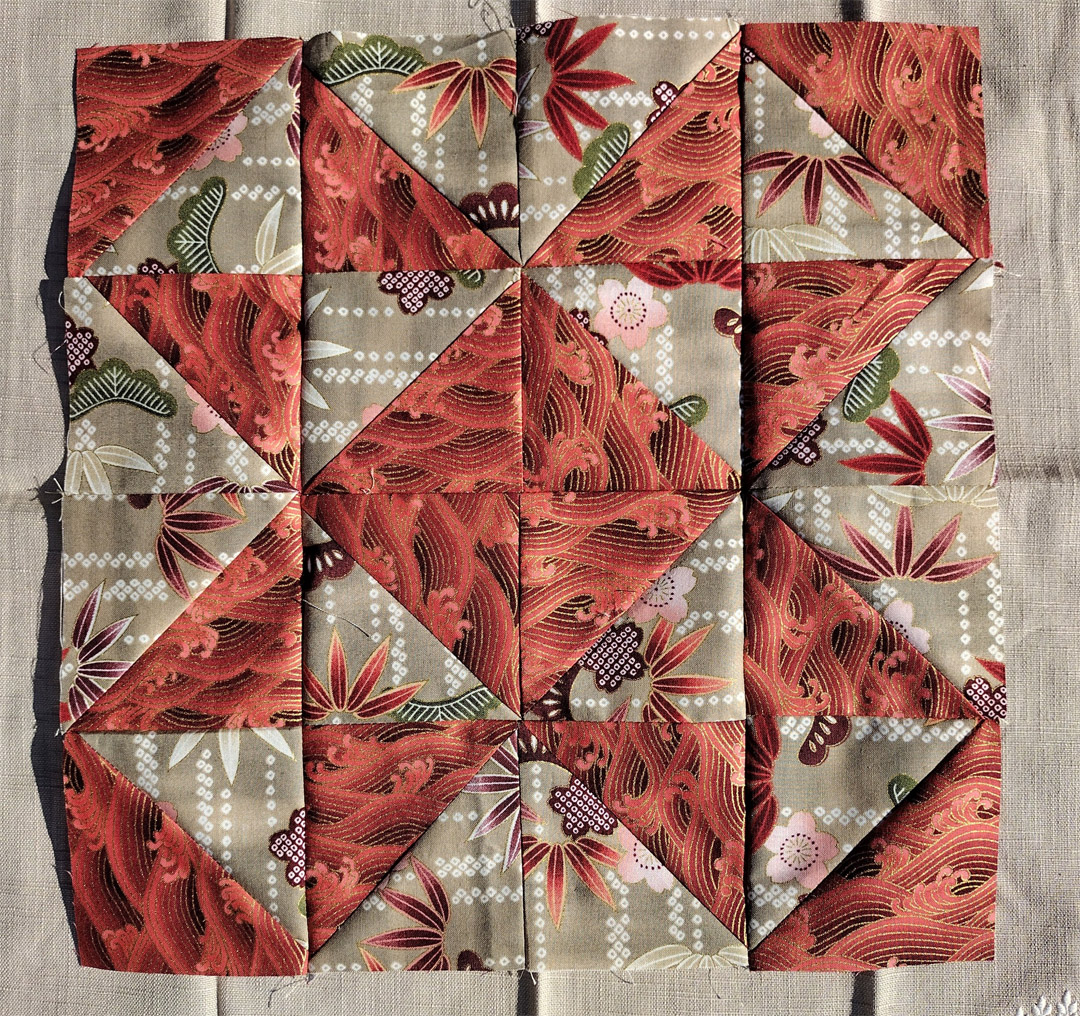
Block made from half-square triangles.
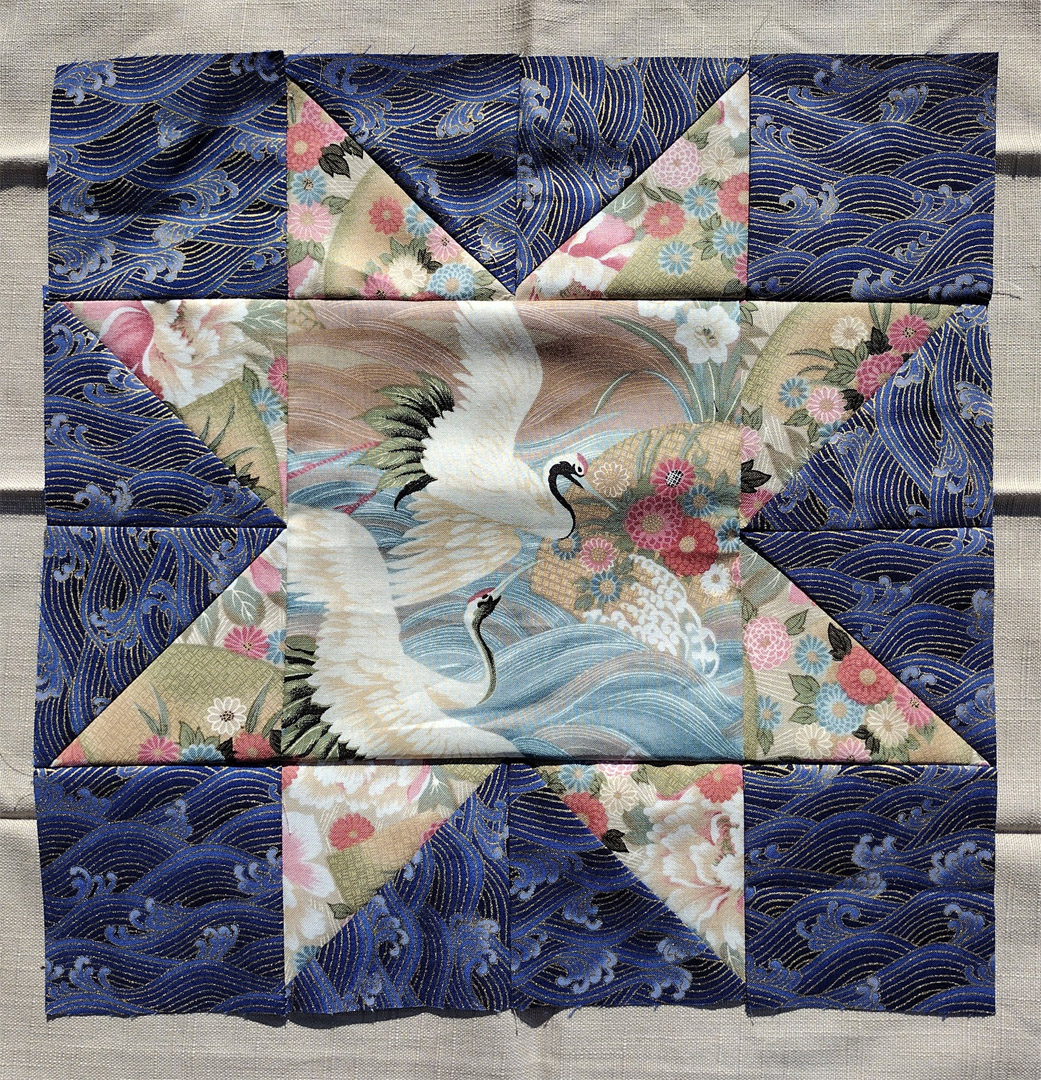
Block made from half-square triangles and squares. I wanted to make the most of some of this large-scale design without cutting it up!
Then there were the blocks that I saw in the book, but found more helpful tutorials on YouTube.
First was Dresden Plate. The pattern as shown in the book, had two templates, for both curved and pointed segments. The directions called for them to be needle-turned and hand-appliqued. Nope!
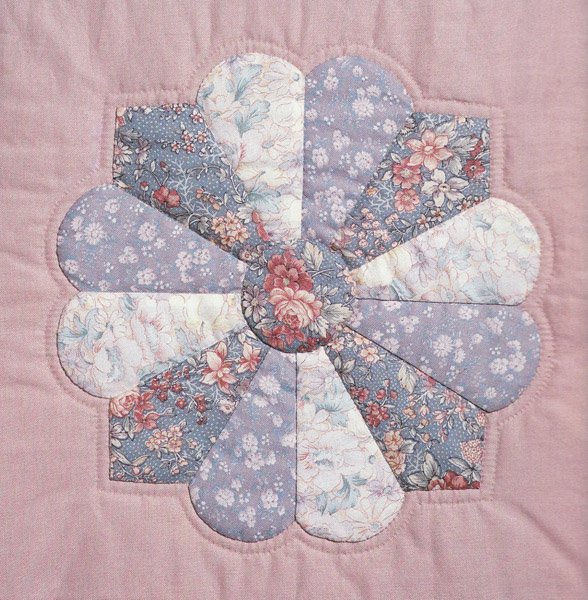
Dresden Plate, as shown in the book, in those 80s pastels.
Fortunately, I remembered that Eleanor Burns has a quick and easy version, and while I was hunting for template plastic, I found I already owned Eleanor’s acrylic template! It had been in an auction box.
I loved making this block! You can chain-piece all the little segments, there is minimal pressing involved, and extreme precision is not a requirement! I fussy cut and fused the large center (it looks like a sunflower head), small flowers, and butterflies. I used some metallic copper thread to blanket stitch all the petals.
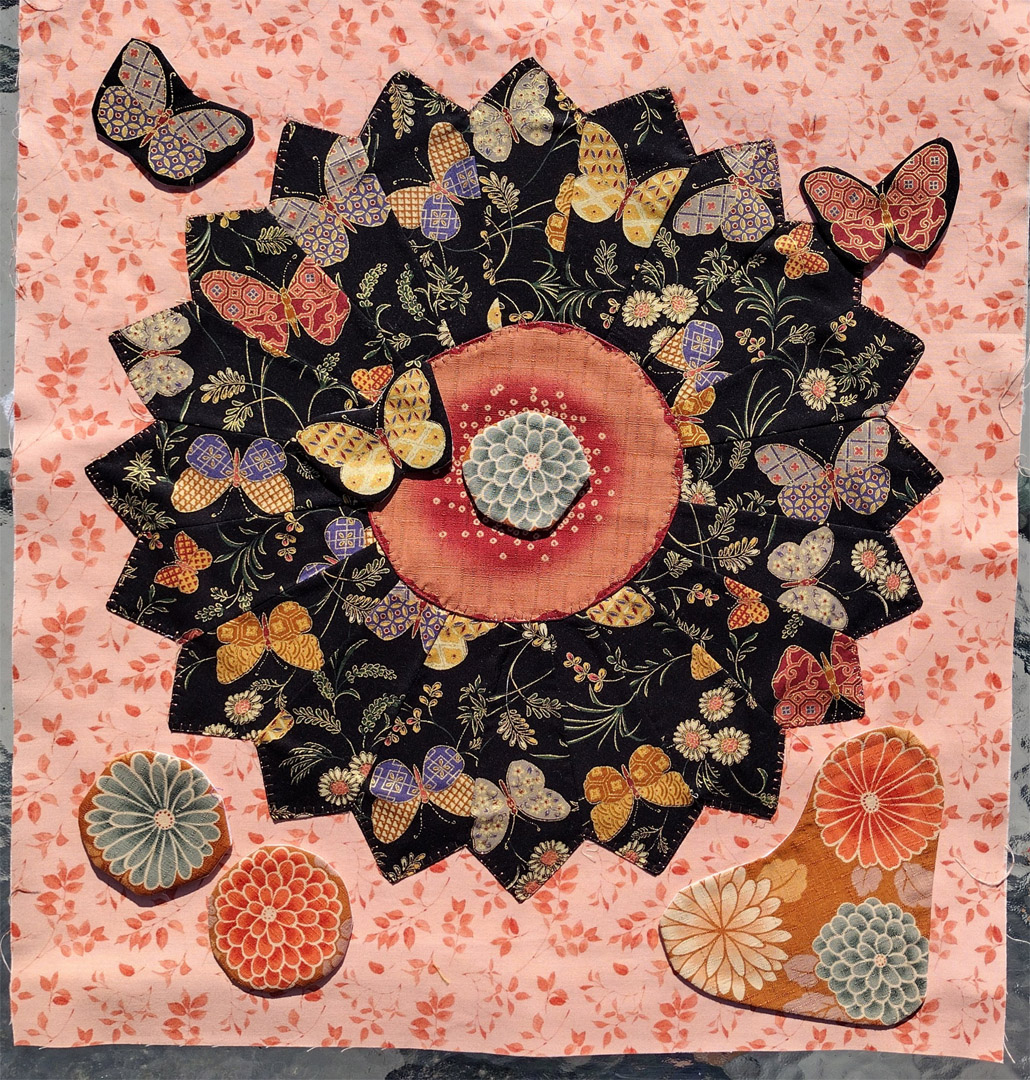
Dresden Plate — machine-stitched, fused, blanket stitched with metallic copper thread.
Back to the book to try its directions for making Drunkard’s Path. I bravely tried stitching curves, and that lasted for about a minute. Then I found this great tutorial, that uses fusible webbing, from Elizabeth Epida!
This block again has everything I love –more impact than effort! I made two to look at different arrangements.
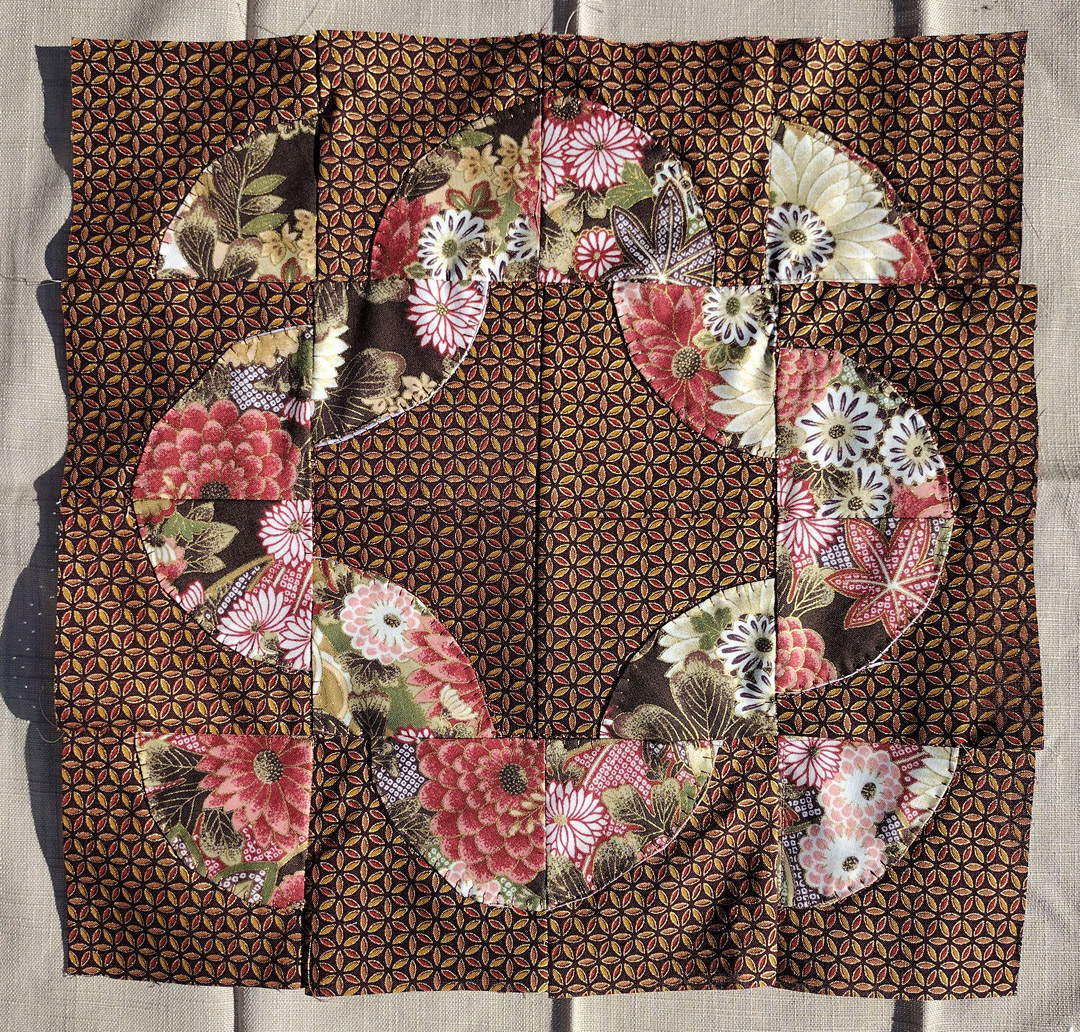
Drunkard’s Path Block.
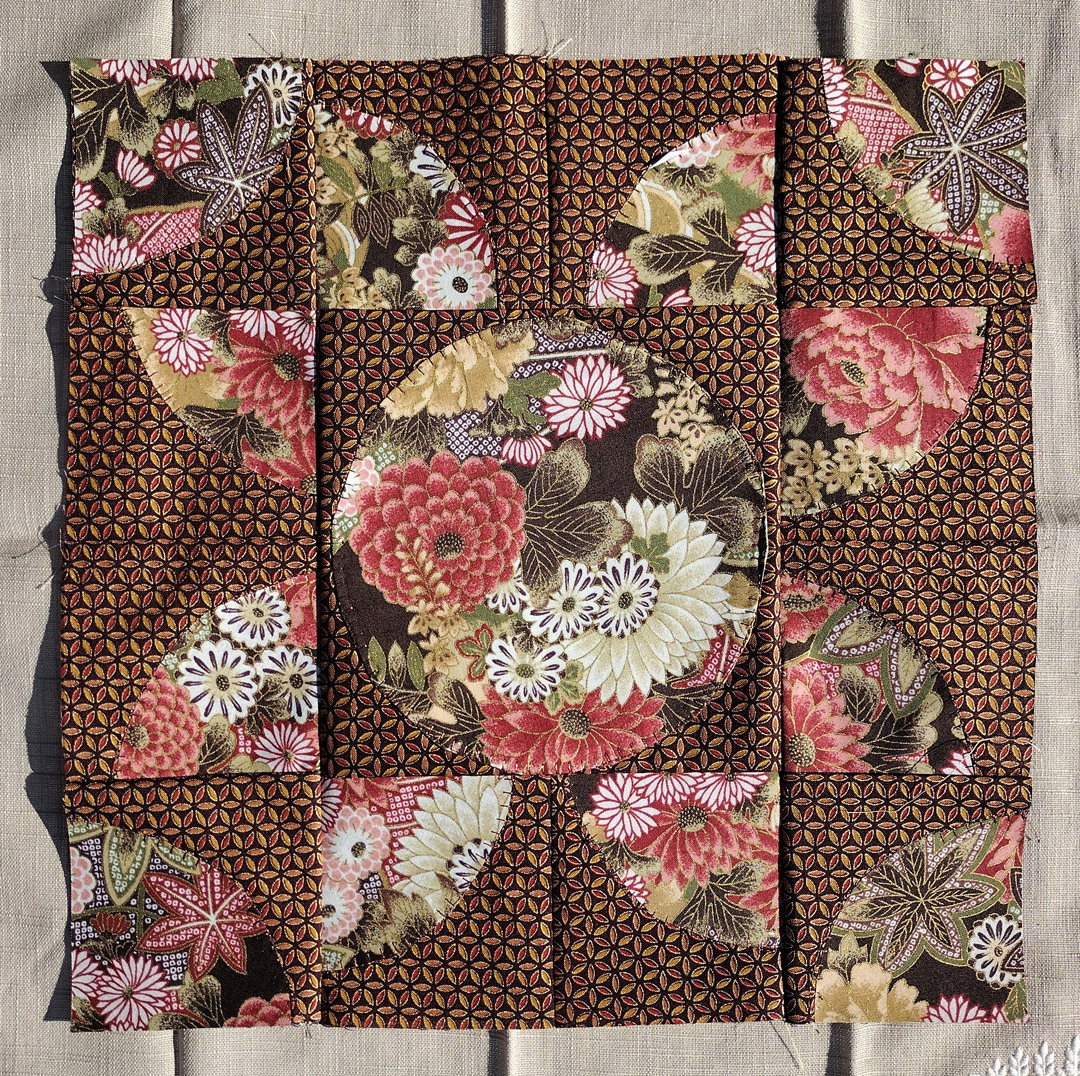
My second Drunkard’s Path block. I used a large circle in the middle, again to showcase the fabric design.
So, so far I have 8 blocks. I think I will make a few more and then combine them into a wall quilt. I am going to keep this book a while longer because there are more blocks I want to try.
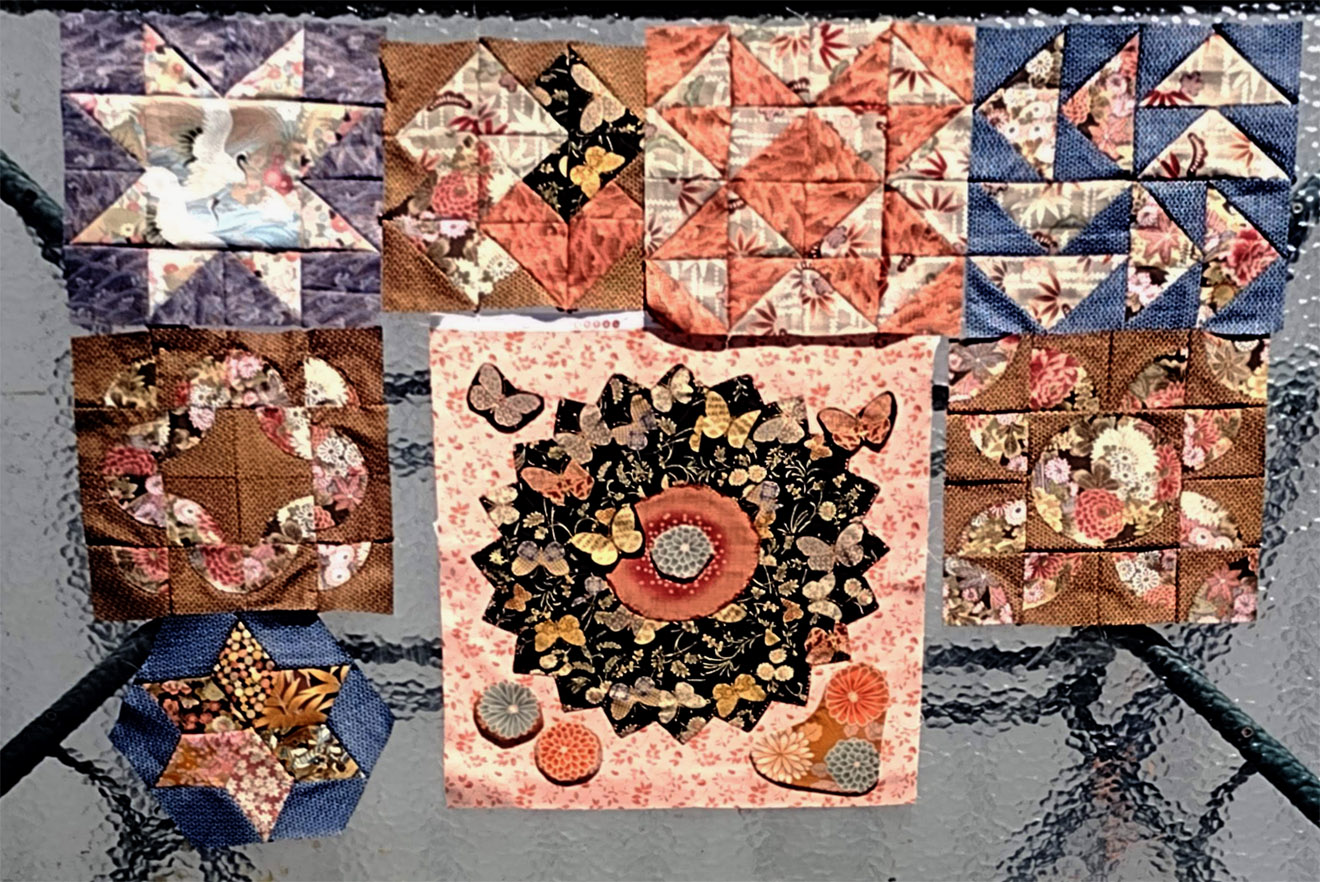
My sampler blocks, 2025.
I am so glad I participated in this blog hop. As I worked on the blocks for a few hours each day over the last month, I felt like I was giving myself a quilting retreat! I wasn’t rushing to finish anything, just taking the time to learn, and treating myself to beautiful fabrics and threads.
So thank you to Bea for hosting! I am looking forward to visiting the other participants to see what books they dusted off, and I hope you visit them too!
March 3
March 4
March 5
March 6
#Dustoffaquiltbookbloghop2025
#bealeequilter




Wow! I love your sample blocks, especially the star with the crane fabric in it, and the drunkard’s path in the crysanthemum fabric.
Thanks, Andrea! I really enjoyed stepping beyond my usual fabric choices and process!
Nice to meet you! Your ‘dusty’ book provided some challenges and you rose to meet them so well. I have a couple of her other books (still gathering dust, but I’ll have to take another look).
Thank you! There were challenges indeed and I am glad we now have the internet to help us find a solution that works, but this book was a great place to start. 🙂
That sound like it was a perfect book to learn new techniques! The blocks you made so far are amazing – I hope you continue and have a Beauty of a quilt!!!
Thank you! I am so glad she included so many student samples and I plan to copy the ones that shed a new light on those traditional blocks. 🙂
Wow this sounds like a great book! I like the fact that now we can find tutorials online to help. I can choose the one I like! I enjoyed your Asian fabrics too.
I totally agree about being grateful to find additional help online! Thank you for commenting!
Sampler blocks are so much fun. These are great and I love that it felt like a little retreat making them. Also, love that you found other techniques when you needed them. It will be a beauty, hope you keep working on it!
Thank you! Usually I am working with donated fabric and I am trying to go quickly to get a quilt put together — it was very nice to take all the time I needed to get a block just right. 🙂
Great sampler blocks, with lovely fabrics!
Your blocks came out wonderful and will make a lovely wall quilt!
Thank you so much!
Your blocks came out wonderful and will make a lovely wall quilt! I have noticed that some of the older quilt books have different methods to create the block. Maybe they are more time-consuming, plus, the block does not come out correctly without your own adjustments.
Thank you! And I agree –when I was searching for extra help with some of the more difficult blocks, I noticed the differences in instructions between books. Sometimes they had one little tip that was just what I needed! 🙂
These are fun blocks!
Oh my, you made me look ! I have done a sampler quilt, all in greens and purples and shades there of. All together except for the backing…..book by Diana Leone. Some hand pieces and some machine sewn. How different from your Asian fabrics, which give those patterns a whole different feel. I have my grandmothers Dresden Plate and the Lone Star of Texas. Maybe I should get myself together and finish this for the great grand kiddos. And while looking for this I found a very old quilt, all had sewn, and no idea where I got it from. scheech…
Susan! You really need to send me some pictures and let me do a guest post of your great collections and your work!!
Purple and green is one of my favorite color combinations!
Actually, that would be a good idea to document my Grandmothers things. I’ll have a friend help me with that.
Thanks for the idea.
You have a wonderful selection of oriental fabrics. I’ve tried to use what I have but still have a few pieces. What a great learning experience this has been. I always prefer to make blocks the “easiest” way if I can!
Yes, life is too short for me to make difficult blocks! 🙂
Setting aside Asian-inspired fabrics was a great idea. All of your work is wonderful. I especially liked your block made from half-square triangles and your block made from half-square triangles and squares. Your Dresden plate is lovely, too. This will be a beautiful wall quilt when you have it finished. Nicely done! Interesting blog hop!
Thanks, Maddie! I thought of you a lot for this blog hop because I know you used to have a business of selling used books, and I just can’t imagine how much work that would be!! Keeping them all organized, etc. Whew!
It was a chore for sure. I used to pay my son’s girlfriend to alphabetize the books by category and then by title on the shelves. For homeschoolers, it wasn’t about the author, it was the history title or biography title etc. – that was important. Books were so much easier to grab off shelves by title. Yes, whew! 🙂
It’s always a joy to see how people pair fabric. Thank you
That is so true — when people say, “I don’t see the point of cutting up good fabric and putting it back together,” I always think, “But I want to see what will it look like combined with x, y, z…” I love the combinations. 🙂
Good for you! That was quite a project. I’ll be watching to see if you ever make any of those new blocks again…
I am definitely planning to make Dresden Plates and Drunkard’s Path — I even ordered cutting templates!!
How wonderfully creative! I love how you worked with different patterns and designs.
Thanks, Claudia, it was so much fun to just play.
I LOVE to hear you use the word play!!!
those striking, rich asian fabrics have elevated the blocks to new dazzling heights….lovely just lovely
Thanks! I was remembering how Jinny Beyer uses the fabric patterns to make the piecing look more complicated, and I think I could definitely push that technique more!
It’s amazing how much quilting techniques have morphed and changed over the years. Looks like you did a lot of research on finding the way that works best for you. I can’t imagine not having a rotary cutter, and I am sure quilters of days gone by couldn’t imagine having one. LOL!! Your book is a treasure trove of days gone by.
You are so right about the quilting techniques morphing! As I was looking through some of the older books, I was noticing how little they actually quilted their finished pieces — just a row of echo quilting around each shape, like in that Dresden Plate photo. Everything looks so puffy to me! Not that I am any great quilter, but I see amazing quilting at the International Quilt Festival, and my eye has grown used to that instead of to the more minimal quilting of the 80s and 90s. 🙂
Great looking blocks!
I love how you explained your approach to each block, very interesting. It will be interesting to see how you finish this into a wall hanging.
Yes, if I sewed as much as I analyze, I would get more done! 🙂
So may beautiful blocks, including my favorite, the Dresden. Thank you for sharing all of them!
Thank you! I am sorry I never tried the Dresden earlier, I think it is my favorite too!
That’s an interesting book. I enjoyed watching the videos and learning about how you made your blocks. They look great in those fabrics anf I’m looking forward to seeing your wall quilt 🙂
Pingback: The Endeavourers’ Reveal Day, November 2025 — Sashiko | Deep in the Heart of Textiles
Pingback: Wrapping up 2025 and Planning for 2026 | Deep in the Heart of Textiles