Quaker Homespun, Part Four – New Technology
This is part four of my “book report” on Quaker Homespun, a biography of Thomas Fox, a wool cloth manufacturer who lived through the Industrial Revolution. We won’t go into any specific machines that he used, but we will look at the difficulties he faced, many of which have parallels in our own times.
Thomas was never an early adopter of technology. In 1785 he wrote:
We do not much wonder at manufacturers being individually fearful of introducing new machines, since, however useful, the first promoters usually suffer from popular violence without being sufficiently protected by the laws. (p.51)
He did consider switching to steam engines for power, or moving his business to a place with consistent water power. He also worked with a machinery-making firm called Backhouse of Darlington, who were trying to perfect machines capable of spinning and weaving wool, but it turned out that they were more focused on machinery for flax and he was not able to get any equipment from them.
In the end he decided to stay with horse power, and in 1790, he went to Manchester to order scribbling, carding, and spinning machinery from Joseph Taylor of Deans Gate. [The author sometimes mentions Joseph Taylor, and sometimes James Taylor, without further explanation.]
Returning post haste to Wellington, he began the construction of a machine shed, 150 feet long, and he engaged a wheelwright to set up a horse wheel underneath, the horse wheel costing £60. In January 1791, Thomas reported to James Taylor, ‘Our horse wheel is now completed and we are very anxious to have the machinery set to work.’
But nine months were to pass by before a pound of yarn could be spun. There was an increasing demand by Lancashire cotton firms for James Taylor’s machines and little attention could be spared for the needs of a Somerset serge maker, 200 miles away. Thomas remonstrated repeatedly.
As time went on, the required billies [a machine to open and blend the wool] and spinners were put together, but the craftsmanship was shoddy, ‘unseasoned wood being used which occasioned the machines to warp, the iron work brittle and badly finished’. Loosely packed, the delicate machines were rough handled onto canal barges and sent off through the canals and waterways…. On two occasions, an eagerly awaited machine was found to be in pieces when it arrived. On April 9 1791 Thomas wrote to James Taylor, ‘We this morning opened the package with the Billy which to our concern we found much damage owing to the slovenly manner of its being packt, in a case vastly too large and without straw to keep it steady, so that the spindles are bent or broke and various parts of the work much injured.’ The same sort of thing happened again two months later. (p. 54)
Joseph Taylor had also sent two mechanics to install the machines and tend them after installation. One of them was not satisfactory — “He does not appear any way calculated for the undertaking he has engaged in as he is not acquainted with the nature of the machinery nor has he a genius for it.” The other mechanic had to be sent back to Manchester to make the machinery that had never been delivered, and bring it back to Wellington.
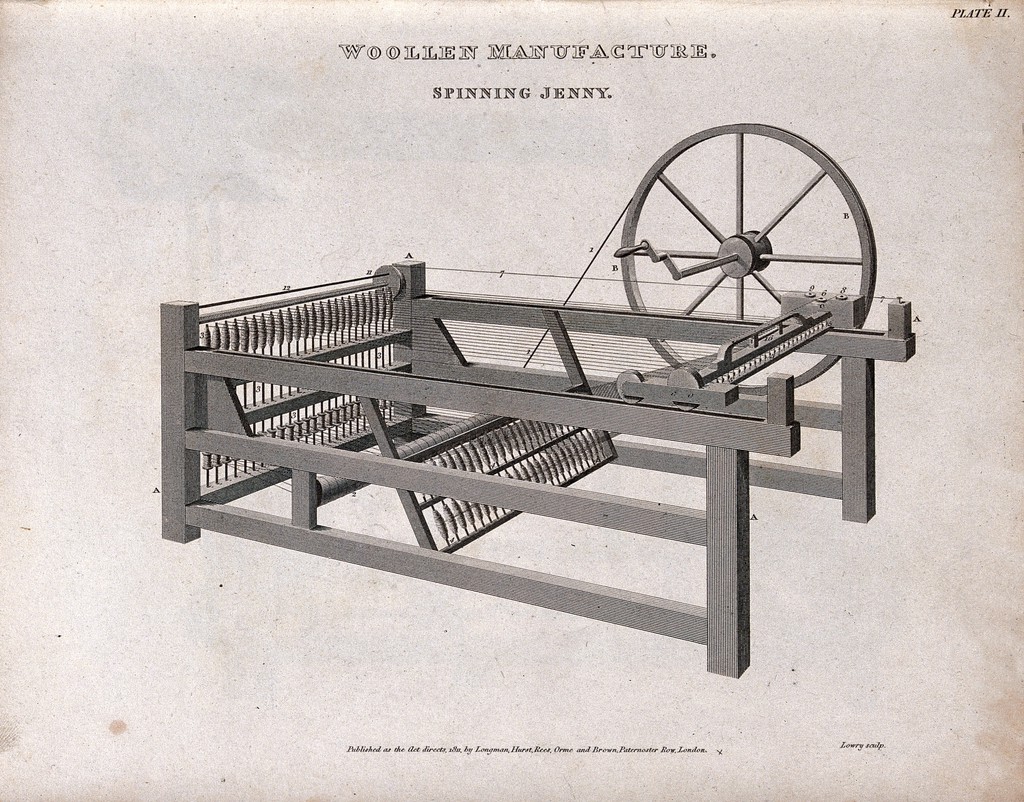
At last in September 1791, the four horses moved slowly around the horse walk the horse wheel was set in motion, and the busy clatter of machinery began. With studied restraint, Thomas wrote to a friend, ‘We have all our spinning jennies now completed and they answer pretty well.’
Too late for many small south country mills to complete with the big new factories now being built near the Yorkshire coal fields, the Industrial Revolution had spread to the woolen industry of the southwest. (p. 55)

Horse wheel, from Diderot’s Encyclopedia, 1765, Plate 27_2_2. Source

Credit: Textiles: a carding machine. Engraving by W. Lowry, 1809, after J. D. Herbert. Wellcome Collection. Source: Wellcome Collection.

Credit: Textiles: a spinning machine. Engraving by W. Lowry, 1811, after J. D. Herbert. Wellcome Collection. Source: Wellcome Collection.
About 1797, Thomas purchased Tone Fulling Mills and installed more machinery at Trade Court. He then purchased Coldharbour Mill on the River Culm, eight miles away in Devonshire. He paid 1100 guineas for 15 acres with a stream and buildings (somewhere around £190,000 in today’s money). Coldharbour was water-powered, and had previously been a grist mill. At first Thomas meant to put only a small amount of machinery there, but he inherited some money, and decided to expand the mill.
And it was about here in my reading that I finally decided to research whether any of this was still standing, and to my excitement I found that Coldharbour Mill is still there, still working, and the water wheel is still in action! They have also added steam and there is a team that maintains and demonstrates the steam power system. I have added it to my textile destination bucket list, but in the meantime you can take a virtual tour on their website! And here is a very short introduction video to give you a taste:
And suddenly WordPress won’t allow me to put the caption for the spinning jenny with the illustration, so here is that information:
Credit: Textiles: a spinning jenny. Engraving by W. Lowry, 1811. Wellcome Collection. Source: Wellcome Collection.




Whoop-whoop! I love the mill. I wish it was a bit closer, as then it would be e convenient to volunteer.
This is an interesting read. I enjoyed the video, and I imagine a tour would be good fun.
Wow! That mill looks so “modern”. I had no idea such large-scale mills were built so early. I did chuckle at how clean everything looks–you know that wasn’t the case back in the day! Thanks for the “book report” 😀