Resources for Handwoven Coverlets
Brief Overview
If you are visiting this page, then you probably have a handwoven coverlet that you are curious about. Can we tell when it was made? Where, and by whom?
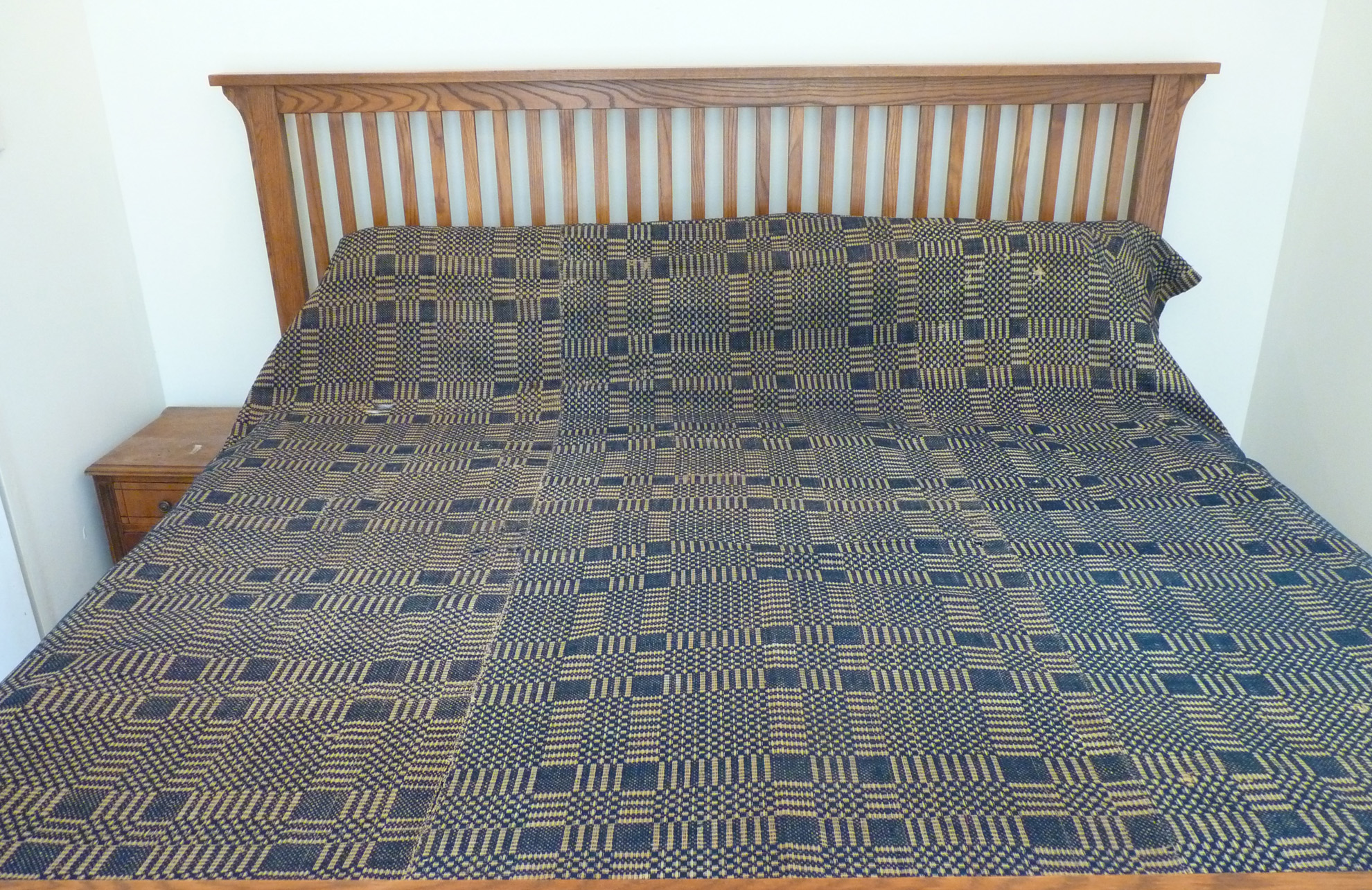
In most cases, we can only get a general idea. Overshot coverlets were most popular from about 1810 to 1850, and they were often made in households, by both free and enslaved people. But the patterns weren’t published in newspapers, providing us with nicely documented dates; and the same natural dyes were used that whole time, so we can’t narrow down a date of manufacture based on the dyes.
At the same time, industrialization was sweeping through the textile process in fits and starts. A weaver might have grown and processed all the fiber and dye on her own, might have spun her own yarn, and then have woven it up into a coverlet on a loom her husband built, but odds are that somewhere along the way she had a little commercial help. Depending on the region she lived in and her family’s resources, she might have taken her wool to a carding mill to be made into rolls for spinning; she might have bought factory-made cotton thread for warp; she almost certainly bought the indigo or madder to do the dyeing of the yarn. With all these variables, it is hard to be sure of a specific date.
Then around 1825, the Jacquard mechanism for looms, which allowed more details and curves in the pattern, came to America and was adopted by professional handweavers. Women could still do their own spinning and dyeing of yarn, and then turn it over to a professional for a more intricate design than they could do at home. These coverlets often have a date woven into them, with the weaver’s name, or the name of the person who commissioned the piece. But overshot coverlets continued to be made at the same time.
(There were also two other techniques — double-woven coverlets made on multi-harness looms, and summer-and-winter coverlets, but I am not going to cover those here.)
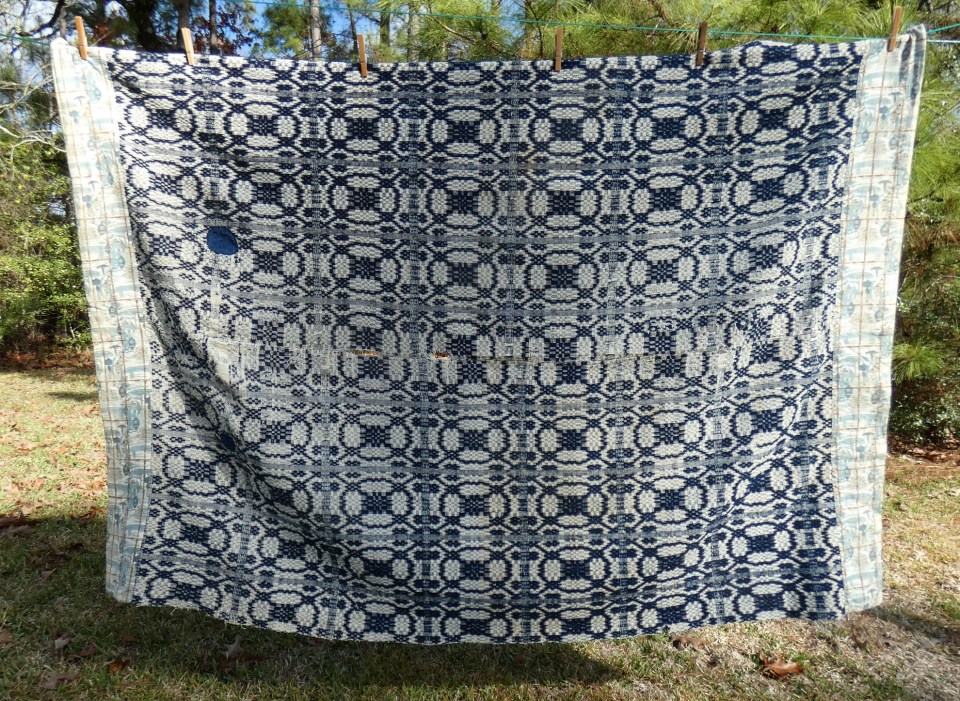
Overshot coverlet – Spiderweb pattern

Jacquard coverlet.

The body of an overshot coverlet is composed of plain weave, with thicker pattern threads “shooting over” a number of warp threads.
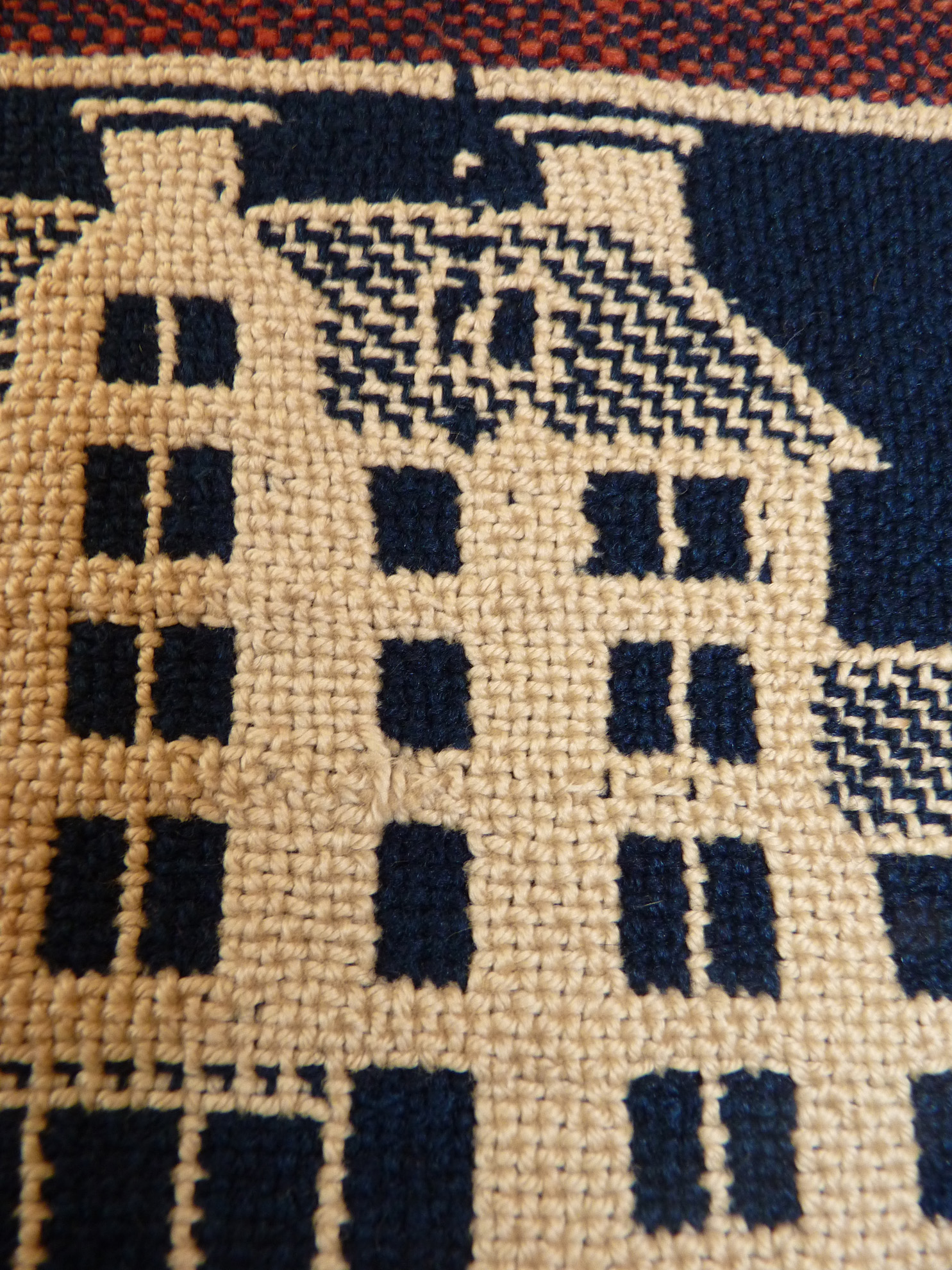
Detail of the double-woven Jacquard coverlet.
By the start of the Civil War in 1861, new trends in home decor made these coverlets seem old-fashioned, and the demands of war claimed both materials and those professional men who had woven them, ending the era of peak popularity.
In the late 1800s/early 1900s, some groups created small weaving workshops, especially in the Appalachians, to preserve and revive the art and to bring income to depressed areas.
I am not a trained textile historian, but I love to dig out resources! So here you go, and I hope you find good information.
Favorite Resources
My favorite coverlet reference book is American Woven Coverlets by Carol Strickler, 1987. In concise and readable language, it details how, when, why, and where coverlets were woven. There is a catalog of pattern motifs, so you can learn if that design is your coverlet is a rose or a star; a bowknot or a blooming leaf. There are drafts so you can weave your own! This book is at the Internet Archive, and can be borrowed for an hour or for fourteen days, with a free account.
My choice for best article: Home Weaving in Southeast Iowa: 1833 – 1870 from Annals of Iowa, because it gives accounts from women’s diaries, explaining their choices and chores in going through the steps of weaving.
A very brief history can be found at the Smithsonian, along with many videos of interviews with coverlet weavers.
Online Publications:
I would have saved myself a lot of time if I had found this Colonial Coverlet Guild of America bibliography earlier, but their bibliography does not contain links. I have only included books with links on this page.
MetPublications: American Quilts and Coverlets in the Metropolitan Museum of Art
I find the information for Catalog Number 61 to be very helpful.
Internet Archive : available to borrow for an hour or 14 days:
The afore-mentioned American Woven Coverlets.
More Quilts and Coverlets from the American Museum in Britain
Keep Me Warm One Night: Early Handweaving in Eastern Canada by Harold B. Burnham and Dorothy K. Burnham. It has a large and informative section on coverlets.
Weaving a Legacy: the Don and Jean Stuck Coverlet Collection. Mostly Jacquard coverlets.
Coverlets and the Spirit of America: the Shein Coverlets — more Jacquard coverlets, showing both sides!
How-to book: Weaving a Traditional Coverlet by Helen N. Jarvis. I got to see Ms. Jarvis speak at a guild meeting back in the 1980s or 90s — she wove a reproduction coverlet for the Lincoln Bedroom at the White House! I especially remember her talking about how the fringes were woven and knotted separately.
Handicrafts of the Southern Highlands, by Allen H. Eaton, 1937, more information on handweaving revival in the early 1900s.
From HathiTrust Digital Library:
Heirlooms from Old Looms, published by the Colonial Coverlet Guild in 1955
WorldCat.org will help you find these books through a library:
Knopf Collectors’ Guide to American Antiques: Quilts, Coverlets, Rugs, and Samplers
A newer book that looks very good: Textile Art from Southern Appalachia, by Kathleen Curtis Wilson, 2001.
Functional Overshot: Basic Source for Modern Design, 1960, by Grace D. Blum. A wonderful book that explains how to weave overshot motifs, and shows actual samples.
University of Georgia Press:
Overshot: The Political Aesthetics of Woven Textiles from the Antebellum South and Beyond, by Susan Falls and Jessica R. Smith, 2020. Cultural and political aspects of overshot weave. I have not read this book, but it looks interesting.
Online Collections:
Helen Louise Allen Textile Collection at the University of Wisconsin – Madison
Drafts typed up in 1939 by WPA workers.
Pennsylvania German Textile Collection
Coverlets in the Appalachian Artifacts Collection — Library Homepage at Berea College
The Smithsonian has page called the National Woven Coverlet Collection, but I think it is confusing. Each sub-page has some information, but then each one goes into a scroll of individual coverlet descriptions, but many of them don’t have images! I have no idea why they arranged it that way. I think a better way to browse through the items is to go to the Search Collections page and type “coverlet” into the search box. That way you get a page with 20 results and concise descriptions. You can expand the description by clicking on the item’s title, but if you want to see a large, zoomable view, you have to click on the title of the item and wait for its individual page to load, and then you can click on the image. I should do a tutorial.
The Foster and Muriel McCarl Coverlet Gallery has many coverlets that came from the now-closed American Textile History Museum
Preservation Long Island has a beautiful gallery of 23 coverlets, and a virtual version of the exhibition they had up in 2023.
Kentucky Historical Society has coverlets from the 1930s Churchill Weavers Company, as well as from the heyday of coverlet weaving in the 1800s.
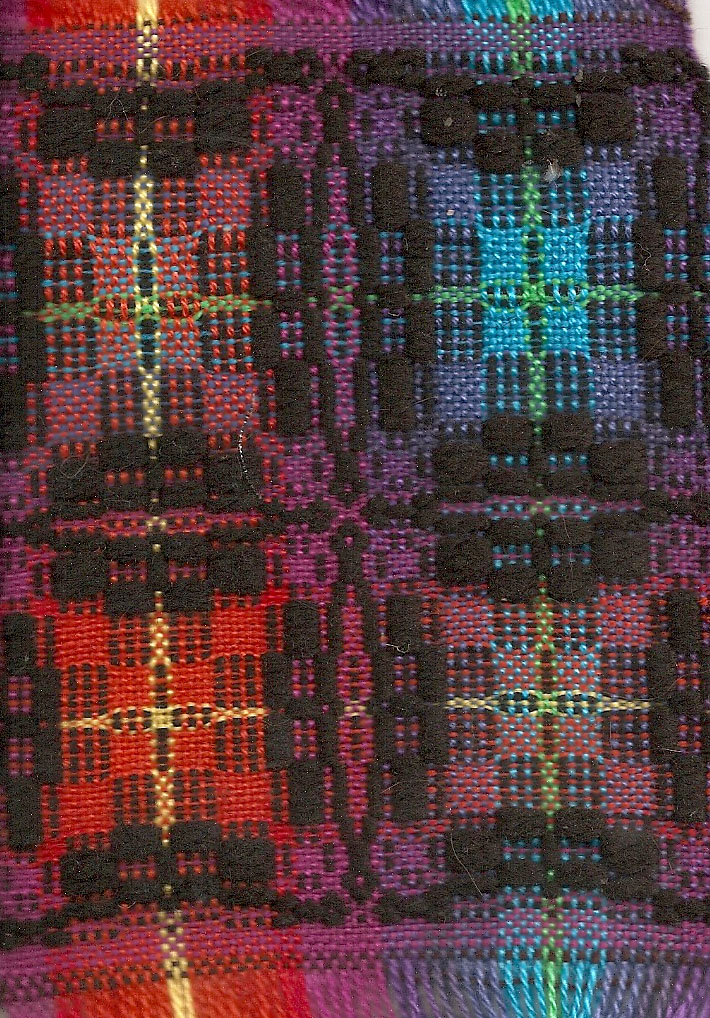
Overshot in non-traditional colors.
My other posts about coverlets:
Pine Blossom overshot This coverlet has 40 threads to each inch of the 36″ wide warp. Two panels were woven 90″ long and then joined together. So including loom waste, this coverlet required about 8,640 yards of linen or cotton warp, then about that much again for the tabby weft, and about that much wool for the pattern weft.
Double Chariot Wheels overshot
How to Read a Coverlet — research on behalf of a reader
Conclusion
I hope this list of resources was helpful, and if you have a coverlet you would like me to feature, I would be happy to include it!