Quaker Homespun Supplement: Manufacturing Serge in 1728
This post is a supplement to my series on Thomas Fox, a Quaker who ran a family serge-making business in the late 1700s and early 1800s. The description of serge is from a wonderful book from 1728, the Cyclopedia by Ephraim Chambers, and the illustrations are pulled from various sources, including Diderot’s Encyclopedia from 1765. I am posting it for those who love historical resources and detail, but feel free to skip it if it is not for you. 🙂
Cyclopedia title page
Serge Manufacture, from 1728 Chambers’ Cyclopedia
SERGE, in Commerce, a Woollen crofs’d Stuff, manufactured on a Loom with four Treddles, after the
Manner of Rateens, and other crofs’d Stuffs. The Goodnefs of Serges is known by the Croffing, as that of
Cloths by the Spinning….E’er either Kind is ufed ’tis firft fcour’d…

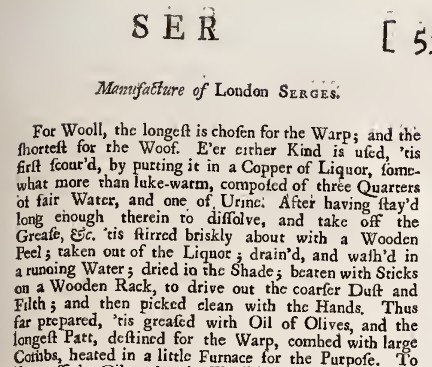
(And now, for your reading ease, I will replace all those f‘s with s‘s , and replaced the missing e‘s, to match how we write now. But I will leave all the great original spellings.)
SERGE, in Commerce, a Woollen crossed Stuff, manufactured on a Loom with four Treddles, after the
Manner of Rateens, and other crossed Stuffs. The Goodness of Serges is known by the Crossing, as that of
Cloths by the Spinning.Of Serges there are various Kinds, denominated either from the different Qualities thereof, or from the Places
where they are wrought. The most considerable is the London Serge, now highly valued Abroad, particularly
in France, where the Manufacture is carried on with good Success, under the Title of Serge Facon de
Londres.For Wooll, the longest is chosen for the Warp; and the shortest for the Woof. E’er either Kind is used ’tis
first scoured, by putting it in a Copper of Liquor, some-what more than luke-warm, composed of three Quarters
of fair Water, and one of Urine. After having stayed long enough therein to dissolve, and take off the
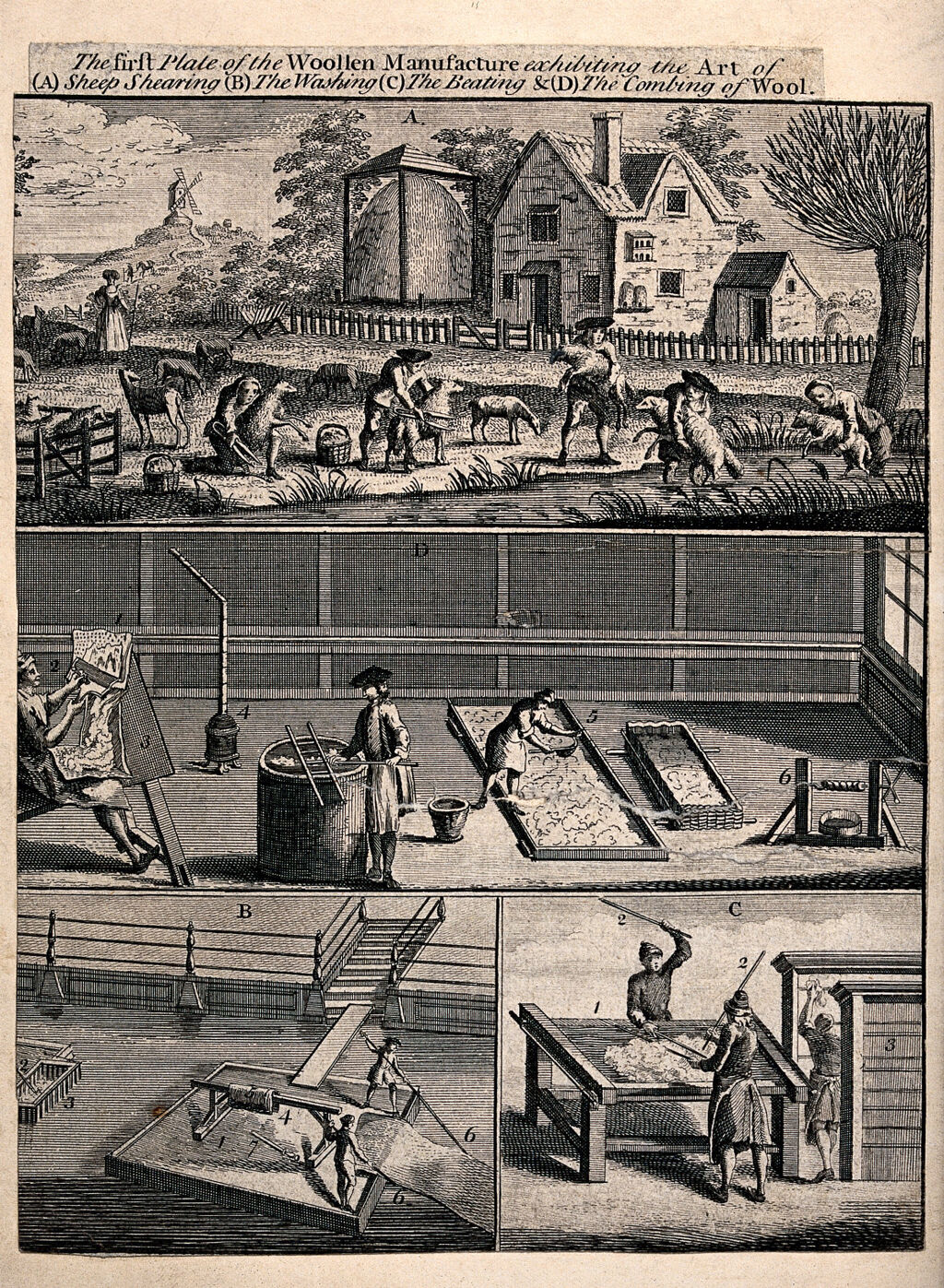
Grease, Etc. ’tis stirred briskly about with a Wooden Peel ; taken out of the Liquor ; drained, and washed in a running Water; dried in the Shade; beaten with Sticks on a Wooden Rack, to drive out the coarser Dust and Filth; and then picked clean with the Hands.Credit: People dipping sheep in the river and shearing them in the field, then washing, beating and combing the wool. Engraving. Wellcome Collection. Source: Wellcome Collection.
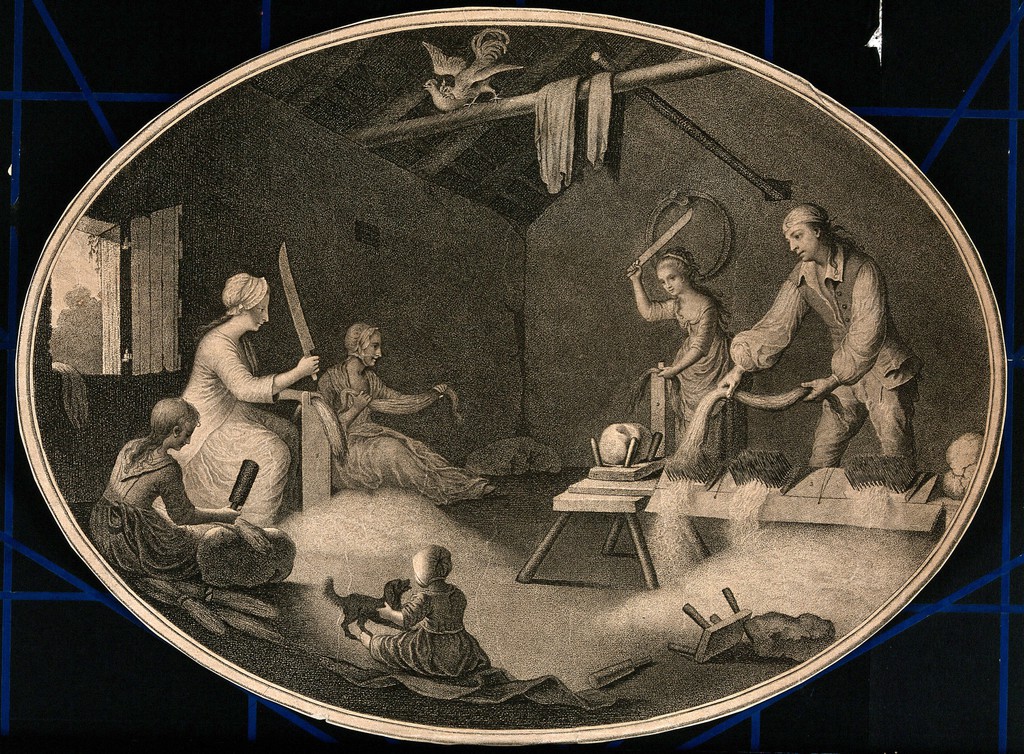
Thus far prepared, ’tis greased with Oil of Olives, and the longest Part, destined for the Warp, combed with large Combs, heated in a little Furnace for the Purpose.
Credit: Four women with knives and wooden paddles are cutting and beating the wool and a man is putting it through a combing device. Stipple engraving. Wellcome Collection. Source: Wellcome Collection.
To clear off the Oil again, the Wooll is put in a Liquor composed of hot Water, with Soap melted therein :
Whence being taken out, wrung, and dried, ’tis spun on the Wheel.As to the shorter Wooll, intended for the Woof, ’tis only carded on the Knee, with small fine Cards,
then spun on the Wheel, without being scoured of its Oil.Note, The Thread for the Warp is always to be spun much finer, and better twisted, than that of the
Woof.The Wooll, both for the Warp, and the Woof, being spun, and the Thread divided into Skains ; that of the
Woof is put on Spools(unless it have been spun upon them) fit for the Cavity or Eye of the Shuttle ; and that for the Warp wound on a Kind of Wooden Bobins, to fit it for Warping.When warped, ’tis stiffened with a Kind of Size, whereof, that made of the Shreds of Parchment
is held the best ; and when dry, is put on the Loom.
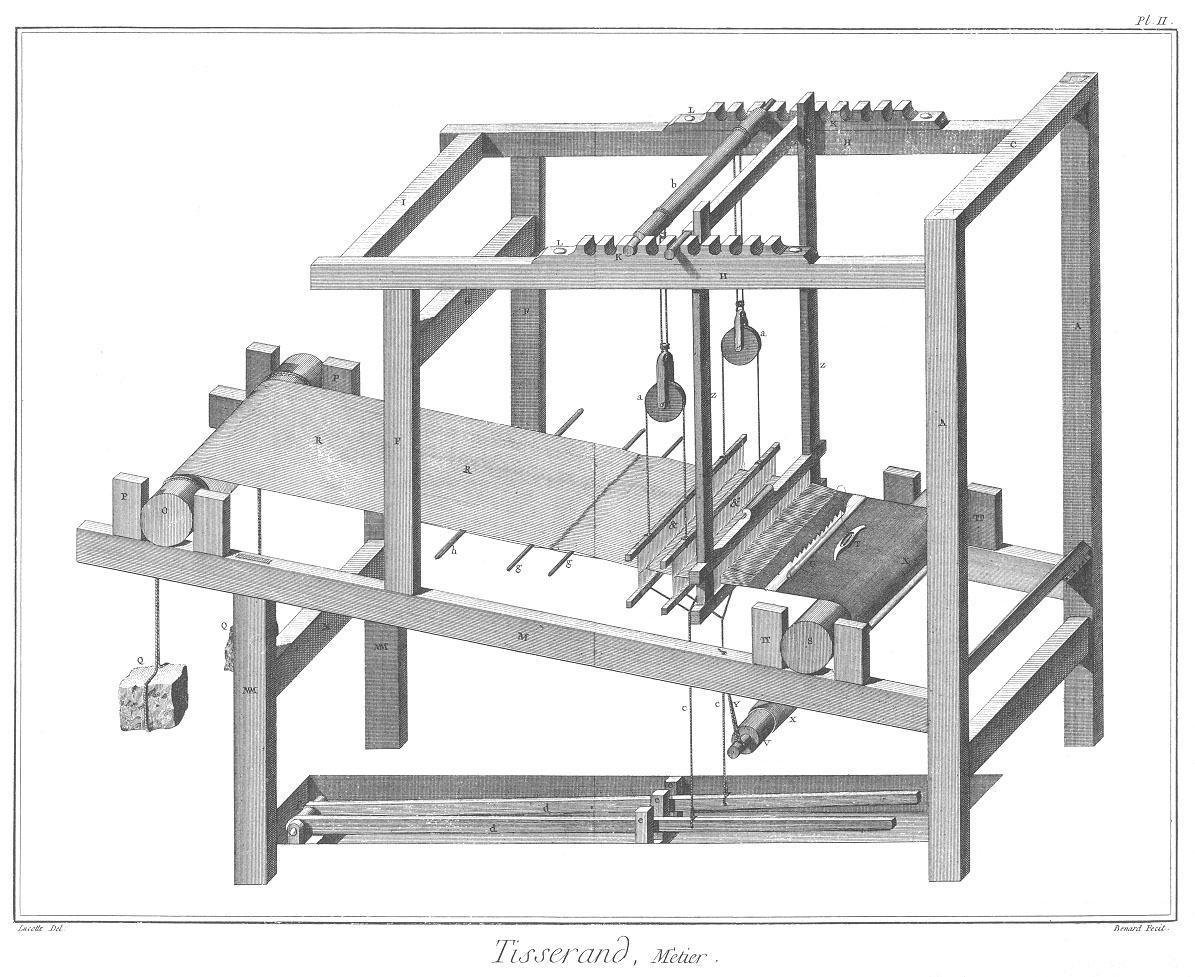
Loom from Diderot’s Encyclopedia, Plate 28_2_2, 1765, source
When mounted on the Loom; the Workman raising and falling the Threads (which are passed through a
Reed) by means of four Steps placed underneath the Loom, which he makes to act transversely, equally, and
alternately, one after another, with his Feet, in Proportion as the Threads are raised and lowered, throws the
Shuttle across from one Side to the other; and each Time that the Shuttle is thrown, and the Thread of the
Woof crossed between those of the Warp, strikes it with the Frame to which the Reed is fastened through whose
Teeth the Threads of the Warp pass ; and this Stroke he repeats twice, or thrice, or even more, till he judges
the Crossing of the Serge sufficiently close :
Thus he proceeds, till the Warp is all filled with Woof.
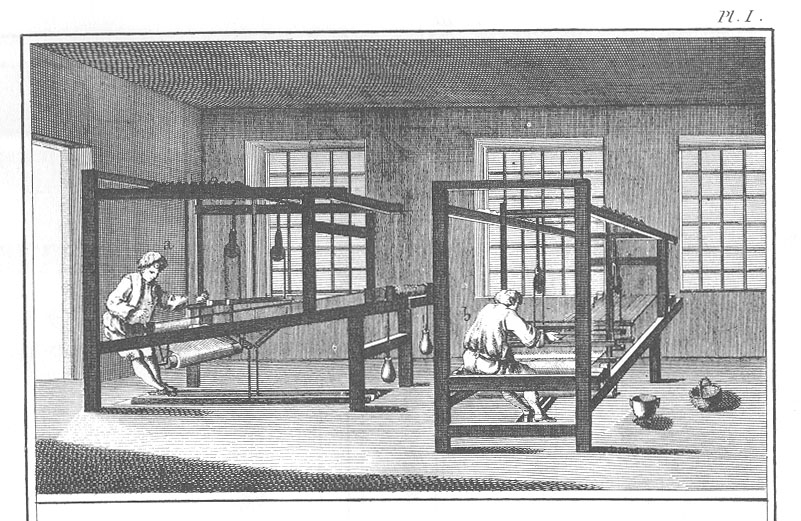
Weavers, from Diderot Plate 28_2_1, source
The Serge now taken off the Loom is carried to the Fuller, who fulls, or scours it, in the Trough of his Mill,
with a Kind of fat Earth, for the Purpose, first purged of all Stones and Filth. After three or four Hours scouring, the Fuller’s Earth is washed out in fair Water, brought, by little and little, into the Trough, out of which it is taken when all the Earth is cleared :
Then, with a Kind of Iron Pinchers, or Plyers, they pull off all the Knots, Ends, Straws, Etc. sticking out on the Surface, on either Side :
Then return it into the Fulling Trough, where ’tis worked with Water somewhat more than lukewarm, with Soap dissolved therein ; for near two Hours.
‘Tis then washed out, till such Time as the Water becomes quite clear, and there be no Signs of Soap left.
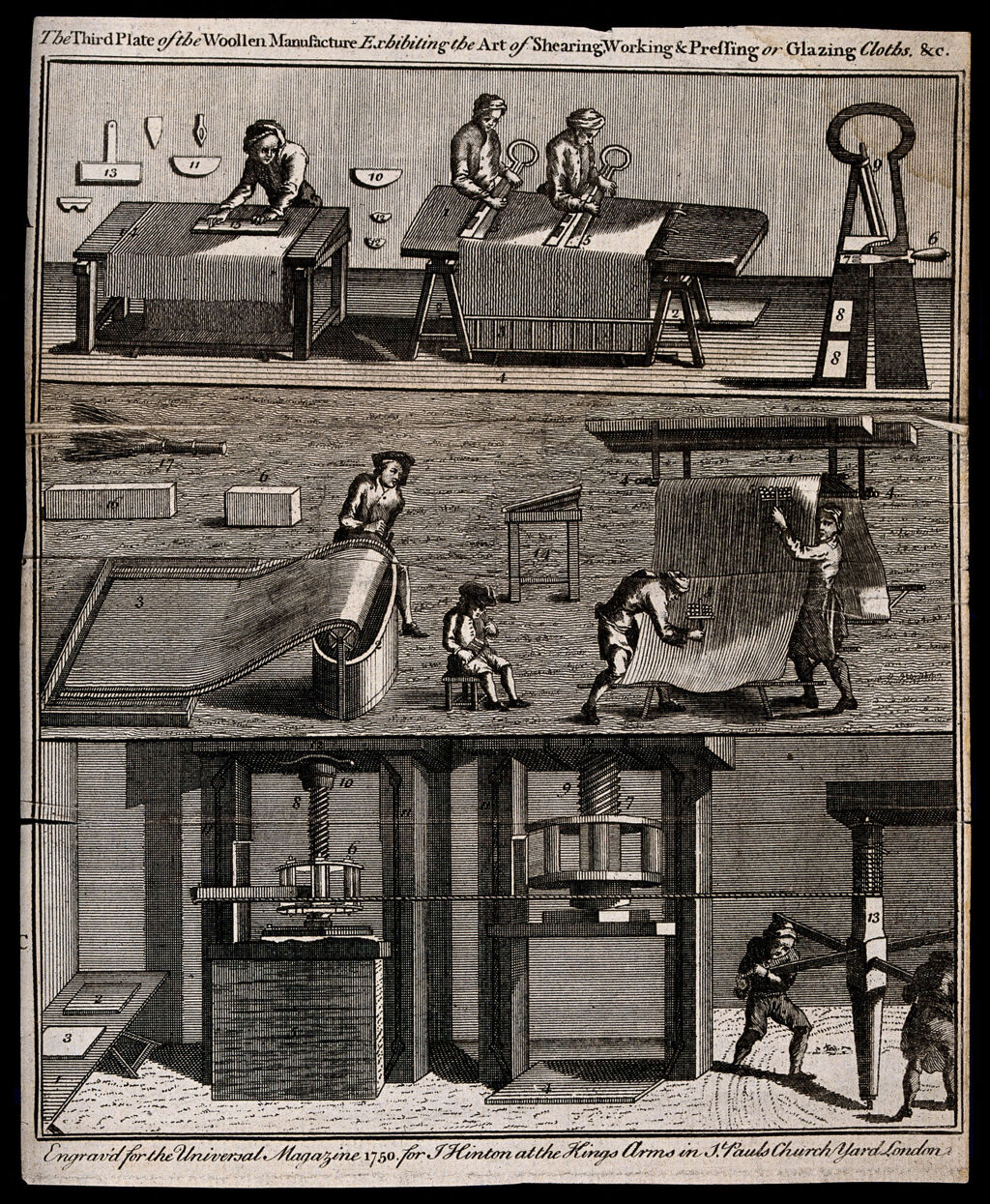
Credit: Textiles: three stages in the production of woollen cloth, cutting the nap (top), washing [or sizeing ?] (centre), and pressing (bottom). Engraving, 1750. Wellcome Collection. Source: Wellcome Collection.
Then ’tis taken out of the Trough, the Knots, etc. pulled off, and then put on the Tenter to dry, taking Care, as
fast as it dries, to stretch it out both in Length and Breadth, till it be brought to its just Dimensions.When well dried, ’tis taken off the Tenter, Died, Shorn, and Pressed. See Dying, Pressing, and Sheering.
– Cyclopedia, pp. 712, 713
A technical, more recent definition, from Fabric Glossary by Mary Humphries, 1996:
Worsted (combed)[from long stapled fleece] yarn, 2/2 right hand twill weave, flat wales, clear finish; twill line visible on back as well as front, solid color (piece dyed), usually bottom weight for suiting. p. 211
Note: I accessed the Diderot illustrations from this wonderful website, The Encyclopedia of Diderot and d’Alembert, that has translated the plate titles into English and made them searchable.
To learn about a serge business in England, you can read a series of posts about Thomas Fox, starting here with Part One.