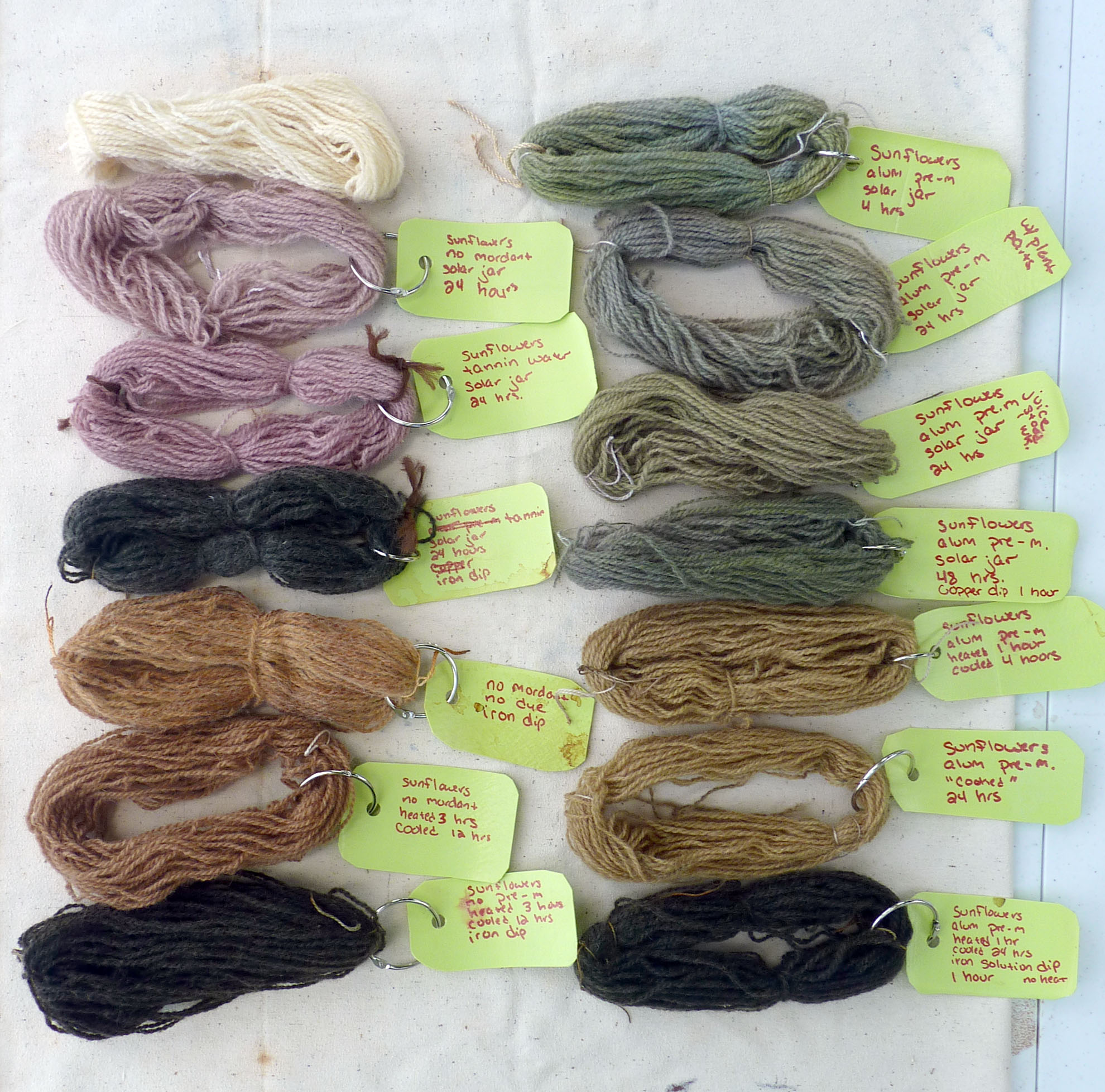
How is this possible? It’s all done with sunflower up untill black? I want to dye cotton into green and ask if it is possible to dye silk yarn a natural way?
As with most natural dyes, it is pretty easy to get color onto yarn or cloth — the hard part is getting a color that will STAY. It usually fades pretty quickly. I dyed those samples three years ago — the pinks faded almost immediately. With the green samples, I put some away in a closet, and some outside in the sun — the ones in the closet still look good but the outside ones also faded to a very pale tan.
The protein fibers of silk and wool are the easiest to dye. Plant fibers like cotton and linen are difficult.
The black colors came from dipping the plant-dyed yarns into a solution of old iron scraps that had been sitting in vinegar and water — the black color happens almost immediately, and it stays in the yarn — BUT it makes the yarn brittle and after several years it may fall apart.
A good book for a beginner is Harvesting Color by Rebecca Burgess.
What variety of sunflower was used to obtain the pinks and golds? How were the flowers processed and what parts were used?
Thanks, Leah Leahsgarden@gmail.com
I think those were “Russian Red” sunflowers, just a seed packet from WalMart, whatever they called the red seeds that year. 🙂 Maybe “Claret Cup” or “Evening Wine,” I really don’t know. I tried the flower heads with and without seeds, didn’t really see a difference. The pinks came from just sticking some flowers in a glass cooking pot, pouring some boiling water over top, then leaving a 10 gram skein in the “tea” in the hot sun all day, and letting it cool over night. The pink looked nice but it really didn’t last long.
The golds were probably done the same way, but with alum-mordanted skeins. I have more details about how I mordant the skeins before dyeing, on the “Natural Dyes” page. Thanks for commenting and I hope you have good luck with natural dyes!
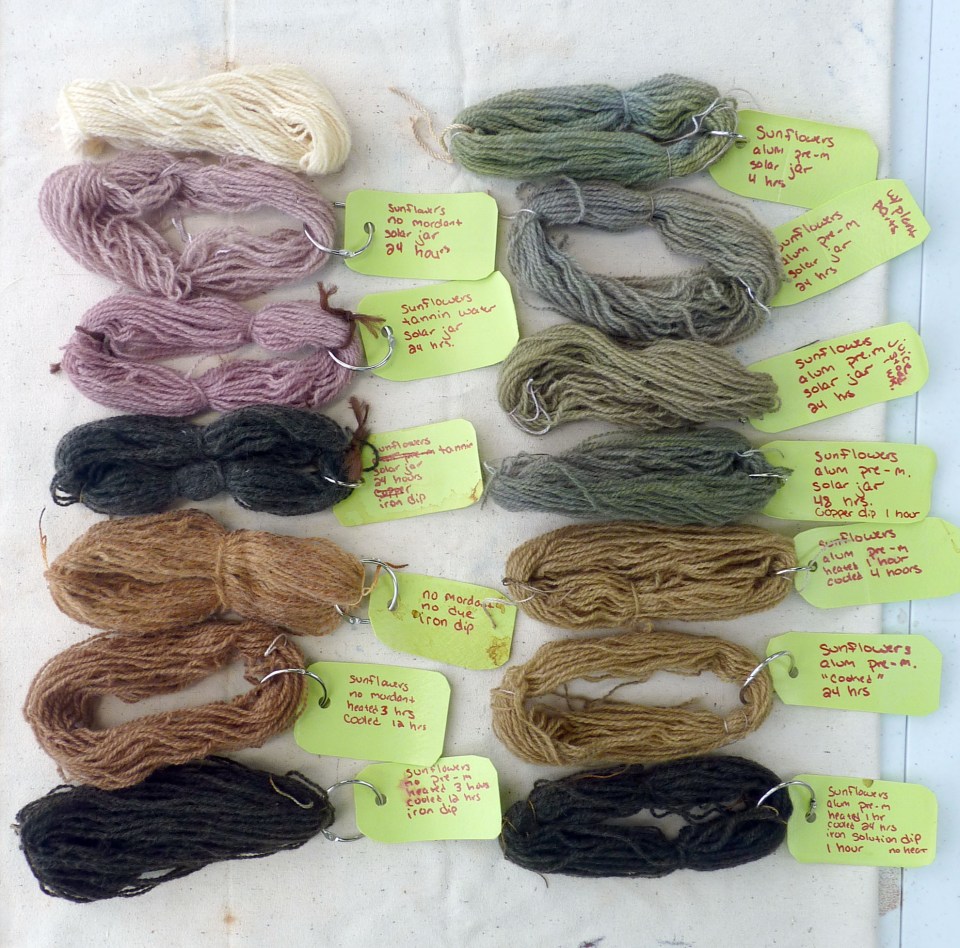
How is this possible? It’s all done with sunflower up untill black? I want to dye cotton into green and ask if it is possible to dye silk yarn a natural way?
As with most natural dyes, it is pretty easy to get color onto yarn or cloth — the hard part is getting a color that will STAY. It usually fades pretty quickly. I dyed those samples three years ago — the pinks faded almost immediately. With the green samples, I put some away in a closet, and some outside in the sun — the ones in the closet still look good but the outside ones also faded to a very pale tan.
The protein fibers of silk and wool are the easiest to dye. Plant fibers like cotton and linen are difficult.
The black colors came from dipping the plant-dyed yarns into a solution of old iron scraps that had been sitting in vinegar and water — the black color happens almost immediately, and it stays in the yarn — BUT it makes the yarn brittle and after several years it may fall apart.
A good book for a beginner is Harvesting Color by Rebecca Burgess.
I hope this helps!
What variety of sunflower was used to obtain the pinks and golds? How were the flowers processed and what parts were used?
Thanks, Leah
Leahsgarden@gmail.com
I think those were “Russian Red” sunflowers, just a seed packet from WalMart, whatever they called the red seeds that year. 🙂 Maybe “Claret Cup” or “Evening Wine,” I really don’t know. I tried the flower heads with and without seeds, didn’t really see a difference. The pinks came from just sticking some flowers in a glass cooking pot, pouring some boiling water over top, then leaving a 10 gram skein in the “tea” in the hot sun all day, and letting it cool over night. The pink looked nice but it really didn’t last long.
The golds were probably done the same way, but with alum-mordanted skeins. I have more details about how I mordant the skeins before dyeing, on the “Natural Dyes” page. Thanks for commenting and I hope you have good luck with natural dyes!