Costumes by Karinska
I am not sure what algorithm suggested the book Costumes by Karinska to me, but I am grateful I bought it! I knew absolutely nothing about this costume creator; in fact, I thought this was an embroidery book I had seen in a friend’s collection. But I was in for a treat in learning about this extraordinary artist.
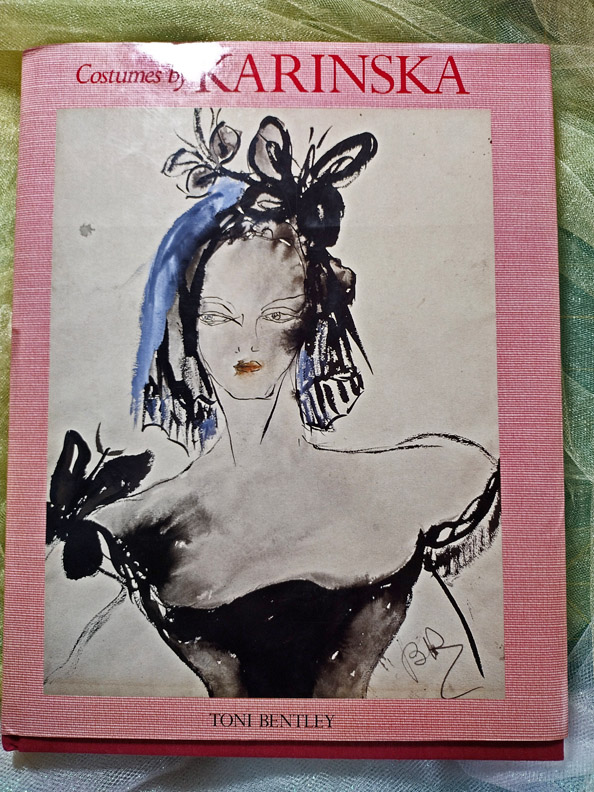
Costumes by Karinska, by Toni Bentley
Varvara Andryevna Zmoudsky was born into an upper middle class family in Kharkov, Ukraine, in 1886. She always loved embroidery, but studied law. She married at age 20 and had a daughter, but her husband died of typhus. She moved to Moscow and opened a studio and embroidery school. She developed a way to make “paintings” out of silk chiffon, and had a one-woman exhibition.
She married again, to Nicholas Karinsky, thus giving her the name Karinska. The unrest of the Russian Revolution caused their separation. Her husband emigrated to New York, but Karinska didn’t know that and believed he was dead. She managed to leave Russia at age 37, and never returned. Settling first in Paris, she supported herself by selling hand-made dress accessories and Russian headdresses, to the Folies-Bergère and the Opéra Russe à Paris. Gradually this led into repairing and then making costumes for the ballet. Karinska made her first tutus at age 45!
From then on she was working almost constantly, executing the designs of people like Dali, Marc Chagall, Cecil Beaton, for ballets, operas, and movies. “It was Karinska’s job to figure out how many yards of what fabric, cut on what line, in what colors, and with what decoration, would result in a wearable costume that reflected the very elusive atmosphere of [the designer’s] sketches.”
She also worked in London, and then in 1939, moved to America and started her career over again! If you are a fan of old movies, you have seen her costumes in Gaslight, Joan of Arc, and Hans Christian Andersen. Her most fruitful partnership was with the choreographer George Balanchine, and her costumes can still be seen at the New York City Ballet.
Karinska made many innovations to the tutu:
Karinska’s experiments with cut, shape, seaming, and decoration of the bodice had begun in 1932…Using anywhere from six to fifteen panels of fabric, Karinska was a pioneer in the practice of cutting on the bias…Karinska’s tremendous innovation was in using the bias cut for a tightly fitted bodice, where the give and take of the cut could be used to accommodate the aerobic requirements of a dancer’s — or opera singer’s — rib cage. A typical Karinska bodice would be a mixture of panels, the back and center front usually cut the normal way, with various bias-cut panels in between, under, and around the ribs and diaphragm…She used only ‘living ‘ fibers — ones made by plants and animals. These fabrics, unlike inert synthetics, give off an energy all their own, and when complemented by stage lights, their various hidden qualities rise and shin., Thus, the ballerina’s torso, wrapped in its straight and biased panels, would gleam as it moved around the stage, giving off alternately light and shadow, matte and sheen, like the facets of a precious stone. (p. 105, 108)

Left: tutu from A Musical Joke, 1956. Right: tutu from Ballet Imperial, 1964
What strikes me about Karinska’s work is the detail she put into it. Even in a big production, each dancer in the corps would have a personalized costume — necklines and trimmings would have variations.
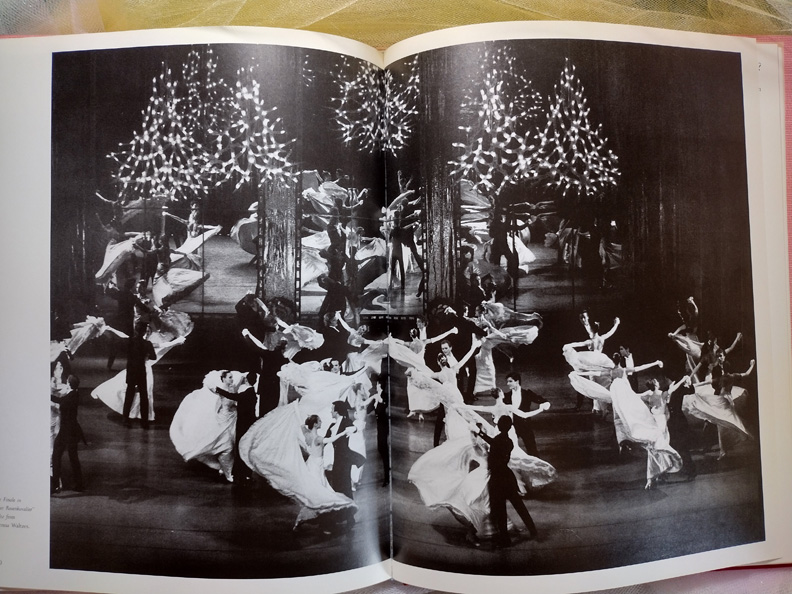
The finale of Vienna Waltzes.
Quite often there would be tiny details that the audience would never see — little charms with the portrait of the choreographer George Balanchine, or flowers that she crocheted herself. Karinska bought huge amounts of old lace, etc. that can’t be found today, and much of it is still stored for the New York City Ballet.
It was in the exploration of decoration — on a neckline, a waistline, a sleeve, a headpiece, or a skirt — that Karinska’s work went beyond the relative simplicity of couture dressmaking to the theatrical, where exaggeration is imperative to elicit the maximum visual effect from a great distance…Karinska felt about antique lace the way most women feel about diamonds. She was a master of the unnecessary detail — the back twist of braid, the inset brocade flower, the hand-embroidered cuff closure, the beaded design in four shades of red. ‘She loved concealing things, which I thought was an elegance of hers,’ says Stanley Simmons, a designer who worked with Karinska. ‘There were ribbons under chiffon, or ribbons under the net, or rhinestones on the second layer of the net and not necessarily on the top. She would put an orange satin ribbon under a piece of gray and put mirrors on the satin ribbon for no reason at all — it was a mystery.’ (p.116)
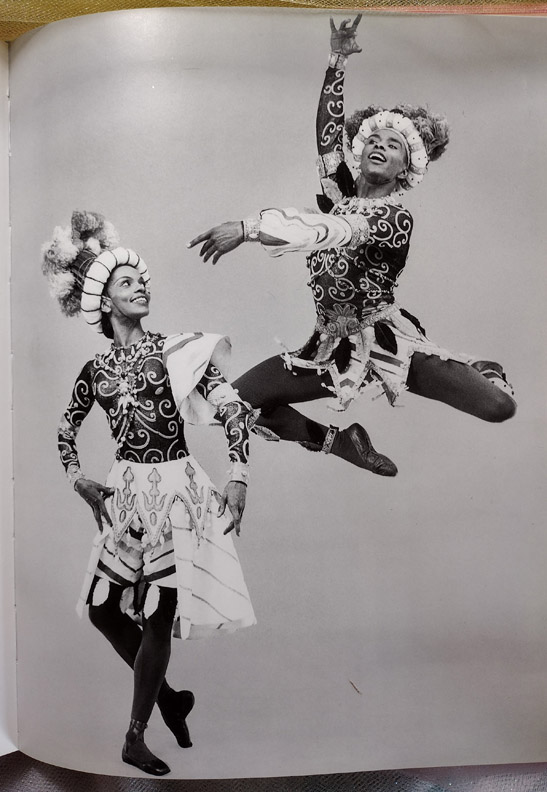
Mary Hinkson and Arthur Mitchell in costume for Figures in the Carpet, 1960
This book is aptly titled. There is a minimum of information on Karinska’s personal life, but so many aspects of her costuming are covered — her technique, her relationships with famous clients, her complete resumé. The book is full of designer sketches, photographs of the costumes as works-in-progress and on the stage, and now in archives.
Here are two videos where you can find out more about Karinska’s costumes and how they are still used today!
After reading this book, I understood why people say the name “Karinska” with so much reverence. There is so much inspiration in her work for creators in any medium!
Costumes by Karinska, by Toni Benton, Harry N. Abrams, Inc., Publishers, 1995




Interesting. thank you
Wow, stunning! This was truly her calling. I’d love to know more about her inclusion of beautiful details even in the hidden, unseen layers. A first edition of this book is sells for $500.
The Australian Ballet’s website quotes George Ballantine saying, “I attribute to (Karinska) fifty percent of the success of my ballets to those that she has dressed.”https://australianballet.com.au/blog/karinskas-costumes?srsltid=AfmBOopRwUWLPxTOubceRwwBM0Xq40gsI5UZDNZPOdNpfkkgOcerM3AX
My step daughter is a junior at Savannah College of Art and Design, studying fashion design. I need to find out if she’s studied Barbara Karinska. She really enjoys working in tulle.
When I am looking for a book, I go to Worldcat.org which has all the library catalogs. I was able to search SCAD and they have a copy in their library! I toured SCAD with my older daughter back in 2001 and really enjoyed being there.
It is so weird about used book prices — often I can find them for $5 to $15, but then sometimes I see them listed in the hundreds!
Savannah is beautiful! My stepdaughter is really in her element at SCAD. I mentioned this to her. She said she’s doing is doing her final project on ballet costume and she will add this to her source material.
I too am so glad you got that book. Extraordinary work and life. Thank you for showing us some details.
That was fascinating! I never heard of her, so I’m glad you found that book!
I saw this on my phone but I was waiting for a time to read this post without distraction and it really has been a delight. I’m so envious of all those who get to work in that wardrobe department. These costumes really are a fusion art and skilled workmanship and magic! And I loved your summary and quotes from the book about Karinska. I especially liked the description: ‘She was a master of the unnecessary detail…which I thought was an elegance of hers’. It seems to me that all those ‘unnecessary’ details and that elegance are the essence of what makes her designs so extraordinary and captivating 🙂
When I was a kid in school, I never liked being put on team projects, but the older I get, the more I admire collaboration and the results that come from combining talents! I love your term “fusion art”. I am glad you liked that post; I remember that you told me about seeing one of those videos! 🙂
I saw the first video before but I hadn’t seen the second one and that was even more interesting. Thank you for sharing it 🙂
Ballet costumes are so magical especially the older ones!
I was always too uncoordinated to even try ballet but I have always loved the costumes!