Quaker Homespun, Part Two — America and “Pernicious Consequences”
In my previous post, we began to follow Thomas Fox, who ran an English serge-making business in the late 1700s. Throughout his career, he had to deal with many challenges, including ones caused by international conflict, technological changes, and labor issues. In this post, we will focus on the American Revolution and its effects.
I would have thought that the American Revolution would have had minimal impact on the people of England and Europe. I thought that a small percentage of the population would be involved by coming over here to fight, but the rest would hardly even be aware of the war. This book, Quaker Homespun, showed me differently — Thomas Fox found that his company was affected greatly:
When the American colonists revolted against King George the third and his government in 1774, the war which followed at first made little impression on the life of peaceful citizens. There were irritations, as when a ship with a cargo of port wine was captured by the rebels and taken to New York. Trade in general however was not seriously affected by the war and the wool trade with the continent continued to prosper.
Four years later however when the French opened hostilities in support of the American colonists, English merchants felt the full impact of the war.
Were and Company had a shipment going to Ostend and Bruges — since these were in neutral nations, the shipment should have been allowed to proceed. But Thomas had several concerns — the French might intercept that ship and keep the cargo, the English might suddenly forbid exports, or the hands on board might be pressed into serving the navy.
Inevitably therefore orders from overseas became fewer and manufacturers, not only those engaged in the woolen industry, began to cut down production and lay off their men.
Faced with unemployment and rising cost of living, the combers and weavers reacted by going on strike for higher wages. Were and Company had five to six hundred on strike in October through December of 1778. They eventually came back, but trade did not improve.
To make matters worse, the Spanish fleet joined France in attacking England, and with about half the British fleet away fighting in America∗, the protection of England was weak, and invasion looked imminent.
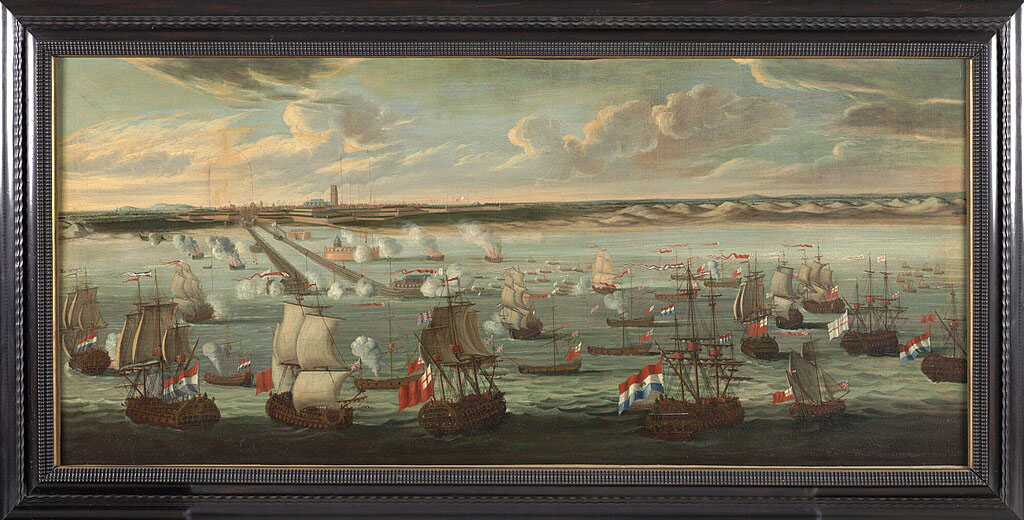
Bombardment of Dunkirk by a combined Anglo-Dutch fleet, 1695; source This painting shows a sea attack about 90 years earlier then the one Thomas Fox and his compatriots faced.
In summer of 1779, this foreign fleet sailed to England, and anchored off Plymouth. A hard easterly gale caused them to go back out to sea, but fears of invasion remained so strong, that no merchantmen ships put into the harbor near Topsham and trade ceased for the rest of the year.
In spring of 1780, trade resumed for a while, but then late that year, Holland also joined in the war on the side of the French and Spanish. Knowing that sales would drop even more, Thomas gave orders for their company not to buy a single pound of wool fleece, and more than 100 wool combers lost their jobs. He was finally able to ship bales of fabric in summer of 1781, when the British allowed the Dutch merchant ships they had detained in the Thames to load up and sail for the Continent.
The Weres were Quakers and therefore pacifist, which impacted their reactions to the war. In 1779, Were and Company was asked to subscribe for the support of the Royal Navy, but refused to do so. But even when Great Britain and Holland were officially at war, Were and Company did subscribe 60 Guineas to a fund raised for the welfare of Dutch prisoners. Also, one of Thomas’s uncles held shares in a revenue cutter that had turned to privateering — when he received his share of the prize money, £2300, he sent it with his son to France, to find the ships’ owners and make restitution for what they had lost. (p. 22)
At this point, the export of finished woolen goods had nearly stopped, and in order to sell something, some people suggested that they be allowed to export the raw wool fleeces which had been sitting in warehouses. This had been illegal since the time of Queen Elizabeth the First, with harsh penalties for exporting fleece. The fear was that if the French got their hands on the good quality English wool fleece, they would be able to create superior fabrics and would out-compete the British, or, as Thomas put it in 1782–
we presume it needless to enumerate the many pernicious consequences that would attend the furnishing our rivals with the means of extending their manufacturers on the ruins of our own.
But with the American war dragging out, the British administration changed, and the new government did not consider the export of raw fleece, and the existing smuggling laws stood.
The war ended in 1783, but Thomas faced a new set of “pernicious consequences”. The Dutch economy had been disrupted by the war and many of Thomas’ old trading partners were bankrupt. He knew that Were and Company’s strong serge fabric would be in high demand in America, but the problem was getting paid for it. He tried sending bales out on speculation to reputable trading houses, mostly other Quakers. The trading houses were glad to accept the wool fabric and sell it in America, but no one had any cash with which to pay him back for it, and he had no agent to go and collect.
American merchants offered to pay him in kind, and although Thomas had no desire to branch out into new products, he eventually accepted shipments of wheat, indigo, tobacco, turpentine, and rice in return for his wool cloth, and had these products sold in European markets.
In January of 1787, Thomas thought he had a promising option:
[H]is Falmouth cousins sent to him a Mr. Samuel Gardner, a merchant from South Carolina, ‘a tall genteel man of very good address’. Thomas and he studied patterns in the serge chamber, watched the laborers at work, and discussed the requirements of the American market… ‘We are much obliged for your recommending us to this gentleman’s notice,’ Thomas wrote to his cousins. ‘He spent yesterday with us, seems exceedingly pleased with our goods, and disposed to do business of some consequence.’ (p. 41)
Gardner at one point suggested that he might take his business elsewhere, saying that he would get a better deal from a Yorkshire competitor, but in the end, promised his order to Were and Company. Thomas wrote to Gardner, “…having a better opinion of thy principles and prudence, we will readily give thee credit of a thousand to fifteen hundred pounds on such goods as thee mayst order.”
Gardner got £2000 worth of goods, and promptly disappeared. Thomas made efforts to track him, but to no avail. He realized the man might be in South Carolina, but he could also be just a few miles away in London; there was no way to find out. The debt was never recovered.
Another method of payment came available in 1793, the American dollar:
Thomas was dubious about accepting. ‘We do not precisely understand what is meant by American Dollars,’ he wrote, ‘whether they are really Continental coin or Spanish.’ (p. 44)
So — shipping stoppages, currency exchanges, and con men — it was interesting to me to see that Thomas Fox faced some of the issues we still have now.
In our next post, we will look at how Thomas expanded into global trade.
∗Notes on the number of British ships and their part in the American Revolution come from this wonderful site, American Battlefields Trust:
At the outbreak of the American Revolution in 1775, the British navy was the largest and most experienced navy in the world, and it was essential to the survival of the British empire. At the start of the American Revolution, the Royal Navy numbered over 250 vessels of all sizes. These ranged from massive ships-of-the-line to tiny sloops and coastal vessels.
In the summer of 1776, this was illustrated by the British attack on New York. Under the cover of artillery fire from Royal Navy Warships over 20,000 troops were landed by a fleet of over 130 ships, prompting one American soldier to remark that ‘I thought all London was afloat.’
And of course a wonderful resource for the American perspective of this era is the new Ken Burns documentary, The American Revolution.




Having seen much of the Burns documentary, I very much enjoy his perspective on our War of Independence.
Me too! I especially liked how he focused on the different factions within America to show that it wasn’t all one unified effort. My husband and I watched it over several nights and after watching, I felt like I had had to live through it!
It’s sobering to see how war disrupted everything, especially in view of the unstable state of our world today. I’ll be interested to learn how Thomas survives.
how interesting, how things change and stay the same………the world, the dollars……..never ends.
Thistle be a beautiful day!
While there is tea there is hope!