Quaker Homespun, Part Three — Thomas Fox and Global Trade
This is part of a “book report” on the 1958 book, Quaker Homespun. The whole book is available online and I read it in just a few sittings, to help satisfy my curiosity about the history of textile manufacturing. I enjoyed following one individual through the era of the Industrial Revolution.
As the American Revolution had had a dampening effect on old patterns of business, Thomas Fox sought new opportunities for the wool manufactory he managed, Were and Company.
At this time, Parliament had reduced the import duty on China tea, being brought to England by the East India Company, with the result that their tea sales doubled in a year. One way they paid for the tea was by selling English woolen cloth in China, where it was especially popular in the cold northern areas.
In 1788, Thomas sent inquiries to Quaker merchants in London to see if he could expand into this business, and received this information:
Long Ells and fine white clothes are the principal woolens purchased by the East India company, both which they buy very largely of in March and pay for them by installments beginning 2nd month and ending 12th month … The principal houses … supply them with immense quantities. To do anything it is necessary to have always many by you, against their time of buying. It is a constant and certain business and open to you as well as others and they buy generally the best that are made. (p. 48)
The merchants also sent Thomas samples of the “Long Ell” cloth that the East India company wanted to purchase — lengths of fine white serge, 25 yards long and an Ell (in this case 31 inches) wide, made of soft and silky wool.
Thomas soon had an agreement with the factors Green and Walford. He informed them that Were and Company’s fabric was scoured cleaner than most, making it take dye better. Loads were shipped to the factors’ warehouses in London, where they dyed the fabric scarlet or blue in preparation for sale.
In 1794, Were and Company was producing 300 “pieces” of Long Ells weekly, and by 1799, production had doubled. During this time, the senior partners in the business had died, and Thomas had started marking all the goods under his own name of Fox.
In 1796, he wrote:
We have sold the greatest part of our stock of serges… and our sales to the India Company have kept pace with our increased fabrick of Long Ells so that we have much reason for thankfulness on our own account as well as for our labourers who are fully employed. (p.70)
However not all was perfect with the East India Company business. Their great profits from selling tea were well known, but they did not share the profits with their suppliers of British trade goods. They claimed to be facing a loss over the sale of woolen fabrics, but Thomas questioned whether they could sell any other product at a better price. He also reminded them that it was their ships had to sail to China anyway, so they might as well be filled with some sort of cargo rather than sail empty, and as British merchants, it was their duty to the country to make the largest possible investments in the manufacturers of their own country.
Feeling responsibility for keeping people employed, he wrote:
Great numbers of poor laborers depend on me for their subsistence and every exertion I can make for that purpose I owe them.
He installed more machinery at Trade Court, and purchased two more mills in the area (and these technological changes will get a post of their own).
Around the year 1800, there were several years of bad harvests, leading to a famine (which will also be covered in its own post). Wool prices became exorbitant, but the East India Company would not pay increase the price they were paying for finished goods. As a result, many wool manufacturers sent in cloth of much lower quality, for which they were paid the same price as previously. Thomas was concerned that the Chinese merchants would be angry at the decline in quality, and would stop buying wool all together.
In 1802, he went over the heads of his factors at Green and Walford, making a personal call on the directors of the East India Company in London, asking them to actually inspect the cloth they bought, and give preference to good quality. For a while nothing happened, as everyone with lower quality cloth wanted to unload it, but in the spring of 1803, Chinese merchants did write to complain of the inferior quality they received. Then the East India Company set up a system of inspecting samples from each manufacturer, and selecting the best. In 1804, Thomas sent nine samples, and they were all chosen.
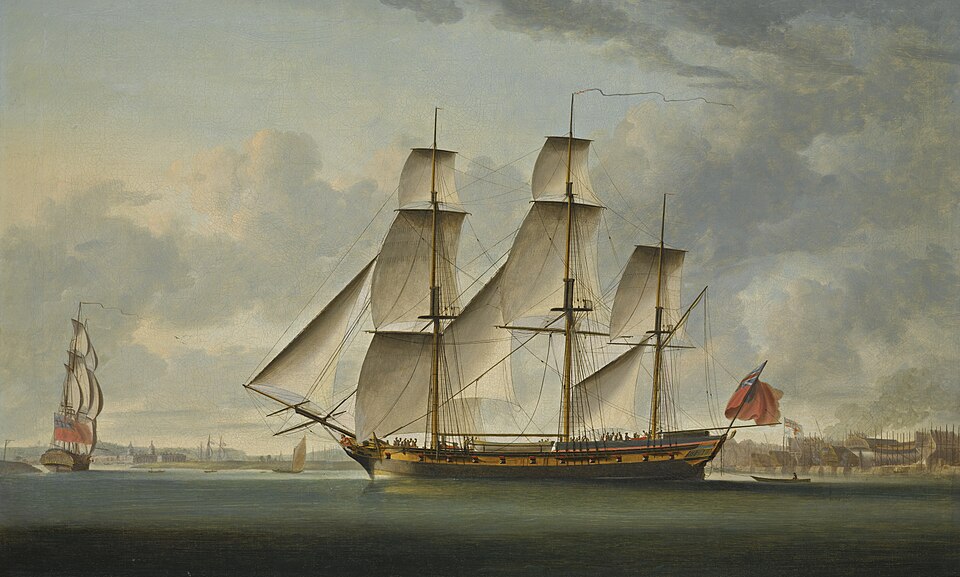
The East Indiaman Delaford, in two positions, passing Deptford, the Royal Hospital at Greenwich beyond, 1787. Source
And then a different problem arose, as in the autumn of 1804, Napoleon had an army camped in Boulogne, ready to invade England. The British government needed more money to fight him, and set up a duty of four percent on all exports. The East India Company responded by discontinuing their British wool purchases, instead sending opium and raw cotton from India to China to trade for tea.
Thomas had to reduce manufacturing at his mills. Always aware of the effect on the workers, he wrote to his local member of Parliament:
16th second month 1805
The foreign staple trade in woolens from the counties of Somerset, Devon, and Cornwall has been declining and is now very nearly annihilated … It is understood that the Company meant to continue sending out the usual quantity of woolens until the late duty of four percent was laid on their exports, since which they have been curtailing them in various branches. In the article of Long Ells only I apprehend the reduction this year will be 110,000 pieces or about the value of £330,000 which will prevent the manufactory of 7,500 packs of wool in this county, Devon, and Cornwall and deprive vast numbers of the laboring poor of their only means of subsistence, which at this time particularly I conceive of the utmost import and very much outweighing the object of about £25,000, the probable amount of duty on this article. (p. 103)
In other words, whatever amount the export duty brought in, it would not come close to the value of the manufacturing that was cancelled as a result. Many would be thrown out of work and would depend for charity on their parishes.
Soon afterward, Members of Parliament convinced the Cabinet that this export duty actually aided the French, by depressing British business, and in 1805, the duty was discontinued, and the East India Company announced that they would buy Long Ells again.
Thomas also continued to sell rough serges wherever there was an opening. ‘The Dutch both at the Cape of Good Hope and their other East Indian settlements wear a peculiar kind of mixed serge, such as their Captains and sailors appear in on Exchange, and other places in London…’ Thomas was the sole manufacturer of this serge and when they could no longer be supplied from French-occupied Holland, Thomas arranged to have the former Dutch colonists supplied from London. The bales were shipped in East Indiamen, by arrangement with and for the profit of the ship’s captains, a recognized practice of the times. (p. 106)
Reading about this aspect of Thomas Fox’s wool business, I was surprised at how extensive his trading network was. From selling mostly in Europe at the beginning of his career, he expanded into America, China, and South Africa within a few decades.
In our next post, we will look at the technological changes that Thomas adopted and the challenges they brought.




A lot of that sounds like modern day business problems. Very interesting, and I’m glad you read and summarized the book for me!
I love this “series” you’ve written! It’s fascinating and something I’d never have found out about otherwise. I’m always surprised at the influence/impact that members of a small religious community had in so many areas and I’m intrigued and want to learn more. Thank you!
Oh good, I am glad you are liking it! His faith played a big part in how he treated the workers and part five will talk about that. I was really amazed at some of the things he did! 🙂
Interesting to read Napoleon’s impact on fabric trade!
Hey, I am NOT ignoring you or these post, I really like them but need to be in a quiet place to really digest them! I did know what serge was, esp re men’s suits but was blown away by how it was made, WOOF
These articles are amazing. Thank You.
Thistle be a beautiful day!
While there is tea there is hope!
Hey Susan, for some reason all kinds of excerpts from those posts attached themselves to your comment so it went into a twilight zone. 🙂 I am glad you like these posts! Remember when you alerted me to Rabbit Goody’s seminar and I learned so much great historical content there; this book seemed like a good complement!
Good.
Thistle be a beautiful day!
While there is tea there is hope!