Quaker Homespun, Part Five — Labor and Community
This is part five of my series on Thomas Fox, who was an English serge manufacturer in the late 1700s and early 1800s. His biography is called Quaker Homespun, and it is all online at archive.org.
In April of 1783, Thomas married Sarah Smith of London. They went on to have 16 children, 9 of whom lived to adulthood.
Working to serve their neighbors was important to both of them. Thomas helped to start a charity school, providing clothing for the children. In 1798, he learned of cow pox inoculation and had many of the child workers treated. He and Sarah were subscribers to the London Committee for the Abolition of the Slave Trade.
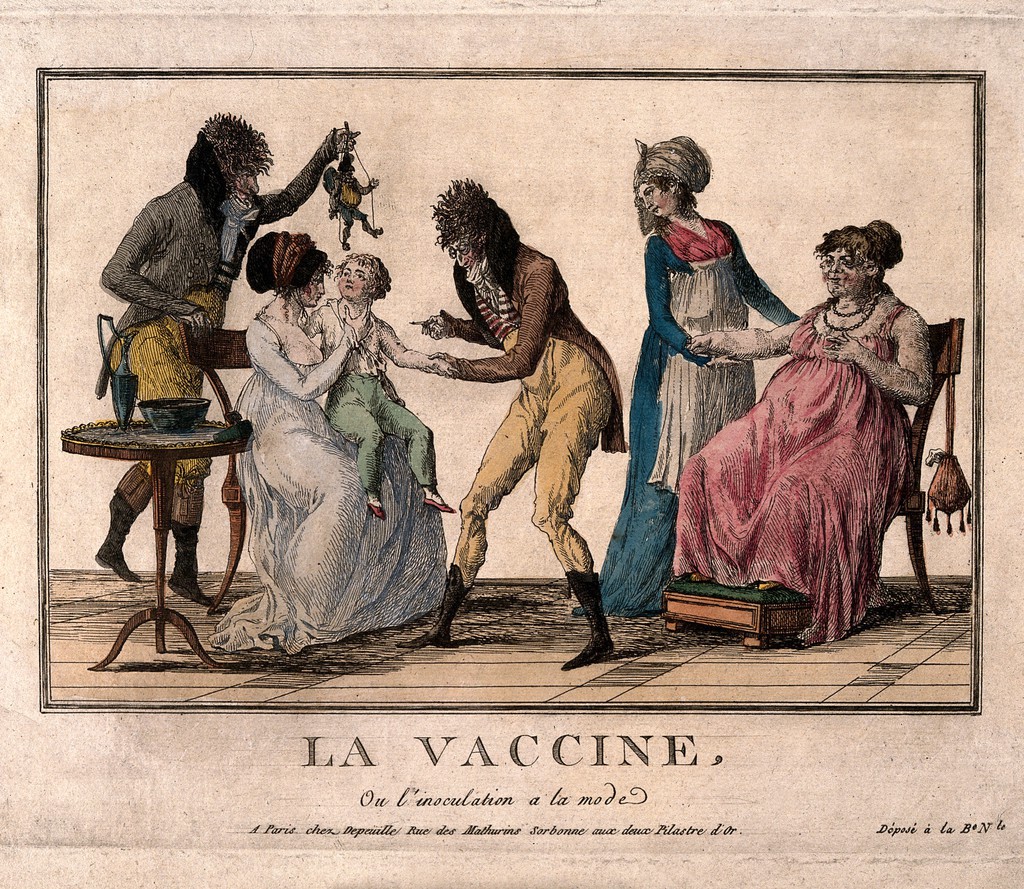
Vaccine illustration from 1800, Wellcome Collection
But the actions that really stood out to me were during the famine of 1800, so much so that I am going to quote extensively.
William Pitt, the Prime Minister had told the House of Commons in 1799 that the country had never been more prosperous; Loans to the government were fully subscribed and taxations on the luxuries of the wealthy, on their carriages, their men servants, and the number of windows in their houses, was yielding a rich harvest. Income tax too had just been introduced, 10% of all incomes over £200 a year being now claimed by the exchequer…
But, as Thomas well knew, the prosperity of the owner of property was not shared by the manual worker. Ten years before this time, he had carried out a survey of living standards at Wellington and had found that the average laboring family of two grown-ups and four children consumed about ten loaves of bread, 6S worth, each week. With a man’s wages seldom more than 10S a week, even if his wife and children worked too, there was very little money to spare. Since then the cost of living had risen and there had been a succession of bad harvests.
By the spring of 1800, it was no longer possible for the poor to obtain ‘the necessaries of life’, and old people began to die of starvation while emaciated and ragged children begged in the streets. On 10th may, Thomas wrote to his cousin… ‘Notwithstanding our friend Pitt’s assurances of the unexampled prosperity of the country, we have but too many and daily proofs of the sad reverse and find unremitting exertions requisite to lighten the pressure on the poor and prevent their discontents bursting into flame.’
In Thomas’s view it was imperative that these circumstances that full employment should be maintained. ‘I make it a point,’ he wrote… ‘to spin all worsted I use by hand in order to employ as many of the poor as possible.’
To alleviate suffering in a practical manner, Thomas also opened a shop at Wellington, where food, fuel, and clothing were sold to the poor without profit ‘and by that means take them out of the hands of the hucksters.’ (p. 85)
[This illustration is probably from the 1850s but it was the best I could find.]
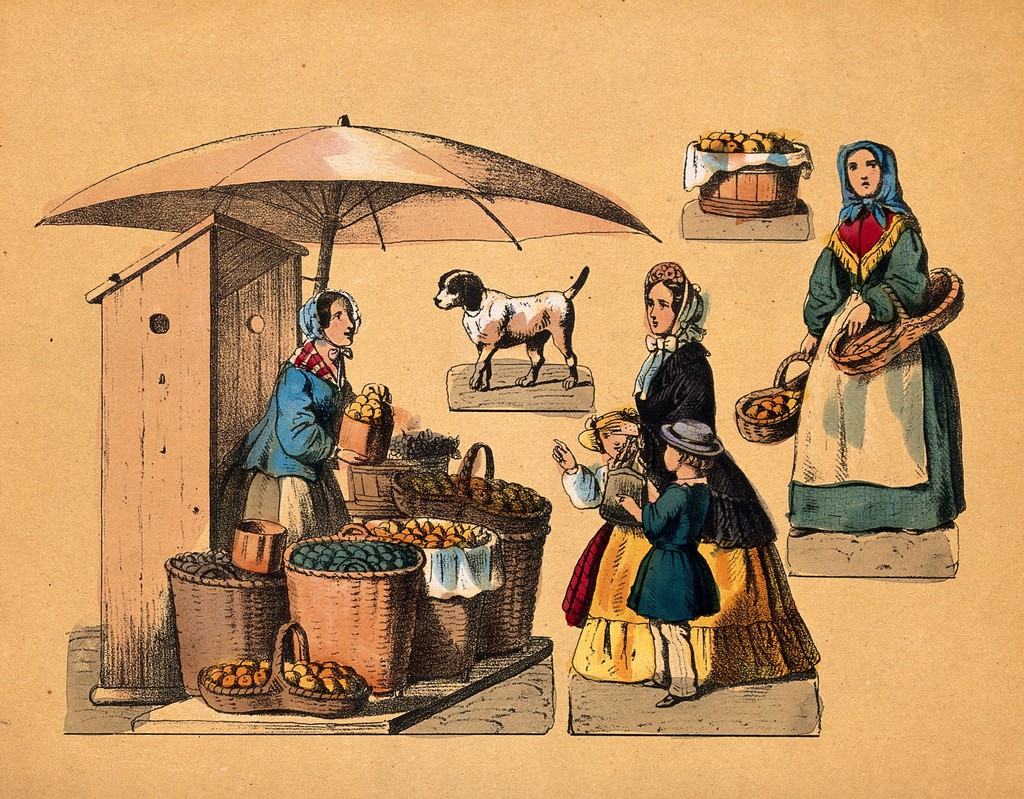
Credit: A woman is selling fruit from her market stall, set up under a large umbrella, to a woman who has two small children with her. Colour lithograph. Wellcome Collection. Source: Wellcome Collection.
He wrote to the County Member of Parliament:
We have a shop established here where great quantities of soup, rice, bacon, salted fish, and potatoes have been sold to the very great relief of our numerous poor who now substitute various articles for wheaten bread and bear their sufferings with exemplary patience… (p. 87)
Thomas purchased rice from the East India Company, and his shop sold over a ton each week. He also purchased American flour.
There was another bad harvest in 1800. Grain was being brought in by the Baltic grain fleets, but Napoleon had signed an alliance with Tsar Paul of Russia, and the grain fleets were blockaded. British exports were also being shut out of continental trade, so that there was less income. On April 15, 1801, Thomas wrote, “Prudence would dictate a total suspension of business but the wretched state of our poor laborers forbids it.”
Soon thereafter, the Tsar was assassinated, and the grain fleets set sail for England. In the fall of 1801, there was a bountiful harvest, and bread prices were reduced. Thomas closed his food shop.
Now of course Thomas was not endlessly accommodating to his workers. There were several strikes over the years. In 1807, Thomas was employing over 3600 men, women, and children, the weavers went out on strike for nine months. During strikes, Thomas usually made some concessions, but he was in a position to wait out the workers, and even threatened to take his business elsewhere to an area where people would be more willing to work for the wages he wanted to pay. But that is the kind of behavior I am more used to hearing about, and I was surprised by all the other things he did for the workers’ welfare over the years.
Thomas was ill for the summer and autumn of 1807, and during that time, four of his sons, all under the age of 21, managed the business. The family was also building a large house near the Tonedale Factory, and Tonedale House is still there! (It is now called Tone Dale House and Stables, and here is the AirBnB listing; I can’t find an independent website for the house. And will it be on my Dream Textile Tour? Yes.)
Thomas recovered from that illness and had many more years in business, and in enjoying his family. He had a stroke in 1820, and died in 1821.
In reading this book and doing some background research, I was really interested to learn how complex the wool manufacturing process was, even in traditional cottage-worker days.
And as I read of Thomas Fox’s business history, what struck me most was that we are still facing the same issues, in slightly different form. Having to decide if and when to adopt new technology, falling for scammers, buying faulty items, dealing with tariffs and duties, having politicians make impactful decisions far beyond our control — these are all challenges that Thomas Fox faced and that we still have. In a way it was kind of reassuring — we are not the only ones who have gone through difficult times.
If you are interested in how these issues played out in later decades, in cotton mills, you might like this post on North and South, an Elizabeth Gaskell novel from the 1850s.




Trying to log in to archive .com am working on itt……
Thistle be a beautiful day!
While there is tea there is hope!
No, be sure you are on archive.org! And not even archives with an s.
actually I am on .org trying to get a password……….
Thistle be a beautiful day!
While there is tea there is hope!
Here is the link. You may need to set up an account to read the whole book, but again, it is free. 🙂
Yes, same thing only different. UGH
Thistle be a beautiful day!
While there is tea there is hope!
Indeed, it sounds like same old same old. And yes, I’m impressed by what he did for the poor in his district during hard times. And I remain amazed at what a huge operation he had. Thanks for the book summary.
Thank you for very interesting post!
Thank you for this interesting series, Gwen 🙂