Textiles: Imagery
The final topic in Mary Schoeser’s book Textiles: The Art of Mankind is Imagery .
Pictorial imagery is an element of textile art the viewer expects to find, despite the fact that it is only one aspect of this enormous field….[O]ne of my essential points is that textiles are three-dimensional objects within which structure, texture, insertions, additions, manipulations and movement can interact. In fact, it is more accurate to describe textiles not a s a visual art, but as a sensory art, one that calls into play all of the senses… (p. 463)
Schoeser divides this section into three parts:
- Identity – textiles like plaids and paisleys — pattern designs that have come to be associated with certain cultures or eras; also “subtle or overt markers of cultural allegiance that are often as dependent on the textile as on the tailoring.” (p. 464)
- Narrative – textiles that allude to historic events or well-known stories that the viewer understands. “Other stories are more current and often contested… Many such contemporary myths reflect concerns about power and its impact on gender stereotypes and relationships, and about the nature of existence. Using textiles to direct attention to life’s struggles with these issues has an added frisson, given that textiles are so often a source of comfort.” (p. 471)
- Of Time and Place – textiles that show isolated scenes, like traditional copperplate-printed toile de Jouy, or that relate to mapping – of places, memories, or even cell functions.
There are so many nuances in imagery that we become aware of by osmosis. Think about looking at a woman’s dress or a man’s tie, and knowing whether the prints are “appropriate” or just “too loud.” Or looking at two plaids and knowing which one would be worn by a working cowboy, and which one would be worn by a preppy college student.
Imagery in textiles is a challenging area for me. Schoeser talks about all the elements that interact in a piece of textile art. For me, aspects of the imagery affect me more than any other element. I am not critical of workmanship or materials, but with just quick impressions of the imagery, I turn into Goldilocks– this piece is too minimal to suit me, that piece is just a mishmash of crystals and glitter: this piece is too purposefully primitive, that piece is too prissily perfect. Little things that feel “off” jar my attention and I quickly move on to find a piece that feels “just right.”
Using imagery in creations of my own is even more of a challenge. I don’t want to create photo-realistic or cartoonish motifs. I am drawn to abstract imagery based on visual reality. Here is one example I liked from the book: Reflections by Jane Freear-Wyld is a tapestry based on buildings in Paris.
Looking at my own collection, I think the piece that best shows the type of imagery I like is this piece by Sheila Frampton-Cooper, that I wrote about here. It is only about 15 inches square, but it has a vibrant blend of contrast, line, motion, and shape.
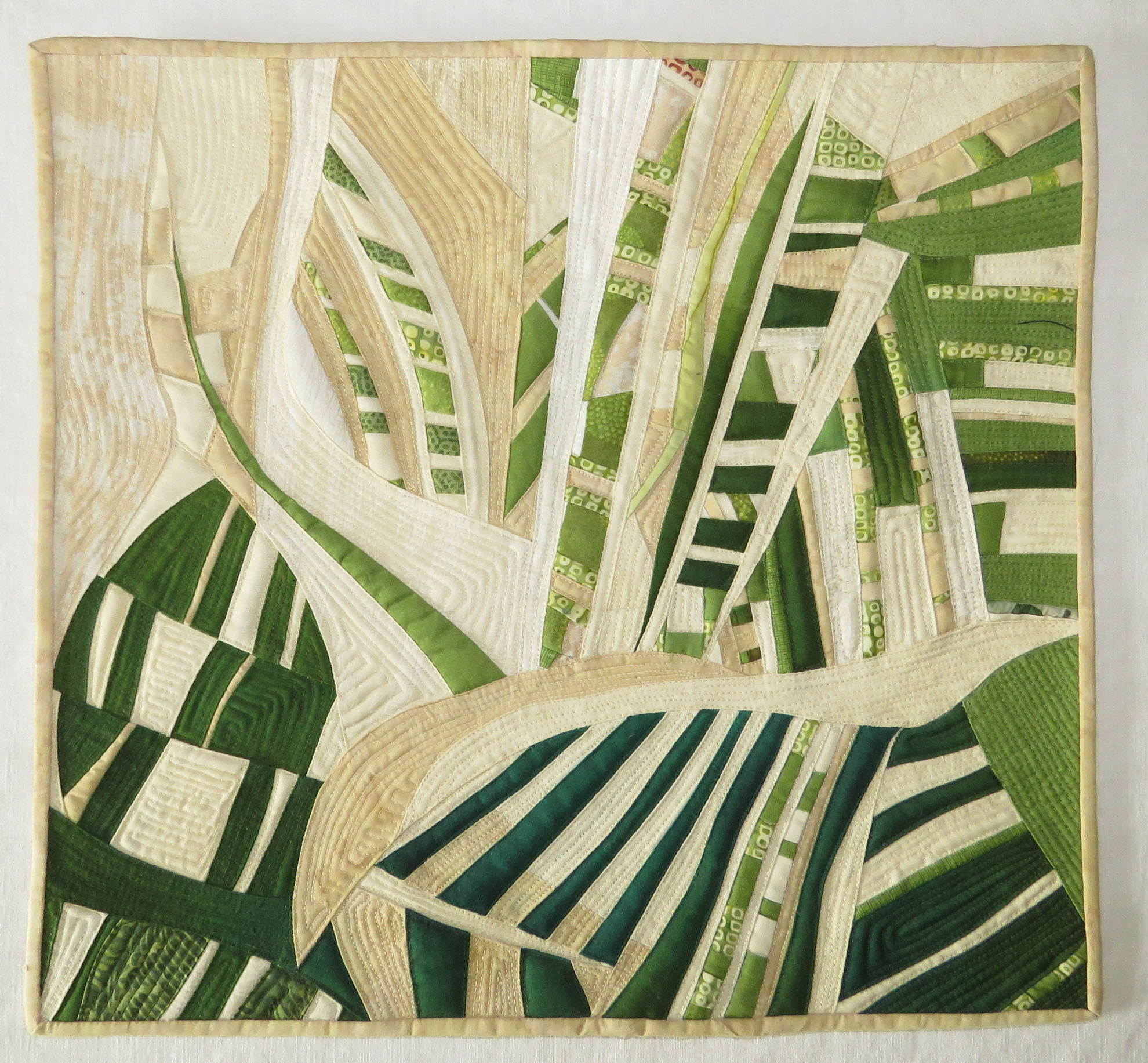
Inspired by a View by Sheila Frampton-Cooper.
I had Mary Schoeser’s beautiful book from the library for six weeks. I enjoyed having that time to dive deep into it and consider all the essays she wrote, but I think anyone would love just glancing through it to see the inspirational textiles.



I really appreciate the time you took to summarize some of the key concepts from the book, and to look for ways to apply the ideas to non-museum textiles. I’m not sure I’d take the time to read the book (it sounds a little too free-flowing and unfocused for my taste?) but you’ve still allowed me to think about some of the key ideas.
Yes, I had a very hard time reading it myself. But there are probably only 50 pages of text, and then there are 500 pages of fabulous and inspiring images! I cannot adequately express how wonderful the variety and quality of the images is!
My “left brain” appreciates your info/review but my “right brain” says TMI!!!!! LOL! I guess that’s why I didn’t do well, according to my instructors, in ‘Art Appreciation’ courses!!!!!! I wanted to stray from the technical verbiage they insisted on using!!!! LOL!!!
This is ironic, because the book is mostly images! 500 pages of gorgeous and/or thought-provoking textiles in all techniques. But if I just copied some of my favorite images and put them in the post, I would be infringing on copyright, so I had to write about the concepts instead. But I think you would like looking at all the photos.
I will have to see if I can find it in my library!!!!!!!
First, you are indeed lucky to own that piece. I realized after seeing it that I own only one quilt not made by me, and it’s a traditional Amish quilt. I need to remedy that. Second, many thanks for the fascinating links. I just love the work with organza and stitching by Jane McKeating, and Elizabeth Brimelow’s two sided quilts are fascinating. It did take a moment to figure out why some of the quilts changed, especially the fruit tree one.
Yes, I know you took that organza workshop (and I really loved the piece you did as a result), and I am interested in organza and transparencies too. McKeating’s work offered a lot of ideas in that area!
I do love that little art quilt. It is the only piece I own by a current quilter – all the others are vintage quilts I picked up here and there.
With my jammed March and early April, I haven’t caught up with you yet. Sounds like a fascinating book. I loved your description of yourself as Goldilocks. I tend to be that way, too. Though I’ve spent more time more recently trying to appreciate different qualities, even if I didn’t like the whole work. Thanks.
Yes, I gave myself a headache trying to figure out how I could express how imagery can affect me, without sounding too negative. I actually like a wide range of work. I need to think through all these aspects as I try to come up with some interesting portrayals of imagery myself. My brain goes foggy when I try to think beyond the predictable! 🙂
I love the inspiration here.