SalvageHappy — The Steamboat Arabia
My husband needed to go to Des Moines, Iowa for business, and he figured that driving would be almost as fast as going to the airport, dealing with security, and then trying to get a rent car company to honor a reservation. I am always up for a road trip, so I was happy to go along.
We got up early on a Sunday and drove to Kansas City, Missouri. The next morning we went to the Steamboat Arabia museum. Our younger daughter had happened across it when she had been in KC on business a few years ago, and told us we really needed to see it.
The Arabia sank in the Missouri River in 1856, fully loaded with merchandise meant for general stores. Over the years the river changed course, and the location silted up. About 40 years after it sank, a group of men dug down to it, because they believed there were 400 barrels of whiskey on it, but they didn’t find any.
Finally, in the 1980s, a salvage team explored for it and found it in a farm field, and went through extraordinary efforts to bring it up. Initially they were going to sell off any valuable finds, but they got so interested in all the objects they were finding, that they decided to open a museum instead.
I’ve been to a lot of historic homes and even replica general stores, where you get an idea what people wore and what tools they used. But seeing this mass of merchandise together in one place gave me a better picture of what life was like in that era. And since I have transcribed old handwritten records of general store inventories (1838 and 1847), I was really interested to see the wealth of objects they had displayed.
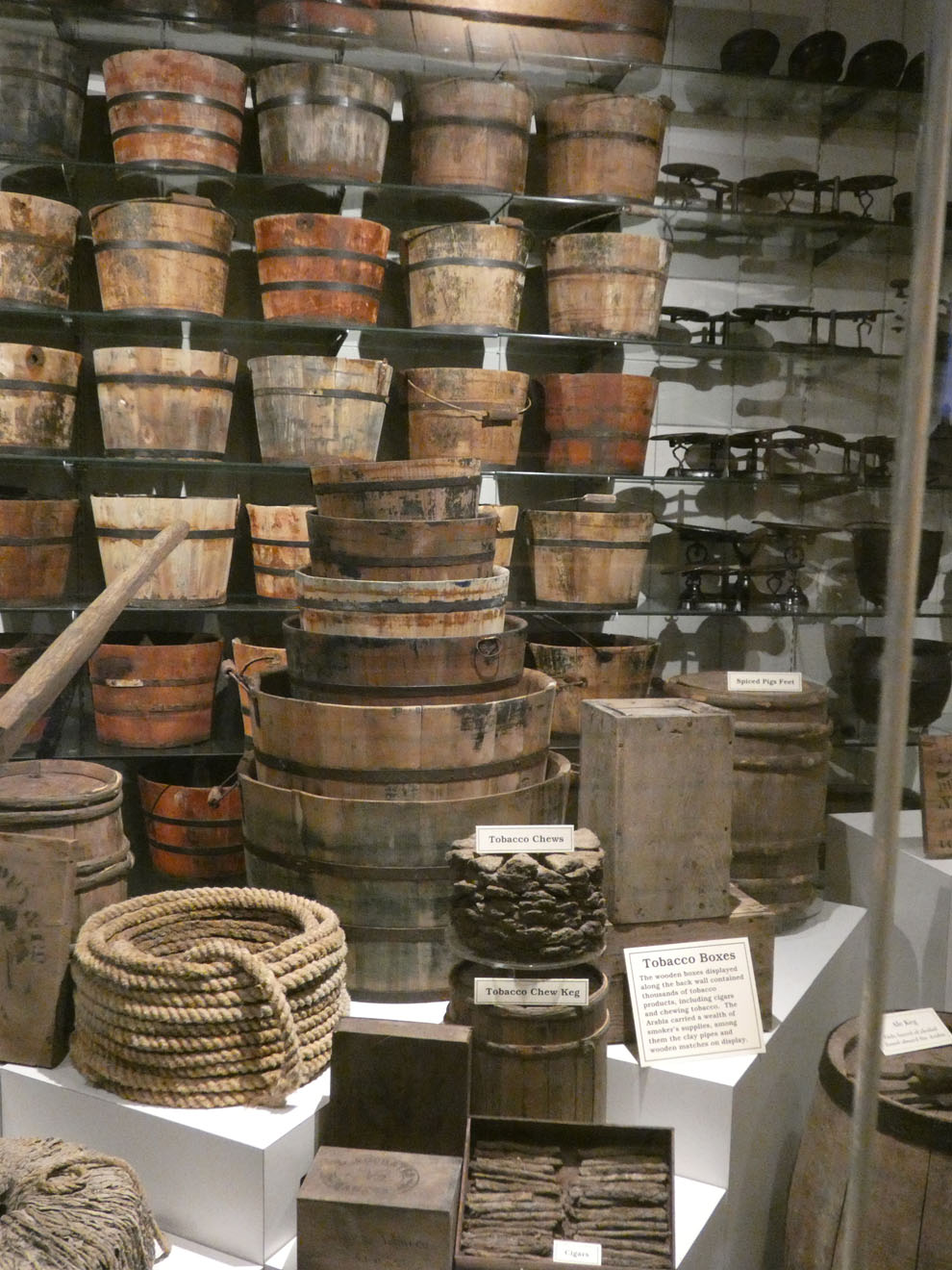
Buckets and barrels from 1856.
I really enjoyed looking at the sewing tools and notions. My pictures aren’t that good, due to shooting through the museum glass cases, but none of these things are shown on the museum website.
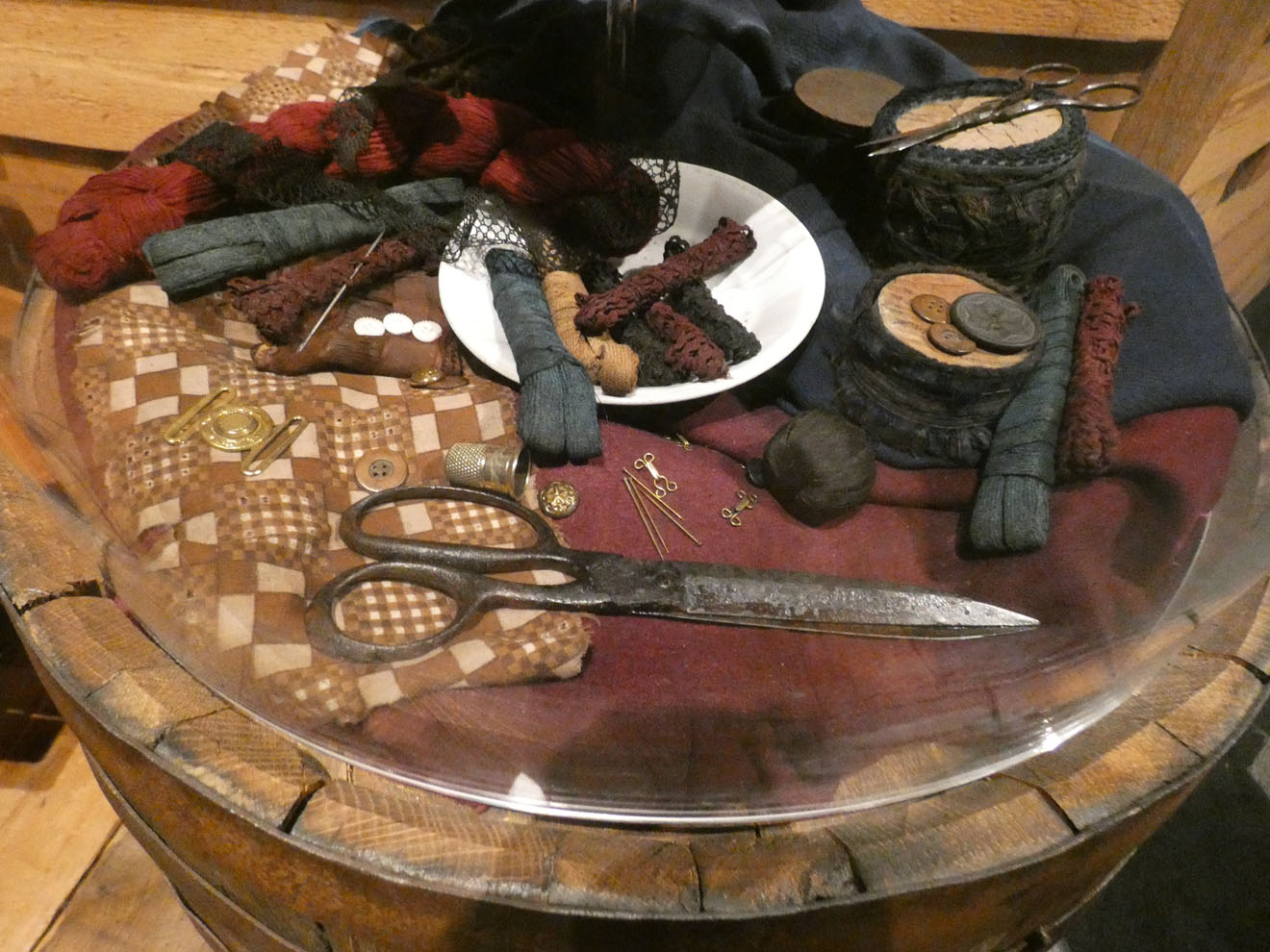
Shears and sewing notions.
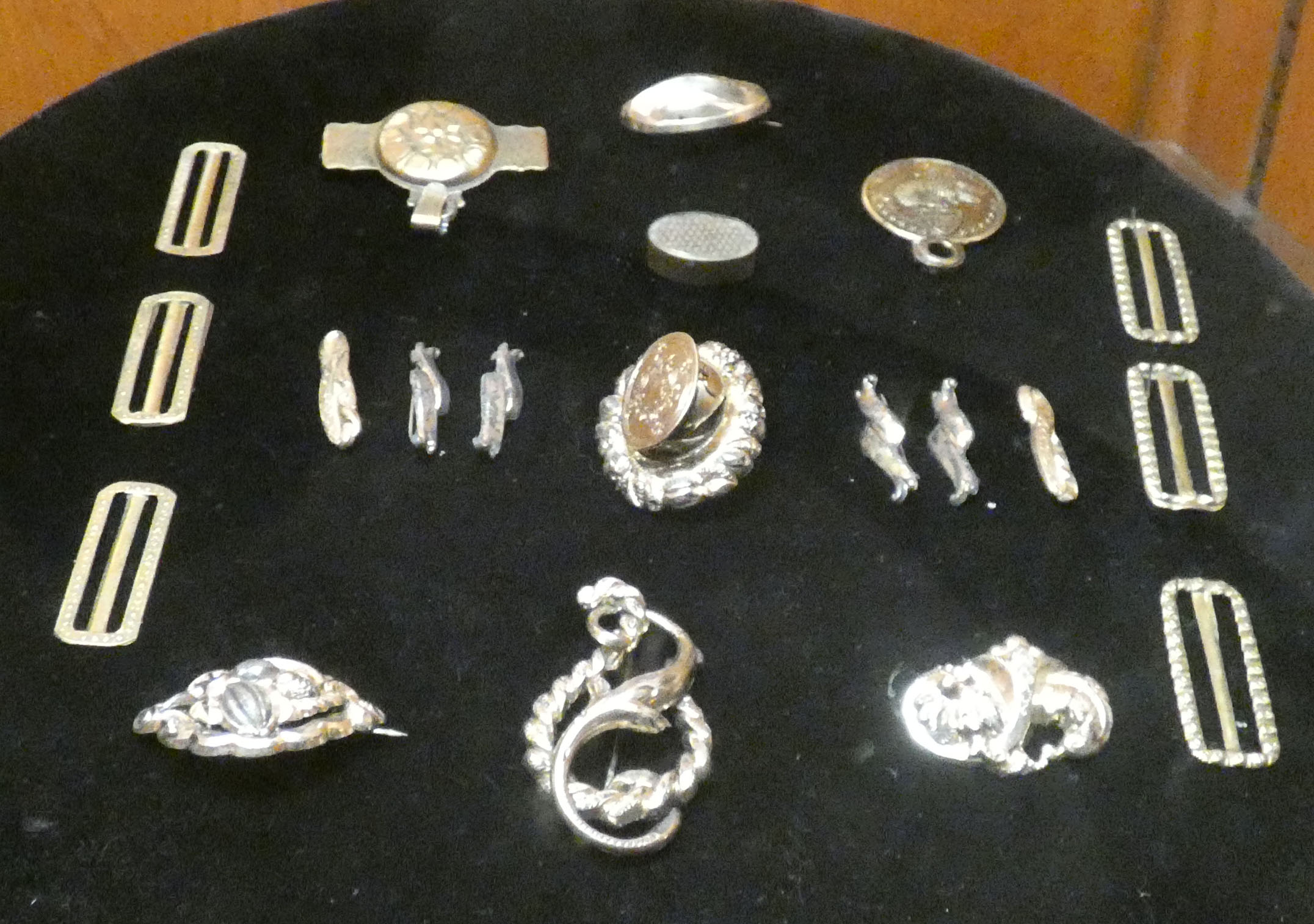
Jewelry.
It was also fascinating to see what lasted after being buried in water and mud for about 150 years. Here on the surface, silk often shreds and rots as the years go by, usually due to the mordants and dyes used on it. But in the water, it was the silk and wool that lasted, and the cotton turned to pulp.
The museum has some conservators working in the open and available for questions. We got to talk a long time to the textile conservator, Holly, and she showed us how she can differentiate between new garments meant for the stores, and old garments that were personal possessions, and how, even if some thread or fabric had rotted away, she could see shadows and marks of where it had been.
Yarns and ribbons were dyed with indigo and cochineal and are still true in color — chemical dyes were just being invented in England. There were lots of ready-made wool pants and jackets in the stock. There were boxes marked “cotton dresses”, but the cotton has disintegrated, and only the china buttons were left. Holly said that from the number of buttons, she thinks there were about 300 dresses in the merchandise.
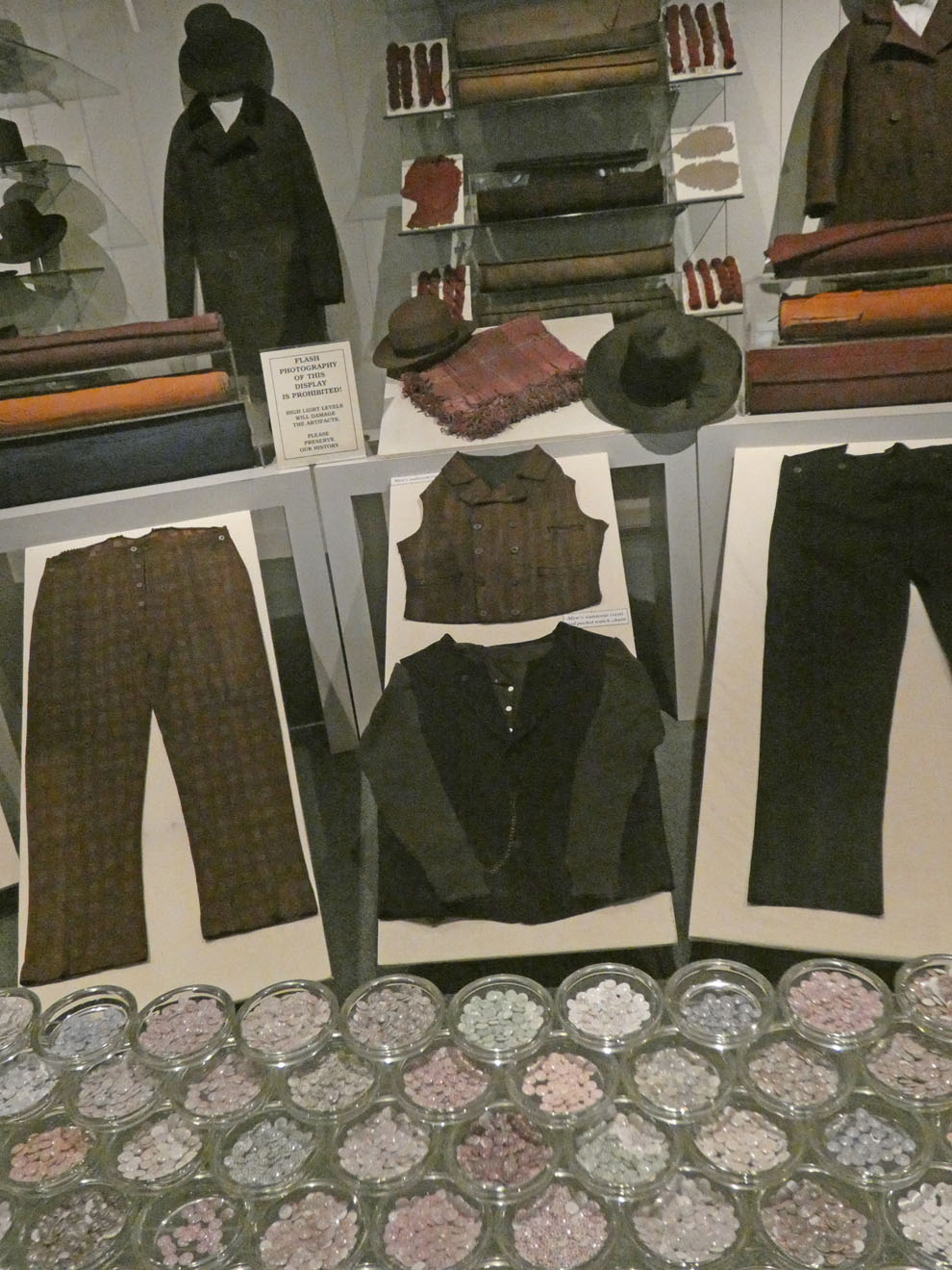
Men’s clothing, and some of the buttons from the cotton dresses that rotted in the water.
It was so interesting to see the care put into the conservation of the humblest items and materials.
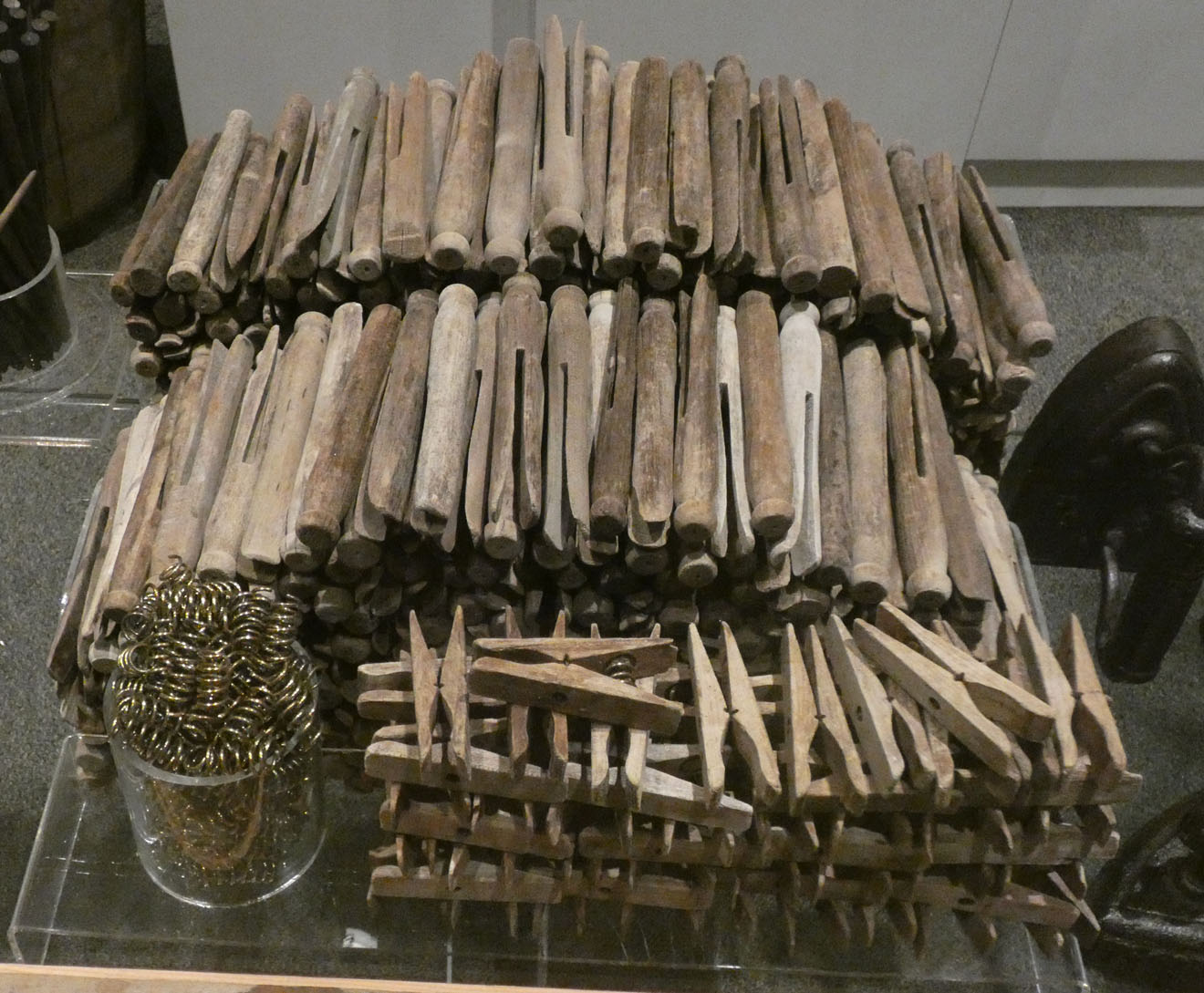
Clothespins of two styles.
I thought this was a great topic for ScrapHappy, because the team that recovered all of this merchandise, could easily have just scrapped a lot of it. They could have sold the coins and tools to collectors, and not made the effort to have the knitting needles or dress-making pins cleaned, or to have hired conservators to carefully wash and mend the garments. But instead, they saved every scrap and used them for education.
ScrapHappy is the 15th of each month, and it is hosted by Kate and Gun, the first two names on the list. It is the day we celebrate the value of those little bits and leftovers!
Kate, Gun, Eva, Sue, Lynda,
Birthe, Turid, Susan, Cathy, Tracy,
Jan, Moira, Sandra, Chris, Alys,
Claire, Jean, Dawn, Gwen,
Sunny, Kjerstin, Sue L, Vera,
Ann, Dawn 2, Carol, Preeti,
Nóilin, Viv, Karrin, Amo, Alissa,
Lynn, Tierney and Hannah




what an interesting story about how they found the ship. I’m going to go and research it on youtube to see if there’s video records!
They had good videos at the museum, very succinct. I hope you can find something online!
I watched a program about this boat. Thanks so much for sharing the finds!
They even had the snag that resulted in the boat’s sinking, and part of the giant metal tube that the people from the 1800s used to try to get to the whiskey, but I just focused on all the textile-related stuff. 🙂
I did not know about this museum, so thanks for sharing this. I will have to keep that in mind on our next trip through Des Moines!
It is actually in Kansas City. KC was on the way from where I live in the Houston area to Des Moines.
Oh that’s right – I did read that! Thanjks!
What a great post, thank you! ‘Salvage’ might as well be the theme word for ScrapHappy, since I think that’s what we do with all our bits and pieces, so this was a perfect choice for today.
That’s such an interesting post. Thank you for sharing
That is awesome they opened a museum instead of selling the stuff off. I enjoyed your photos of what was found during their excavation!
Me being from the Des Moines area, make sure to go to Winterset Iowa. Marianne Fons has set up a quilt museum there! I hope you are still in Iowa! Gwen, I thank you for sharing all these little tidbits or scraps of yesteryear! I loved this post!
I did not know you lived near Des Moines! I would certainly have reached out to see if you had any sightseeing advice for me or if we could have met up somewhere. But it is a good thing I didn’t, because I was in Des Moines less than 24 hours. We got there about 5 pm, then my husband met with business people in the morning, and then a work problem had us heading back home before noon. I did get a very lovely meal at Centro downtown, and even a little bit of snow!
What fun! I have read about this before but hadn’t seen pictures! Thanks!
What an interesting post! I am much more interested in the stuff of everyday life than the bling of Kings and Emperors.
This was so interesting to read about! Thank you for sharing!
Thank you for sharing this!