A Balkan Treasure
A few weekends ago I went to an antique show. I had no intention of buying anything; I was there to meet up with an antique dealer I had met at a previous show, to give her some vintage textile books. I couldn’t find her, and just cruised through the show a couple of times. I bravely resisted buying an overshot coverlet from 1850, and also a great wheel. As I was just about safely out of the show, I walked around a large corner booth that had a little bit of everything — old toys, license plates, china — and I happened to see the booth owner lift this big, folded-up textile off a storage tub to get at something underneath.
And I zoomed straight into the booth and just about pulled it from his hands.
I couldn’t immediately tell what era or culture it was from, but I could see that the weaving was spectacular, so I bought it. It turned out to be about 9 feet long by 6.75 feet wide, with warp and weft of wool.
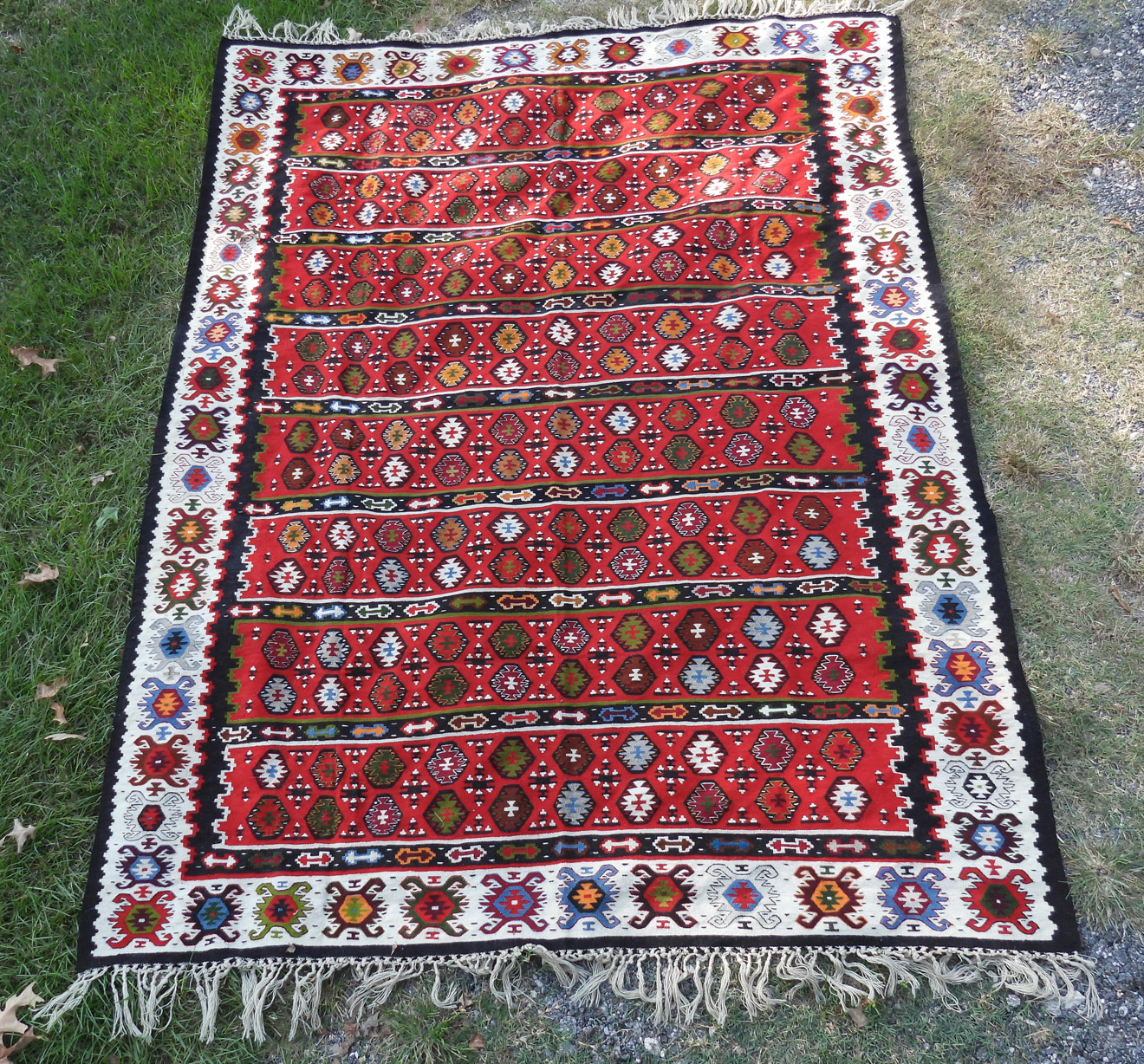
A beautiful flat-woven rug (kilim), about 9 feet by 6.5 feet, 274 cm by 205 cm.
When I got it home and started to research, I took a quick picture of two border motifs and uploaded it to image search.
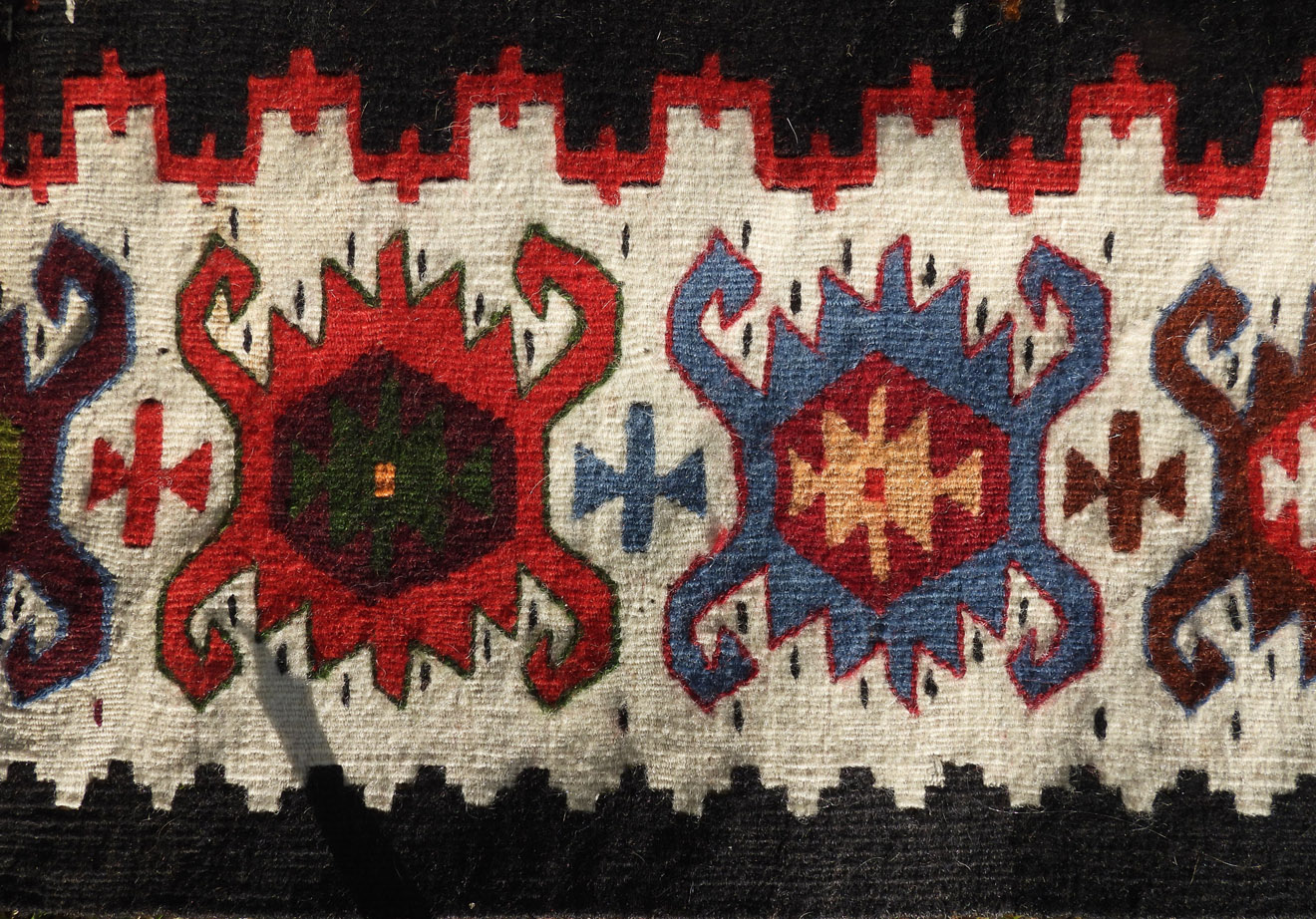
Motifs from the border.
I was surprised that from just that small part of the rug, the search results showed a lot of complete rugs that looked just like the one I had just bought. Here is the oldest one I have found:
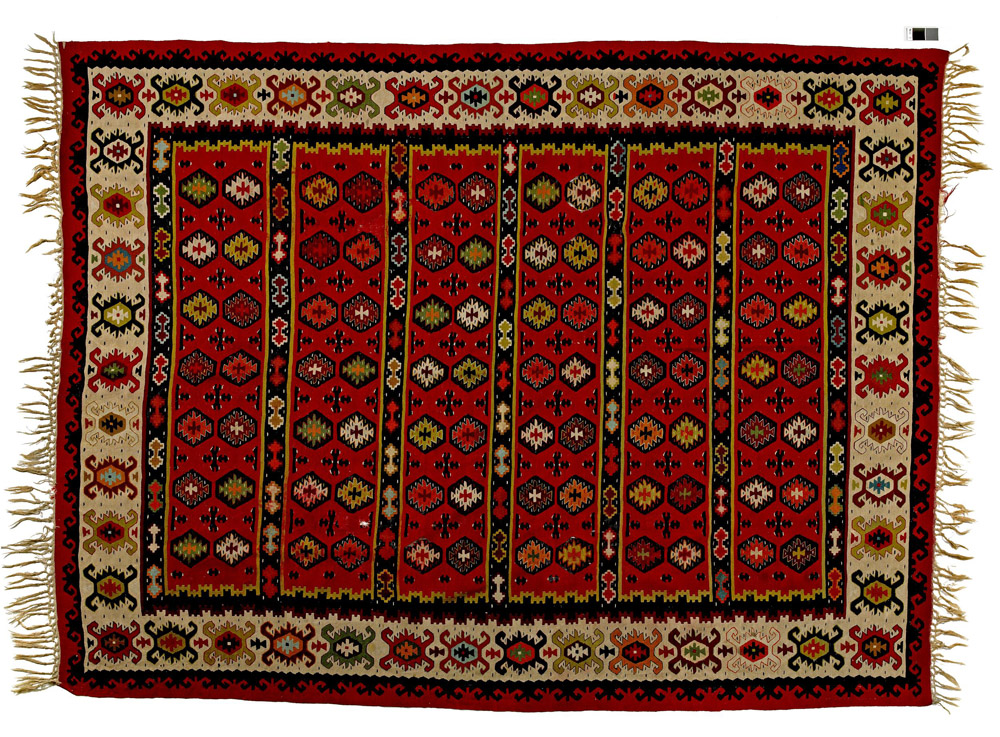
British Museum object 39859001, c. 1870-1890
© The Trustees of the British Museum. Shared under a Creative Commons Attribution-NonCommercial-ShareAlike 4.0 International (CC BY-NC-SA 4.0) licence.
https://www.britishmuseum.org/collection/object/H_Eu1997-04-218
I can tell that mine is not close to being that old, but from the curator’s notes, I learned that these are called Pirot kilims. I found that at least one workshop, Kilim Arts and Crafts, is still in existence in Serbia, and is still working in traditional ways. They describe their rugs as having 6-7 warps per cm, and 28 weft picks per cm, so I decided to scan this rug to help me count the warps and wefts more easily. As I set a corner on my scanner, I heard a little “clunk”, and found a tiny metal charm tied into the warp. It might say Pirot, but that might be wishful thinking on my part. 🙂
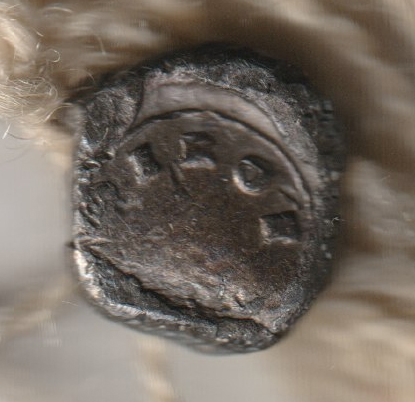
A little metal charm tied into the warp.
The warp and weft count on this rug match what the workshop describes, and with the additional info from the charm, I thought maybe they could tell me if that was their maker’s mark, or possibly a mark from another workshop. I have emailed them twice, but I haven’t received any response.
I also learned that this pattern is now called “Bombs” because supposedly the hexagons look like grenades carefully packed in cases. 😟
Here is a detail of the weaving — you can see that the wefts don’t travel across the whole piece. The different colors go across small areas of the warp, and where they meet, they don’t dovetail; they are turned back away from each other. This leaves small slits that give sharp definition to the motifs. However, if this was carried on for much of the length of the rug, it would lose its structural integrity, so that is one reason the designs are stepped.

Different colors of weft create the pattern…
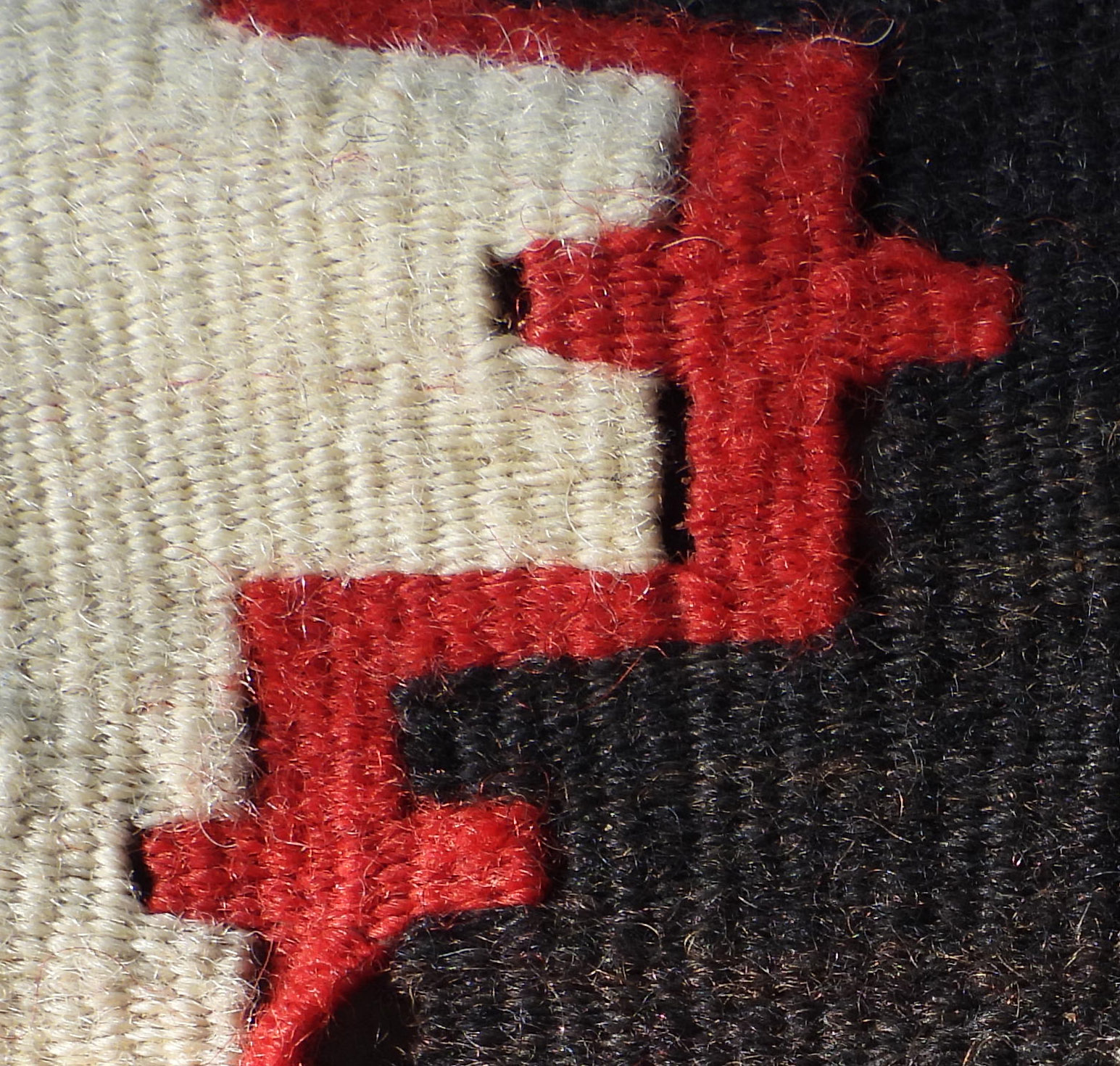
…creating small slits where the colored wefts meet and separate.
And let’s have a quick comparison with knotted rugs. Kilims look the same front and back, but knotted rugs look more velvety on the front, and more spotty on the back.
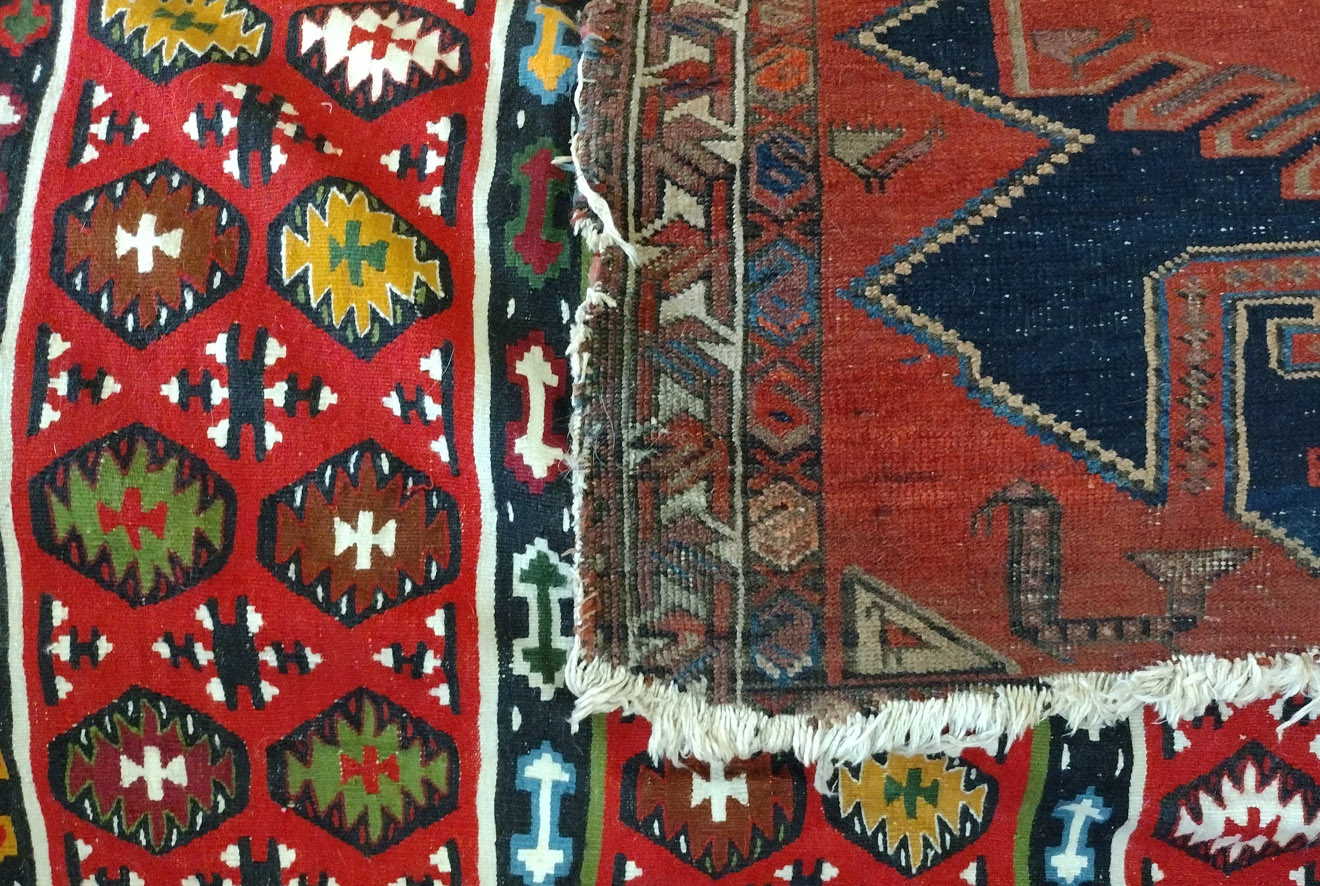
The kilim on the left, next to an old knotted rug, which looks more matte and velvety.
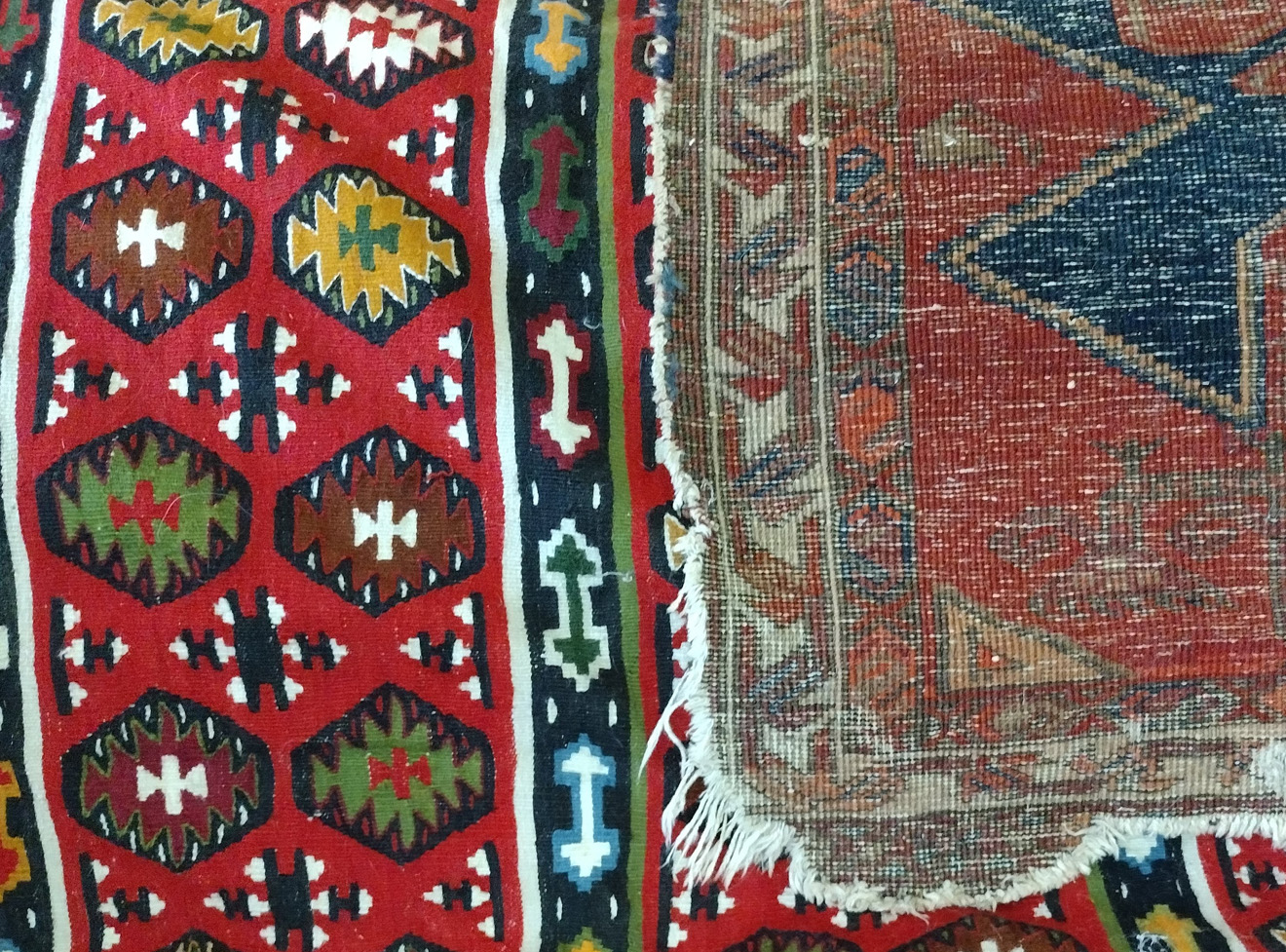
The back of the knotted rug shows how the short pieces of wool are wrapped around the warps and held in place with white wefts.
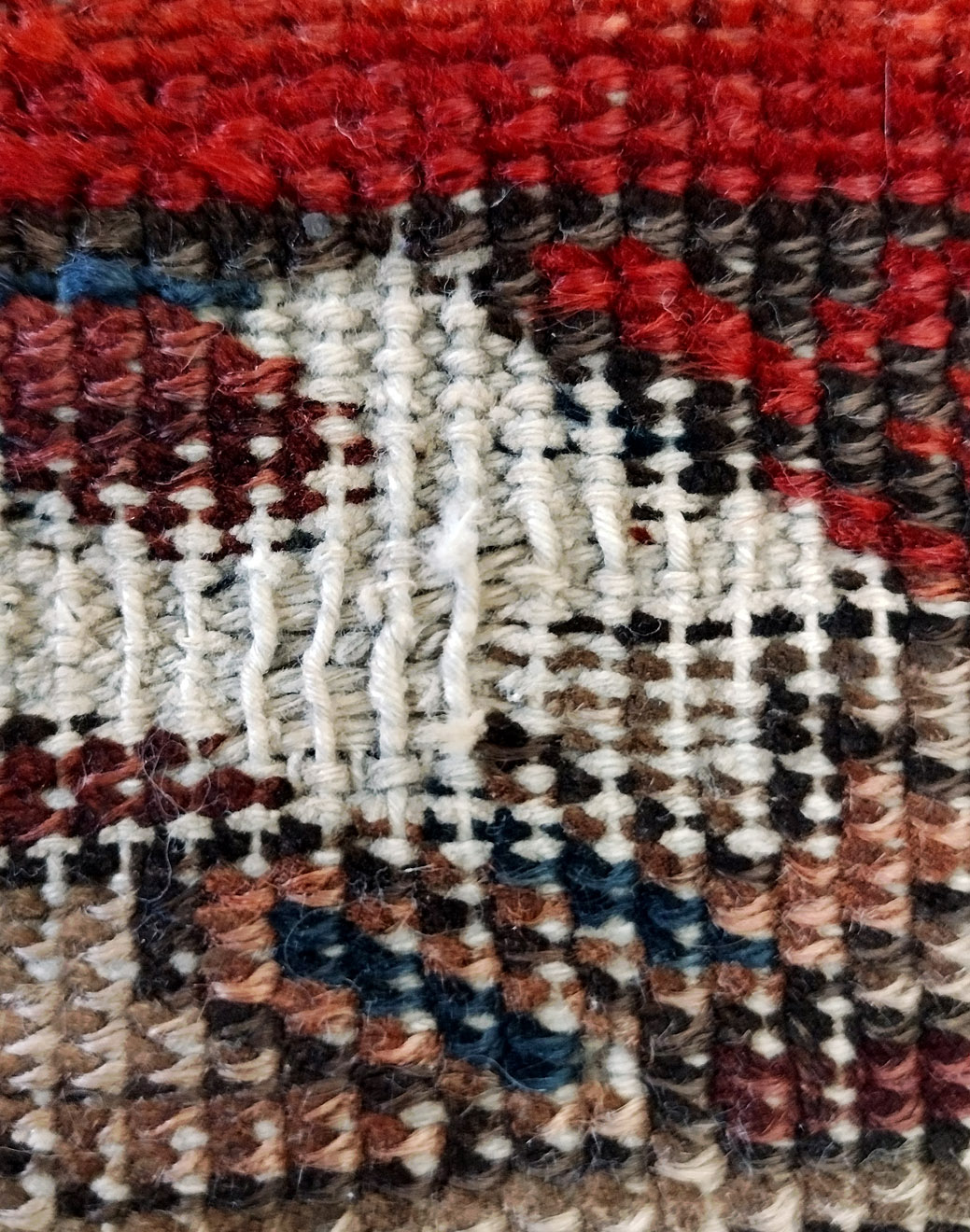
This damaged spot in the knotted rug, shows warps and supporting white wefts, where the colored knots have worn away.
So now of course I would love to travel to Serbia and visit the kilim workshop, but in the meantime, I am very happy with my new find!



What a wonderful treasure!
WOW, yes, a true treasure!
Thanks, Jean, I know you can appreciate this craftsmanship!
WOW, yes, a true treasure!
What a great find! I have no knowledge of antiques, but I would’ve liked that the minute I saw it. The bold colors are fun, although the granade thing gives a bit of pause.
Yes, I love the color combinations! I think that’s really what caused me to turn more to quilting than weaving — the ease of putting any two colors next to each other just to see what they will look like. 🙂
What a gorgeous rug! Thank you for the explanation of the difference between kilim and knotted rugs. I’m happy to have learned something today!
Thanks, Andrea, I am happy to have passed on some knowledge! 🙂
What an amazing find!! Congratulations!!
Thank you, Frances, I am so grateful that the booth owner happened to lift it up at just the right moment! 🙂
Oh MY I can just see you ripping this out of the man’s hands haha Did he know what he had? It is beautiful and quite a find, esp at 9′ long! Yes, off to Serbia 🙂🙂
Me
Thistle be a beautiful day!
While there is tea there is hope!
Hi Susan! I am so glad to hear from you!
That is a lovely find and you have done well to research it so quickly. It’s a great decorative piece to own and all the better for knowing some of its story 🙂
Yes, I need to get a huge mansion so I can display it and more textiles properly! 🙂
🙂
I’m fascinated by your find and the research that followed. I hope you make the journey one day.
What a lovely find!
Amazing rug and great investigation!