Guest Post: Coverlet Magic
Today I am so honored to share a beautiful essay from Annie Brannon.
Annie contacted me for information about an antique coverlet she had bought — I am no expert, but I know where to find the information, and I can understand it when I read it and put it in layman’s terms. But what Annie can do is to capture the allure of old handmade objects, to distill the multiple stories in an object’s long history, to express the sense of connection across generations.
So I will turn it over to her…
It’s a bright June morning in Georgia, early enough that you can walk to your car without sweating, sunny enough that you feel like you could do anything. I’m knocking on a stranger’s door, looking through the stained glass panes of her front door, waving like they’re supposed to recognize me somehow. Someone lets me in –
“Hi, I made an appointment to come early, with Lara?”
“Oh yes, hi. We’re still setting up, but feel free to look around.”
It’s an estate sale, my recent obsession. The most strange and morbid kind of treasure hunt, sifting through the valuables of someone who – either moved by death or some other major upheaval – is letting go of everything they’ve accumulated over time. In some cases, it feels like accumulation really is the only word to describe it: piles of stuff here and there in a garage, backyard, or basement; nothing curated or careful about it – just the contents of a life strewn haphazardly about. You find heirloom artwork piled up in Tupperware bins next to plastic bags filled with rubber bands. At least, that’s what you’re hoping for, when you show up at 8:45am at a stranger’s home on a Thursday morning.
But this sale isn’t one of those piled-high backyard bonanzas. This is a beautiful home filled with antiques – a magnificent twelve foot farm table stands in the dining area, and Lara tells me it used to be in her grandfather’s general store. This is not a picker’s paradise, this is someone’s life, and me moving between the rooms, taking it all in.
On the bed in a room at the back of the house, there is a pile of indigo and gold. I’m in a textiles frame of mind, having lately gotten very much into quilts and quilt-making, and my eye goes to it immediately. It’s not a quilt, but it’s still speaking to me, boasting geometric patterns intricately woven in wool; the tag reads, simply, “1800.” I unfold it to find it’s even more beautiful when it’s laid out – I know nothing about woven textiles, but I can’t stop staring. It takes me a second to even notice the tattered edges and several holes throughout. Seeing them, I tell myself I do not need this broken, beautiful thing. Thoughtfully, I fold it back up into place and make another three loops around the house, finding a few smaller treasures as I go.
My sister-in-law and I have a rule for antique shopping: if you don’t think you need it, put it back and take a lap. If you can’t stop coming back to it, it’s time to take it home. On my third trip around the house, Lara caught me eyeballing the coverlet for the last time. I ask her if she knows anything about it, she says no – it was in her grandfather’s cedar chest for decades, that’s all she knows. She looks at the tattered edges and asks me how much I want to pay. I tell her. She agrees. Fast forward half an hour and I’m spreading those frayed edges along the width of my bed at home, telling my husband at a mile a minute every detail I know so far (not much!) —
It’s hand-woven!
It’s 200 years old!
It’s absolutely gorgeous!!

The coverlet from the estate sale.
That was a month ago. And it was only three months ago that I picked up my first quilt in a flea market in exactly the same manner – stare, walk away, think, stare, bring home, and obsess. In both cases, something I don’t fully understand spoke to me from inside these beautiful antiques. In the days and weeks since then, I’ve continued to stare, and to think, and to wonder why I am so quickly and completely drawn in.
Half of my mind is cautious and skeptical. Standing in Lara’s home, I asked her if it was hard to say goodbye to some of these heirlooms. She shook her head quickly and smiled – “Oh no, no no… it’s time to let go. Things can become…” She hesitated, looking for the word. “A trap.”
I know this is true because I see it at every estate sale in one way or another. Everyone is just trying to make sense of a lifetime of accumulation – we build homes full of beautiful things we think are treasures, and then somehow when the owner is gone, the treasures turn into burdens. I am aware, looking at this beautiful new thing in my home, that someday my grandchildren will sell it for pennies and for that reason, it sobers me just to look at it. Already, who knows how many times it has changed hands? Generations have slept under it and now those generations are gone – dust to dust.
So yes, it is, after all, just another thing.
But in a nearby part of my mind, there is another idea sparkling. The something that draws me back to these old things, even when I set them down and walk away. I imagine the men and women who sheared the sheep or picked the cotton, spun and dyed the yarn and thread, somehow acquired a loom, found a pattern perhaps beyond their skill level, and spent untold hours working a craft I know nothing about – one that is still beautiful 200 years after its completion. I imagine their desire to impress their friend or their mother, to show off a new skill they’ve carefully honed over time, and meanwhile keeping their children warm in winter. I imagine how they must have anticipated the way the coverlet would look in their bedroom, the pride they must have felt when it was displayed there. Then I think – the t-shirt I bought at Target last week will disintegrate before my life ends. Meanwhile, this coverlet tells a story as long as the arc of history itself – the human drive to not just make a life for themselves, but to make it beautifully and with skill.
As lovers and collectors of beautiful old things, it is easy to be deceived by the allure of accumulation for its own sake – the thought that “more is more” will always be a trap.
Instead, when you find a gorgeous old textile looking for a new home, remember that what it has to say to us about the human experience is what makes it amazing – not the thing itself.
Somewhere in there is the magic.
Annie is a busy mom of three little boys, and you can find more of her lyrical writing about life here on Substack: https://anniebrannon.substack.com/about
I am so grateful for this essay that beautifully captures the way I, too, feel about textiles!
And now the technical information —
We can see this coverlet was woven in three narrow panels — the horizontal lines of patterns don’t quite line up, and the far right portion of each section sort of drops off, it is not symmetrical.
The closest draft I can find is Bonaparte’s March — Annie’s is woven with an extra pattern block of blue sashing (to use a quilting term) inserted between the large motifs of that pattern. (And the pattern names given to us in the most famous resource book, A Handweaver’s Source Book, may not have been the same name the original weaver used.)
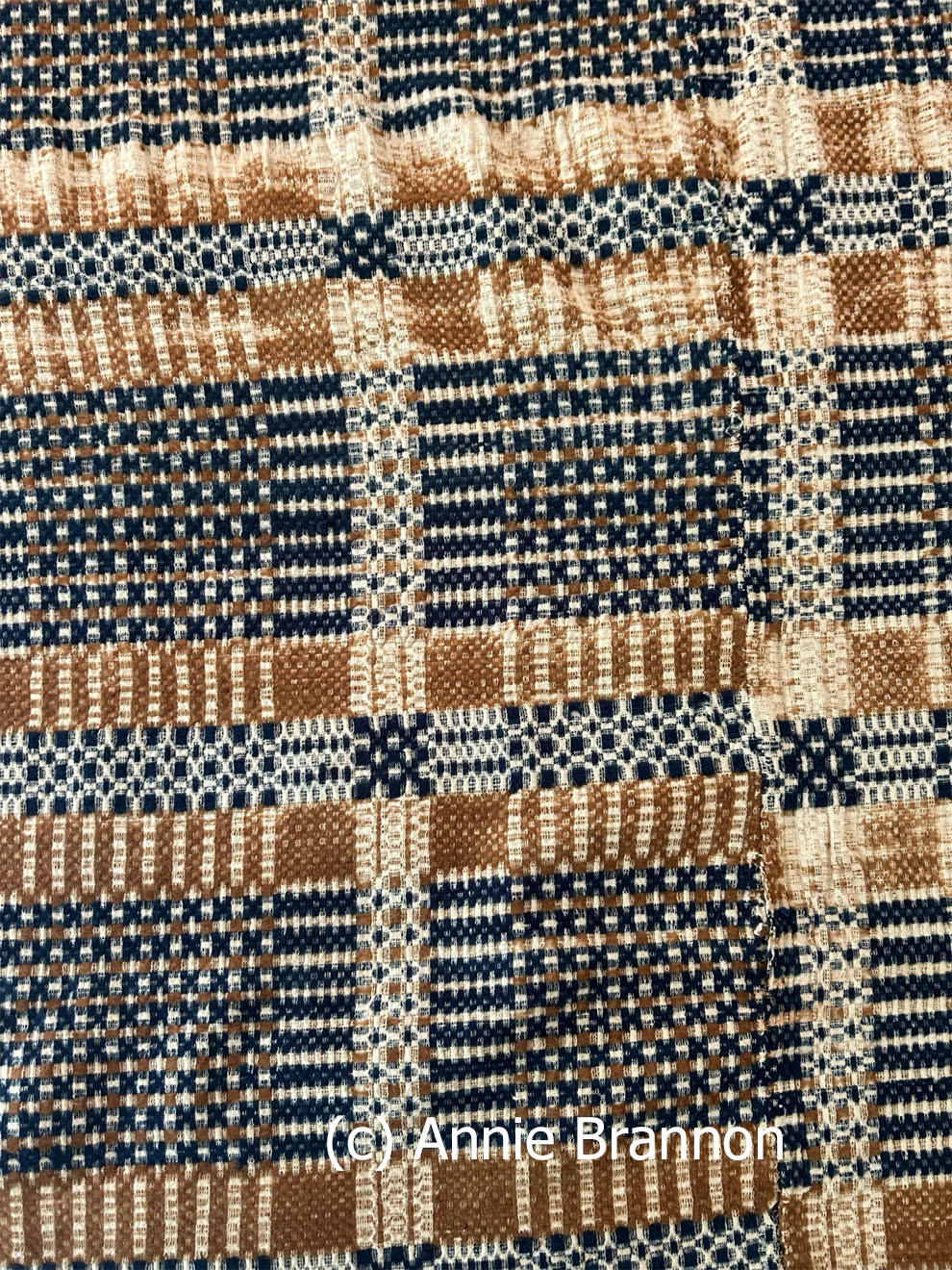
Studying the blocks.
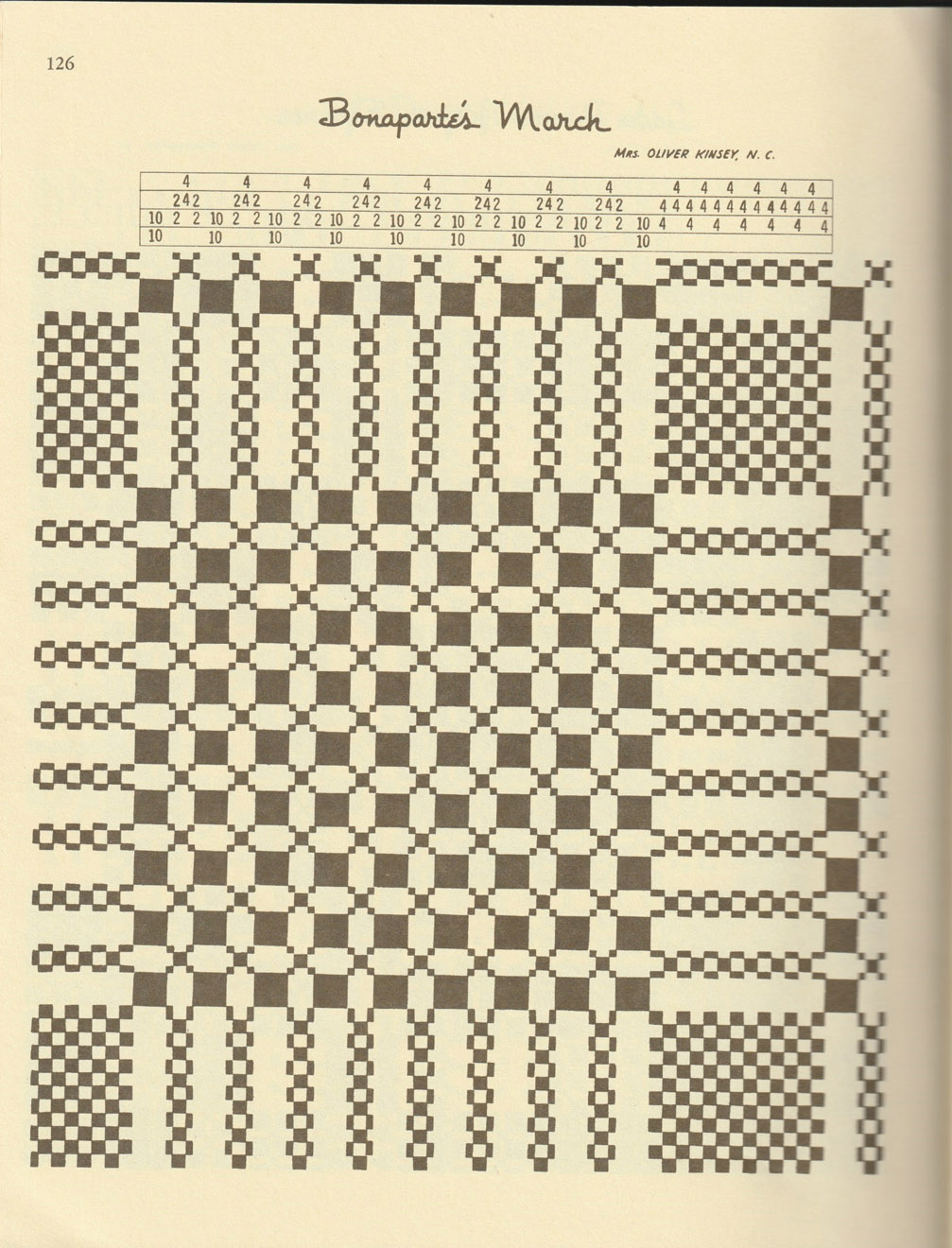
Bonaparte’s March draft from Davison’s A Handweaver’s Source Book, page 126.
The Foster and Muriel McCarl Coverlet Gallery has a fragment that is very similar, with rare provenance information. That one was woven by Rachel Reynolds in Rhode Island, in 1820. This link will take you to their group of fragments, and then you will have to look for object 2017.1.207. In my browser this fragment is fourth from the end. (I have emailed to ask permission to use their image but never heard back, so I will just link to it.)
The blue yarn would have been dyed with indigo; I am not sure about the brown yarn — maybe hickory or walnut.
Annie first asked me to help with coverlet information, at the same time that I was emailing back and forth with Benecio Machado about the McClellan coverlet. So I was deep in coverlet resources at the time! I have created a whole page to list them, but here is my short list of favorites:
- Coverlet reference book: American Woven Coverlets by Carol Strickler, 1987. In concise and readable language, it details how, when, why, and where coverlets were woven. There is a catalog of pattern motifs, so you can learn if that design is your coverlet is a rose or a star; a bowknot or a blooming leaf. There are drafts so you can weave your own! This book is at the Internet Archive, and can be borrowed for an hour or for fourteen days, with a free account.
- Best article: Home Weaving in Southeast Iowa: 1833 – 1870 from Annals of Iowa, because it gives accounts from women’s diaries, explaining their choices and chores in going through the steps of weaving.
- A very brief history can be found at the Smithsonian, along with many videos of interviews with coverlet weavers.
- Best online gallery: The Foster and Muriel McCarl Coverlet Gallery has many coverlets that came from the now-closed American Textile History Museum
I have so enjoyed these coverlet collaborations with Benecio and Annie. A shared interest allows instant friendship, and I also learn so much as I research for others. If you leave a comment for either of them, I will pass it on, and if you have a textile story you would like to share, just leave a comment as well!




Oh YES, magic 🙂 what a find and what a lovely piece of writing. I am so happy she snagged it! Thank you to both of you.
Thanks, Susan! It was fun to “meet” another textile aficionado and lure her deeper into the textile world. 🙂
Amazing coverlet and story. I appreciate the author’s musings on attending estate sales, I’ve had those same feelings!
Yes, I love estate sales too, and she summed up my feelings better than I could! 🙂
What an enjoyable post to read. I’ve often wondered if others felt the same as I do when I go to these types of sales, or help clear out a home. I’m glad Annie decided to take the coverlet home – it’s a beauty!
I know, I never feel like a vulture (as I have heard some estate sale shoppers described), I always feel like I am saving something to be appreciated! If I am ever a ghost at my own estate sale, I know I will be smiling upon those who take my stuff home with them. 🙂
I love learning about old textiles though I don’t collect them. Near me, in Lampeter, is a gallery which puts on an exhibition of Welsh Quilts each Summer – mostly old ones but sometimes with new ones too. One year they hung Kaffe Fasset’s quilts alongside the old ones. The owner buys and sells old quilts and sometimes woven covers. It is a fascinating place to visit.
Someday I would love to do a tour of all the out-of-the-way galleries and museums I have learned about from other bloggers! Places you might not find in the usual guide books, showing collections you can’t find in mainstream books. That would be so interesting!
Here in Houston we do have a big quilt festival, and one year they hung a bunch of Kaffe’s quilts, and he was actually there to explain them. I think that may be the most famous person I have ever seen in person! 🙂
What beautiful prose. Thank you
Thank you for sharing Annie’s musings and rewards through estate sales. You’ve collaborative nicely to bring forward more interesting detail. I’m so immpressed!
I love when we are able to find those unique that speak our names – a coverlet, a quilt, or an old print of a woman in a blue dress. The pieces that are just waiting for us to find them.
Lovely writing.