Korean Clothing from the 1600s
In following my new-found interest in hanbok (traditional Korean clothing), I have come across so many interesting resources that it would take me years to absorb them.
From the wonderful website We Wear Culture, from Google Arts and Culture, I found an interesting online exhibit, called The Costume, the Pattern of Joseon Dynasty It shows the historic garments with reconstructed images of what they looked like when new. (Some of the images are broken in that exhibit but it is still worth seeing.)
That exhibit spotlights one of the research areas that fascinates me most, Excavated Dress (Chulto boksik):
Starting in the early 1970s the South Korean government commissioned a series of construction projects such as building national dams and highways. These projects inevitably entailed the relocation of a number of graveyards, primarily formed during the Joseon dynasty (1392-1910)…
Before the 1970s, articles of clothing and textiles found from the course of tomb relocations were customarily incinerated in private…However, such archeological discoveries inevitably increased, and unearthed clothing and textiles have garnered academic attention as valuable sources for researching period costumes. They have been widely collected across the entire territory of South Korea, and are managed by the national, provincial, and university museums, as well as a few private collections.
…As such cases accumulated, it became clear that the excavated items featured a variety of styles with regional and temporal characteristics, which led to the conclusion that they were in fact daily clothes worn by the deceased. (Dress History of Korea: Critical Perspectives on Primary Sources, pp. 302 – 304)
Following links in that online exhibit, I discovered Gyeonggi Province Museum. Their many publications are available as PDF downloads (with an Open Library license which permits reuse if the item is credited).
This one piqued my interest: Clothes Excavated from the Tomb of Kim Hwak and His Wife. It is 390 pages long and of course it is in Korean, but I can understand the photos and diagrams of clothing on my own, and I have used Google Translate to read some of the paragraphs:
At the Gyeonggi Provincial Museum, during the process of relocating the graves of the Andong Kim clan, … in April 2001, a report was received that clothing had been found in the joint grave of Kim Hwak (1572–1633) and his wife, Dongnae Jeong (1567–1631). (p. 149, translated by Google)
In this joint burial, about 110 clothing items were recovered along with funeral preparations. Kim Hwak’s clothing consisted of 52 pieces, including deep robes, overcoats, shoes, and hats, showing the simplicity and elegance of early 17th-century male attire. The artifacts from the Dongnae Jeong family include wonsam (a type of ceremonial robe), jackets, and jeogori, with the wonsam being particularly valuable as it is the most fully intact wonsam reported in academic circles to date. Since these items have clear information about birth, death, and social status, they not only provide important clues for dating other clothing but also serve as valuable materials for studying mid-Joseon-era costume and textiles. (p.4, translated by Google)
Let’s look at some garment details. First, here is a photo and diagram of a basic jeogori (jacket), Number 13, showing how narrow strips of fabric were joined to create the shape.
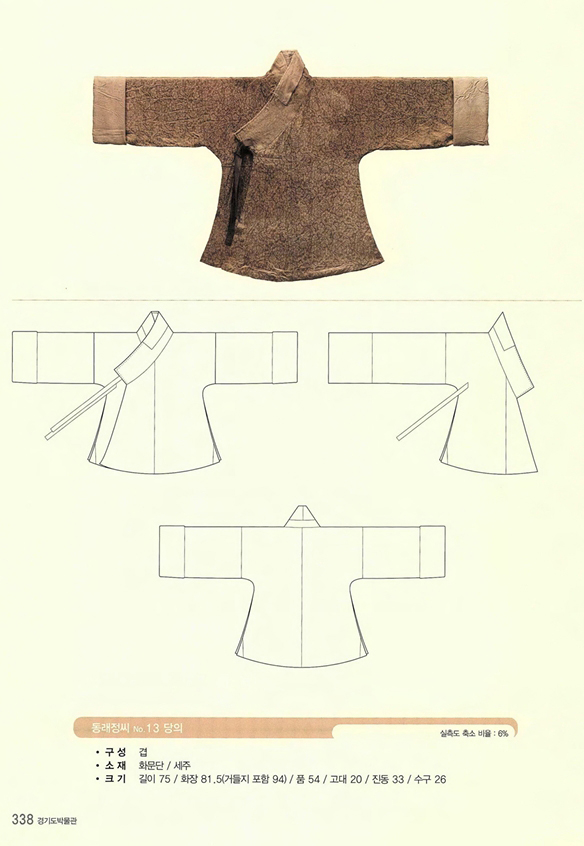
This diagram shows a jacket constructed with larger pieces of fabric…
This jeogori, Number 37, caught my eye, because of the way it was constructed using every tiny scrap.
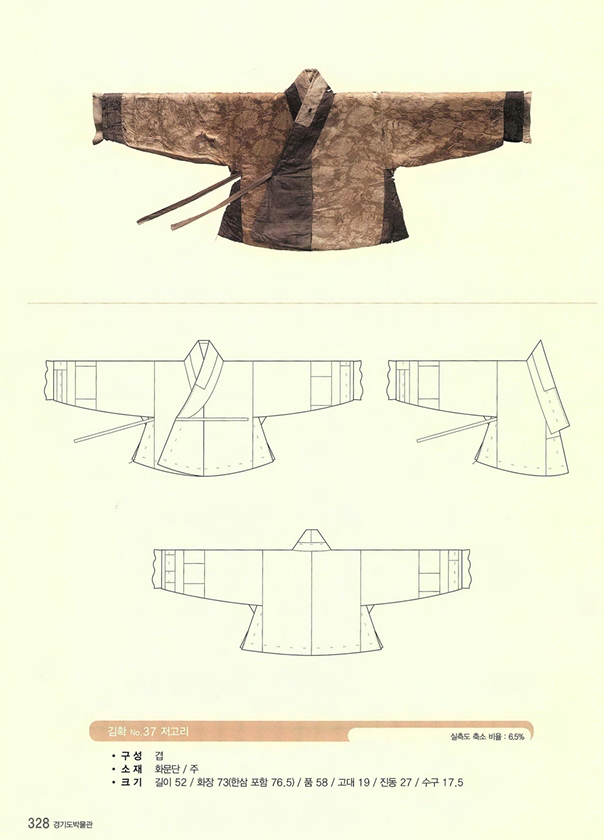
…and this one shows one pieced with every precious scrap.
All of the garments were studied in-depth, including fiber, weave structure, threads per cm, construction details, and proof of wear. Here are some close-ups. I would love to know more about where these fabrics were produced, Korea or China.


Normally, when considering remnant garments like this, I can only make conjectures about the person who wore it. But in this case, we know so much about the original wearers! Because fortunately for us, there was a custom in Korea at this time to place epitaph tablets in the tomb.
When I hear the word epitaph I think of something short, but these were very long, more like the obituaries we publish in a newspaper. They began with family information that followed a formula, and continued with memorial inscriptions, written by family members. In Kim Hwak’s tomb, there are nine tablets with the inscriptions.
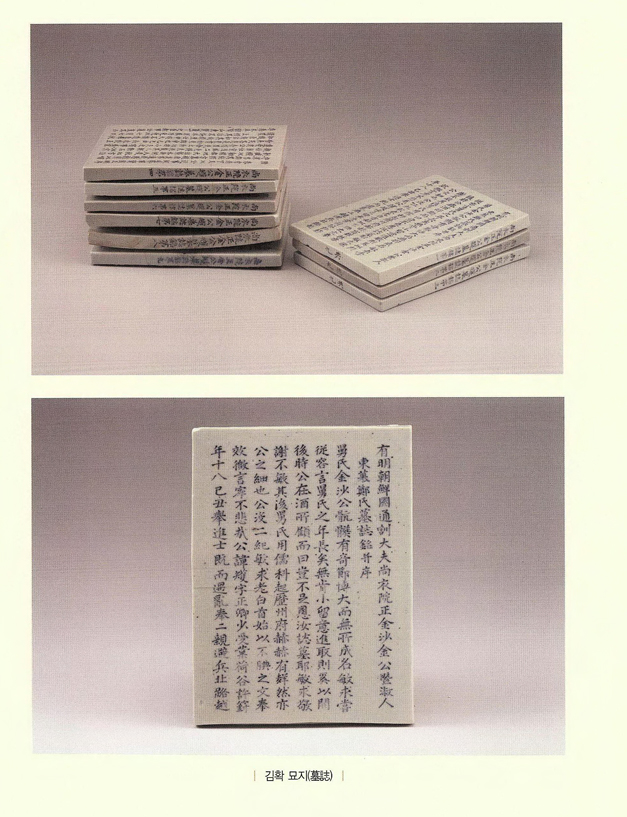
Memorial tablets, from Clothes Excavated from the Tomb of Kim Hwak and His Wife, page 12.
Educated people wrote in traditional Chinese at that time, but the researchers studying this burial have translated them into modern Korean, and then to satisfy my curiosity, I used Google Translate to translate them into English. From what I understand these tablets seem to contain several different accounts of Kim Hwak’s life, which vary from version to version, but repeat many of the significant details. At least some of the accounts were written by his nephew, as Kim Hwak and Lady Jeong had no surviving children at the time of their deaths.
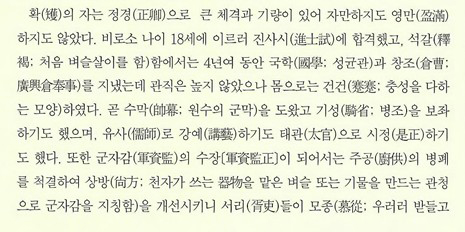
Sample paragraph from the epitaph tablets. Source: Clothes Excavated from the Tomb of Kim Hwak and His Wife
Hwak (熺), whose courtesy name was Jeong-gyeong (퍼띠), had a large build and great ability, and he was neither arrogant nor conceited. Only when he reached the age of 18 did he pass the Jinshi examination, and during his initial service in government, he spent over four years at the National Academy (Guk Hak; Sungkyunkwan) and in administrative duties (창조; serving at Gwangheunghoe). Although his official posts weren’t high, he served diligently. He assisted the commanding officer’s tent, supported the Military Affairs Office (Gi Seong; War Ministry), taught as a lecturer (유사) in martial arts, and served as an inspector (태관). He also became the head of the Military Supplies Bureau (군자감), eliminating corruption in official provisions and reforming the bureau, which garnered him respect from the officials (서리). (Translation of the paragraph above.)
Here are some more excerpts from those inscriptions, gathered from various places in pages 63-73 of the book. Remember I am just an interested amateur, relying on machine translations; I could have gotten things wrong! But I think it is wonderful that this knowledge lasted through the centuries, and I want to share these impressions of this couple.
Officials of Gwangheungchang usually made their subordinates give goods every day, and the subordinates, using this as an excuse, would confiscate the people’s wealth without restraint or sometimes mock their strengths and weaknesses. He reformed all these wrongful practices. [An episode of Rookie Historian Goo Hae-Ryung, one of my favorite series, dramatizes this issue, showing how low-level working clerks were cheated of their pay by their superiors.]
…soon after [1627], he took office as the governor of Sunchang County. He helped the starving people during a famine, distributed seeds to encourage farming, and generally did good deeds for the locals, but he was still dismissed due to suspicions from the provincial governor. In 1629, after serving briefly at the Sanguiwon, he went on to become the deputy governor of Cheorwon, but in 1633, due to illness and at the request of the provincial governor, he was dismissed and passed away in July of that year.
He once built a small thatched cottage by the waters of the lower Dongum County and mingled with the wise men of the countryside. He excelled in writing, disciplined himself with honor and integrity, guided people with morals when performing his duties, and did nothing improper. At the same time, he didn’t curry favor with powerful families and quietly lived his life on his own.
He was large in stature and had remarkable courage, so he didn’t fuss over trivial matters according to custom, and when dealing with things, he didn’t stick to rigid patterns or rules. Whenever there was something that needed to be done, he didn’t hesitate or wait around. Once, his older sister… passed away and was buried in the northern region. Her daughter was only four years old. He personally traveled a thousand li to manage her burial and took care of the girl until she grew up and got married. Whenever someone was in urgent need, he gladly helped and would say, ‘Hasn’t anyone destroyed their ancestors’ inheritance for a dog, a horse, or trivial pleasures?’ During the Japanese Invasion of Korea, in Namwon, because the defeated general Yang Won’s army left the roads full of harm and destruction, he cooked food on the left side of Suseongdo to help, and the starving soldiers all gathered around.
Even normally, whenever guests came, he would always serve food and drink, and he took daily drinking as a pleasure, so leisurely people gathered around him. He built a house in Hiryuu of Dong-eum County, close to his ancestral grave, and felt so attached that he couldn’t bear to leave.
(p. 72) 오호라! Oh ho! My uncle spent his early years mingling with wise men of the countryside and had a great reputation. When managing himself, he tempered himself with honor and integrity, and when handling state affairs, he guided people with benevolent teachings—there was nothing inappropriate in how he conducted himself or managed others. However, opportunities were scarce, so he didn’t even get to test out a tiny fraction of it. The world, chasing wealth and fawning over power, was full of people currying favor, yet he never set foot in the halls of the influential, nor did his name reach the mouths of the powerful. He quietly lived out his life and passed away, so who in the world could find fault with him?
… Lady Dongnae Jeong (Dongnae Jeong Min), was the daughter of Uijeong (Right State Councilor) Hwi Eon-seon (Yeon-sin). She was spirited and beautiful, calm, spoke little, and her behavior was simple. Even before getting married, she never left the main gate or peeked through the windows. When relatives invited her, she always gave a reason if she couldn’t go, and she continued this behavior even as she got older. When Uijeonggong’s (late Gong) ceremonial clothes wore out, she would light a lamp at night and start making new clothes by hand. Before dawn, it was finished, and Yi Jeong-gong admired her nimble skill. After marrying Gong, she served her in-laws just like she had served her own parents, and her in-laws were satisfied with her care.
His wife, Lady Jeong of the Dongnae Jeong clan, was born in 1567 (the 22nd year of King Myeongjong), making her five years older than her husband. She was the daughter of Vice Prime Minister Eonshin and was known for being calm, quiet, and having a simple, upright manner. She served her in-laws just as devotedly as her own parents and meticulously entertained the numerous guests who visited daily while managing the household and slaves with skill. She helped run the family successfully. She passed away in 1631, two years before her husband, and was buried next to him.
I have enjoyed this dive into research on excavated clothing, and I hope to learn more. And, I think Kim Hwak’s life would make a wonderful K-drama TV series!
And here are two more online exhibits from Google Arts and Culture:
- First, Evolution of Korean Dress gives a brief overview of women’s clothing throughout the centuries, as well as interpretations by modern designers.
- This one is more extensive, Women’s Fashion in the Joseon Dynasty; it includes high-definition details of the weave structures, and short videos of how the fashions were worn.



You are quite the textile historian! At first I was thinking it was wasteful (assuming there were limited resources in the 1600s) to have buried all those clothes in the tomb (I guess they wanted to be well dressed in the afterlife) but then look at the historical find and the preservation of those clothes. I appreciated seeing some images and examples of the clothing! You should suggest the K-Drama to Netflix or something 😉
Yes, I am wondering the same thing myself, why so many garments were buried. I have a book on order that explains the burial customs and I can’t wait to read it and find out! 🙂
Well, that was amazing. Not sure how so much survived so long. It does make me wonder who’ll be digging my parents up 400 years from now, but I guess I won’t be around to find out.
I read that they had a protocol for the coffins which resulted in them keeping out air. I ordered a book on funeral practices, and when it gets here, I will know more!
Thank you for sharing all of this, the first article and then tracking down the other info. Fascinating, especially the garment with the extraordinary piecing for construction.
Thank you, I find it very fascinating myself! I have been watching so many K-dramas and I love seeing how the costume designers used this historical information to create their designs.
This is intriguing. I learn something new and interesting every time you post. I like the idea of burying an epitaph with the deceased, and what a boon for historians. I have to say, I’m survived that these textiles survived. Amazing stuff.
And what amazes me more than that they survived, is the beautiful quality of the threads and the weaving patterns — to me it is so incredible what handweavers could achieve, all around the world. 🙂
I fell in love with Korean traditional garments when we visited there several years ago, and like you, find that world fascinating. Thank you for this glimpse into two people’s lives.
I love the way traditional clothing made the most of every scrap of fabric. I supose when you collected the fibers, prepared and spun them then wove the cloth you understood how precious it was.