A Royal Korean Procession in the 1890s
When I started watching K-dramas, I was so intrigued by the costumes; I wanted to know what resources the costume designers had available to them. I have enjoyed dipping into Korean books and websites, but I was very happy to find this resource in English, Korea and her Neighbors, by Isabella Bird, published in 1905.
As I said in my previous post, Isabella Bird was an Englishwoman who traveled the world in the late 1800s. She was in Korea at various times in 1894 through 1897 — it was a time of extreme political upheaval, which I will not go into here, but it gave her the motive to go into great detail on what she saw.
Today we will look at excerpts from her description of the ceremony of Kurdong.
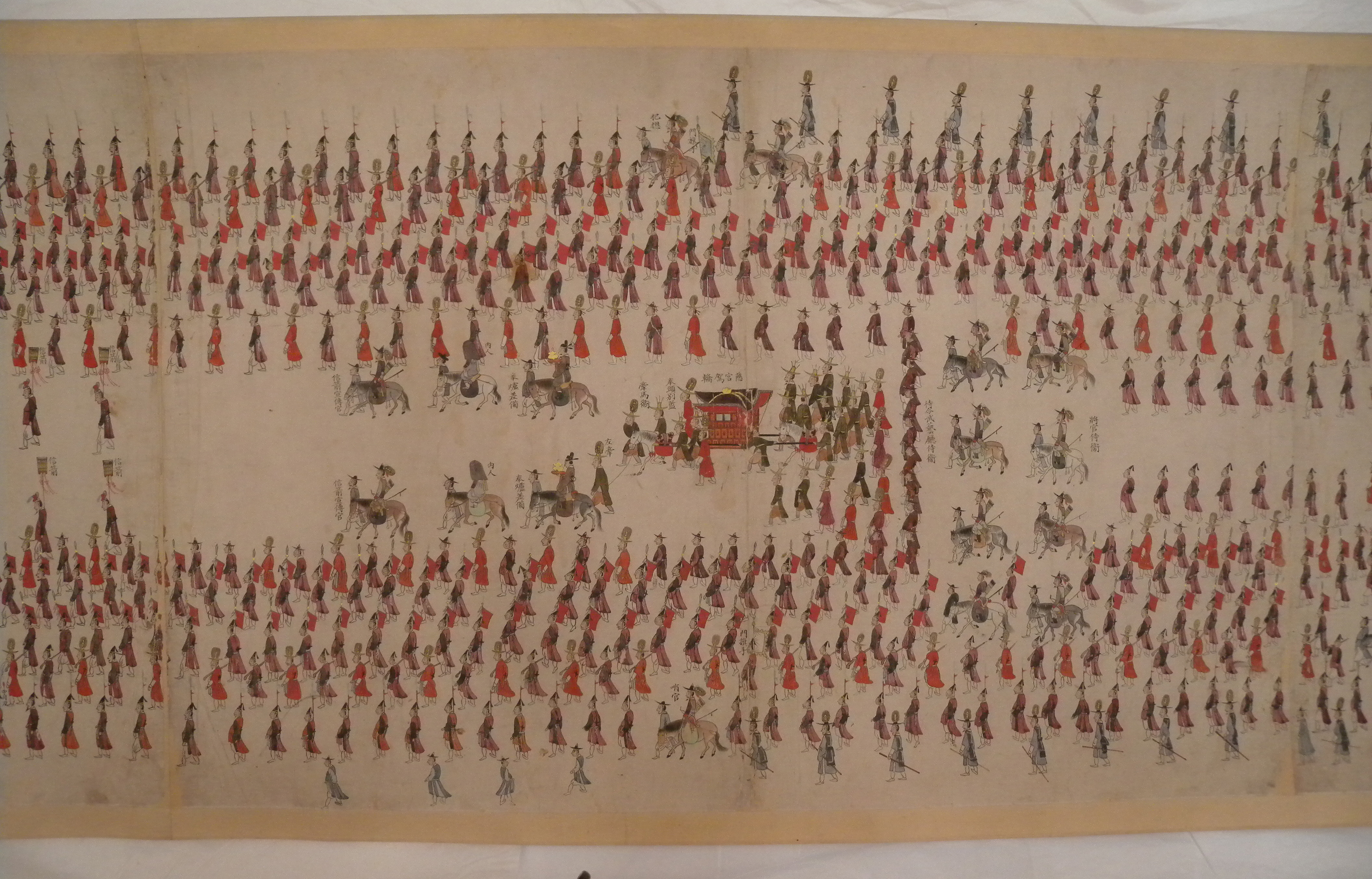
A similar procession from 100 years before Isabella Bird’s visit –Hwaseong Neunghaeng Banchado is a historical illustration to describe the march of Jeongjo of Joseon, the 22th king of Joseon dynasty, when he went to the tomb of his father in Hwaseong Fortress at 1795. From Wikimedia Commons.
If an apology be necessary for the following minute description of this unique ceremonial, I offer it on the ground that it was probably the last of its kind, and that full details of it have not been given before.
The occasion was a visit of the King in state to sacrifice in one of the ancestral temples of his dynasty, members of which have occupied the Korean throne for five centuries. Living secluded in his palace, guarded by 1000 men, his subjects forbidden to pronounce his name, which indeed is seldom known, in total ignorance of any other aspect of his kingdom and capital than that furnished by the two streets through which he passes to offer sacrifice, the days on which he performs this pious act offer to his subjects their sole opportunities of gazing on his august countenance.
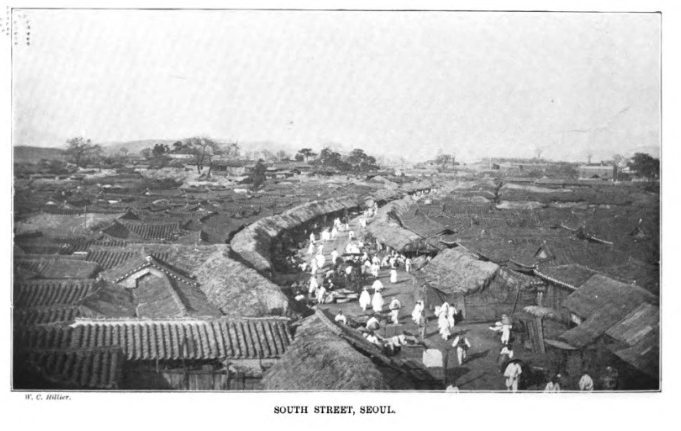
…By six in the morning of the looked-for day we were on our way from the English Legation to a position near the Great Bell∗…For the first time I saw the grand proportions of the road called by foreigners South Street. The double rows of booths had been removed the night before, and along the side of the street, at intervals of 20 yards, torches 10 feet high were let into the ground to light the King on his return from sacrificing….In place of the booths the subjects were massed twelve deep, the regularity of the front row being preserved by a number of Yamen runners, who brought down their wooden paddles with an unmerciful whack on any one breaking the line. The singular monotony of baggy white coats and black crinoline hats was relieved by boy bridegrooms in yellow hats and rose pink coats, by the green silk coats of women, and the green, pink, heliotrope and Turkey red dresses of children.
This was South Street in Seoul in the 1890s.
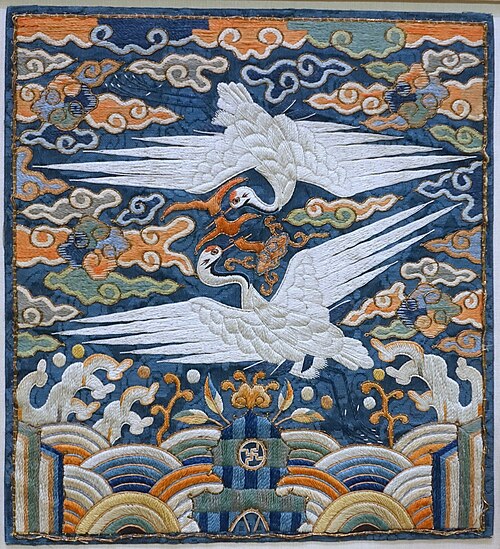
Either on the back or breast or both of the superb dresses of officials were satin squares embroidered in unique designs, representing birds and beasts, storks indicating civil, and tigers military, rank, while the number of birds or animals on the lozenge denoted the wearer’s exact position.
Embroidered insignia badge, Sackler Museum. Daderot, Public domain, via Wikimedia Commons Source.
Palace attendants in hundreds in brown glazed cotton sleeved cloaks, blue under robes tied below the knee with bunches of red ribbon, and stiff black hats, with heavy fan-shaped plumes of peacock’s feathers, rode ragged ponies on gay saddles of great height, without bridles, the animals being led by coolies. High officials passed in numbers in chairs or on pony-back, each with from twenty to thirty gay attendants running beside him, and a row of bannermen extending across the broad street behind him, each man with a silk banner bearing the cognomen of his lord. These officials were superbly dressed, and made a splendid show. They wore black, high-crowned hats, with long crimson tassels behind, and heavy, black ostrich plumes falling over the brim in front, mazarine blue silk robes, split up to the waist behind, with orange silk under robes and most voluminous crimson trousers, loosely tied above the ankles with knots of sky-blue ribbon, while streamers of ribbon fell from throats and girdles, and the hats were secured by throat lashes of large amber beads. Each carried over his shoulder a yellow silk banneret with his style in Chinese characters in crimson upon it, and in the same hand his baton of office with a profusion of streamers of rich ribbons depending from it. The sleeves were orange in the upper part and crimson in the lower, and very full.
The overfed and self-willed ponies, chiefly roan and gray, are very handsome, and showily caparisoned, the heads covered with blue, red, and yellow balls, and sur- mounted with great crimson silk pompons, the bridles a couple of crimson silk scarves, the saddles a sort of leather-covered padded pack-saddle 12 inches above the animal’s back, with wide, deep flaps of bright green silver-bossed leather hanging down on either side, the cruppers folded white silk, and the breastplate shields of gold embroidery.
Yet this was not the procession, though it might well have served for one. At 7.30, while this “march past” was still going on, a gun was fired, and the great bell, which was very close to us, boomed heavily, and a fanfaronade of trumpets and the shrill scream of fifes announced that Li Hsi had at last left the palace.
It is said that there were 5000 servants and officials connected with the palace, and there were nominally 6000 soldiers in Seoul, and the greater part of these took part in the many splendid processions which went to form the Royal procession. It would be impossible for a stranger to give in detail the component parts of such a show, the like of which has no existence elsewhere on earth, passing for more than an hour in the bright sunshine, in detachments, in compact masses, at a stately walk or a rapid run, in the full splendour of a barbaric mediævalism, or to say what dignitaries flashed by in the kaleidoscopic blaze of colour.
The procession of the King was led by the “general of the vanguard,” superbly dressed, supported by retainers on his led pony, and followed by crowds of dignitaries, each with his train, soldiers, men carrying aloft frames of arrows, reaching nearly across the road, and huge flags of silk brocade surmounted by plumes of pheasant’s feathers, servants in rows of a hundred in the most delicate shades of blue, green, or mauve silk gauze over white, halberdiers, grandees, each with a retinue of bannermen, rows of royal bannermen carrying yellow and blue silk flags emblazoned, cavalry men in imitation gold helmets and mediæval armour, and tiger-hunters wearing coarse black felt hats with conical crowns and dark blue coats, trailing long guns.
The King’s Excursion on a Royal Carriage, from Ewha Woman’s University Museum
…drummers beat their drums unmercifully, fifes shrieked, there were more dignitaries with fairy-like retinues in blue and green silk gauze, the King’s personal attendants in crowds followed in yellow, with bamboo hats trimmed with rosettes, standard-bearers came next, bearing the Royal standard, a winged tiger rampant on a yellow ground, more flags and troops, and then the curious insignia of Korean Royalty, including a monstrous red silk umbrella, and a singular frame of stones…After this, borne high aloft by forty bearers clothed in red, in a superb chair of red lacquer, richly tasselled and canopied, and with wings to keep off the sun, came the King, whose pale, languid face never changed its expression as he passed with all the dignity and splendour of his kingdom through the silent crowd. More grandees, servants, soldiers, standard-bearers, arrowmen, officials, cavalry, and led horses formed the procession of the Crown Prince, who was also carried in a red palanquin, and looked paler and more impassive than his father. The supply of officials seemed inexhaustible, for behind him came a quarter of a mile of grandees in splendid costumes, with hats decorated with red velvet and peacock’s feathers, and throat lashes of great amber beads, with all their splendid trains, footmen in armour bossed with large nails, drummers, men carrying arrow frames and insignia on poles, then the “general of the rear guard” in a gleaming helmet and a splendid blue, crimson, and gold uniform, propped up by retainers on his handsome pony, more soldiers armed with old matchlock guns, lastly men bearing arrow frames and standards. (excerpts from pp. 49 – 58 of Korea and her Neighbors)
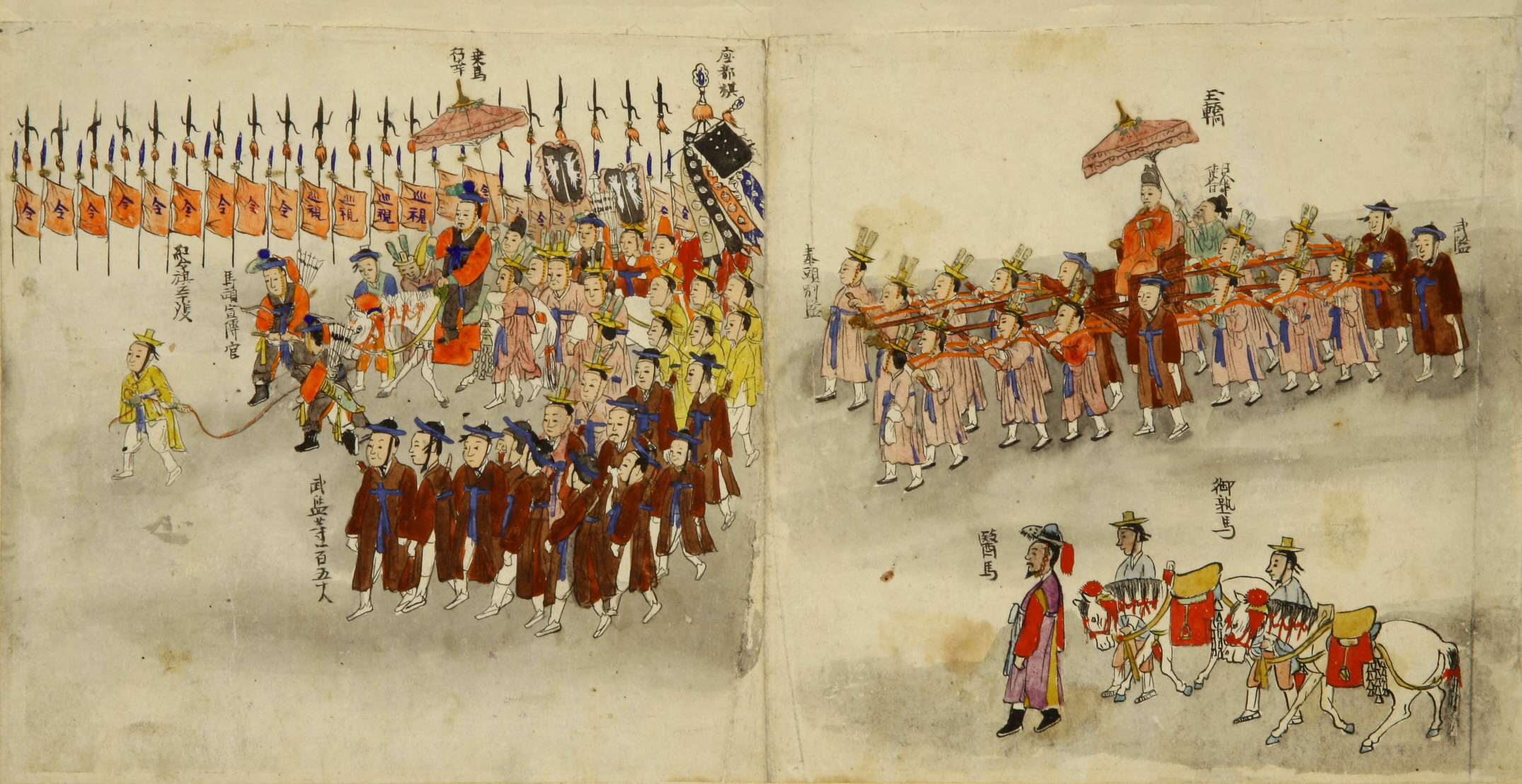
If you have watched any of the historic K-dramas, I am sure you can visualize this procession! And the actual passages in the book are even longer, with more details about troop maneuvers, accompanying noise-makers, and so on.
On a later visit, Isabella was invited to meet the King and Queen:
Hence it was with real pleasure that I received an invitation from the Queen; to a private audience, to which I was accompanied by Mrs. Underwood, an American medical missionary and the Queen’s physician and valued friend.
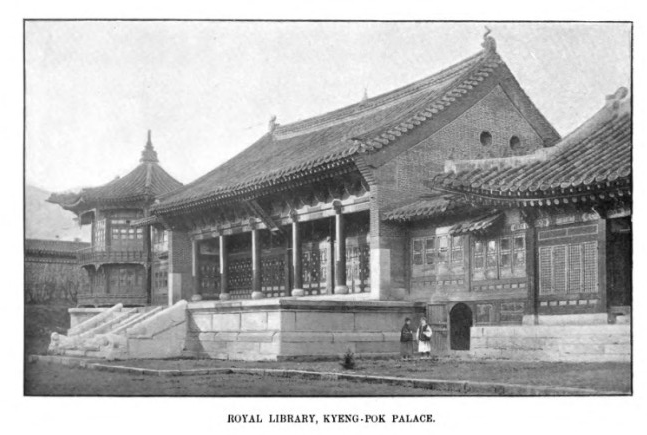
I have been altogether six times at this palace, and always with increased wonder at its intricacy, and admiration of its quaintness and beauty. Entering by a grand three-arched gateway; with its stone-balustraded stone staircase, and stone lions on stone pedestals below, one is bewildered by the number of large flagged courtyards, huge audience-halls, pavilions, buildings of all descriptions more or less decorated, stone bridges, narrow passages, and gateways with double- tiered carved roofs, through and among which one passes…
Library of the palace.
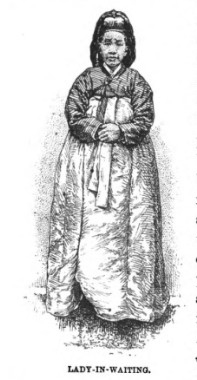
We had nearly half a mile of buildings to pass through be- fore we reached a very pretty artificial lake with a decorative island pavilion in the centre, near which are a foreign palace, built not long before, and the simple Korean buildings then occupied by the King and Queen. Alighting at the gateway; of the courtyard which led to the Queen’s house, we were received by the Court interpreter, a number of eunuchs, two of the Queen’s ladies-in-waiting, and her nurse, who was at the head of the Palace ladies a very privileged person, middle-aged, with decidedly fine features…
A lady-in-waiting in 1895.
Her Majesty, who was then past forty, was a very nice-looking slender woman, with glossy raven-black hair and a very pale skin, the pallor enhanced by the use of pearl powder. The eyes were cold and keen, and the general expression one of brilliant intelligence. She wore a very handsome, very full, and very long skirt of mazarine blue brocade, heavily pleated, with the waist under the arms, and a full-sleeved bodice of crimson and blue brocade;, clasped at the throat by a coral rosette, and girdled by six crimson and blue cords, each one clasped with a coral rosette, with a crimson silk tassel hanging from it. Her head-dress was a crownless black silk cap edged with fur, pointed over the brow, with a coral rose and full red tassel in front, and jewelled aigrettes on either side. Her shoes were of the same brocade as her dress. As soon as she began to speak, and specially when she became interested in conversation, her face lighted up into something very like beauty.
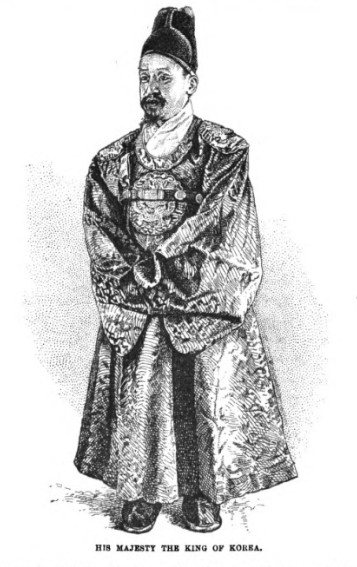
The King is short and sallow, certainly a plain man, wearing a thin moustache and a tuft on the chin. He is nervous and twitches his hands, but his pose and manner are not without dignity. His face is pleasing, and his kindliness of nature is well known. In conversation the Queen prompted him a good deal. He and the Crown Prince were dressed alike in white leather shoes, wadded silk socks, and voluminous wadded white trousers. Over these they wore first, white silk tunics, next pale green ones, and over all sleeveless dresses of mazarine blue brocade. The whole costume, being exquisitely fresh, was pleasing. On their heads they wore hats and mang-kuns of very fine horsehair gauze, with black silk hoods bordered with fur, for the mercury stood at 5° below zero….
An illustration from Korea and her Neighbors.
The black and white photos and illustrations above are all from Korea and her Neighbors by Isabella Bird. I am so glad she captured these historic details and preserved them.
∗ This “Great Bell” is also the one that the K-pop group BTS included on their most recent album, Arirang. Here is a post from Beyond K Class that explains the history and significance of the bell. And here is the Google Arts and Culture story and pictures of the bell.
HathiTrust catalog page for Volume 2




I believe when we were in Seoul some years ago, we took a tour of the Joseon Palace (?), but I can’t put my hands on the photos tonight. It was quite grand, as your narrator indicates, and even on that day a few years ago, we had all sorts of young women and men dressed up in traditional clothing, which brought a nice authenticity to it. (They did this by renting costumes and creating a day out, with a photographer in tow.) Our guide was not as clever as your Ms. Bird, and so we were lost a lot in her verbiage, but it was a lovely afternoon. I hope someday you can get over there and enjoy all the culture, if you haven’t already!
Yes, I hope to go too! I have never been to anywhere in Asia — my husband traveled for work and he has been to a lot of different places. I’ve been to different places in Europe about 6 times but never to any other continents. I am grateful for virtual travel on YouTube but it would be better in person.
Wow that embroidered insignia badge is amazing! Cool dive into historical Korean textiles 🙂
Clearly this was an educated lady who observed well and wrote well, too. The pictures are amazing.
I am late to the party but this was a fascinating read. I love “Asian” history (not sure of the all encompassing word), cultures that are nothing more than distant memories and legends. The actual pictures really made the read even more fascinating. Thank you for sharing this. Sorry it took me so long to go back and find it!