Came for the Costumes, Stayed for the Character Arcs
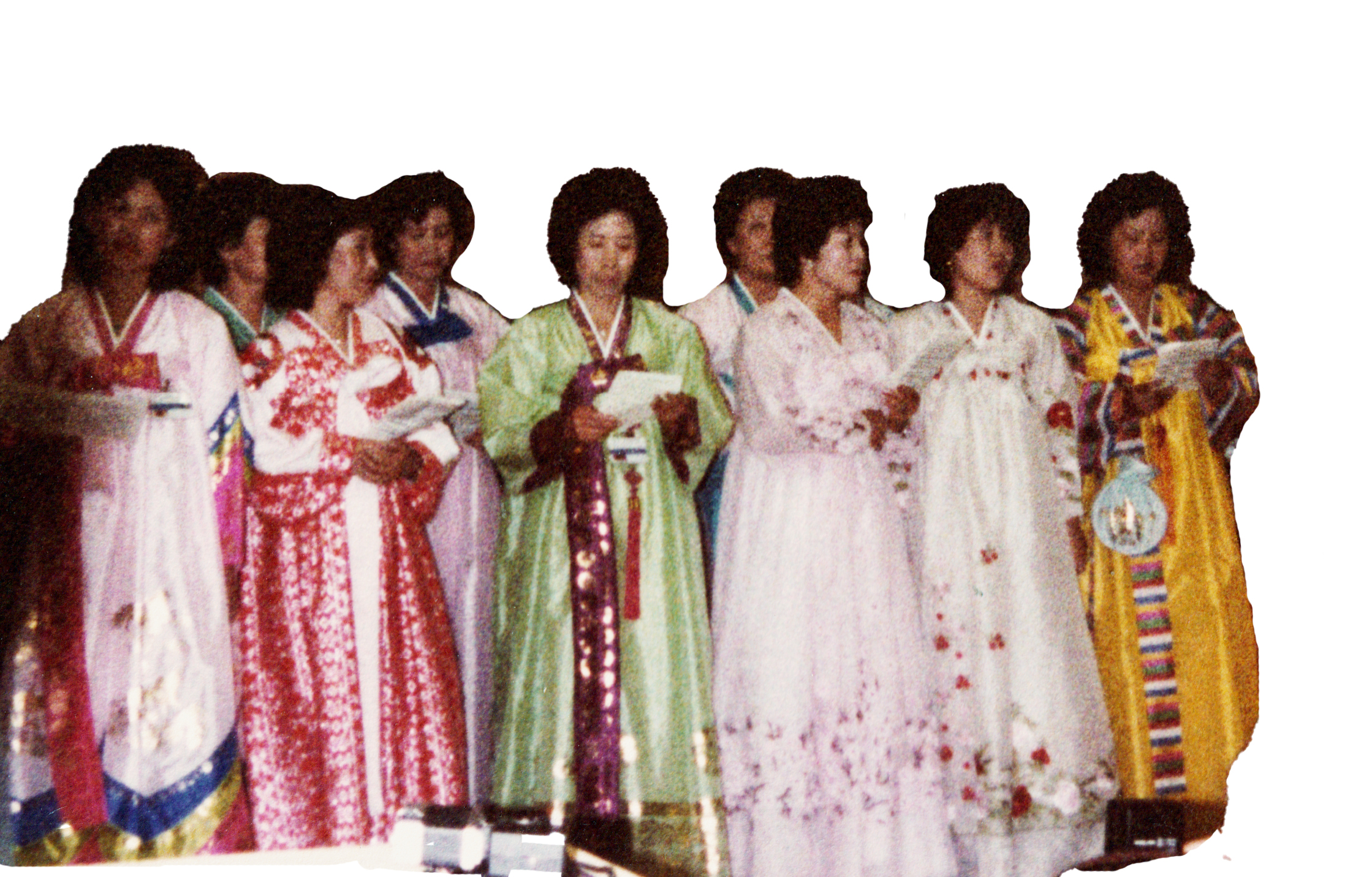
Beautiful dresses during a 1982 visit to Texas.
Last year one of my honorary grandkids recommended the movie KPop Demon Hunters, so I watched it and liked it, especially the beautiful songs.
The Netflix algorithm then suggested some other Korean TV series, so I picked one of the historical dramas to try, and I was immediately hooked. The settings, the costumes, and the cinematography are beautiful, and the actors skillfully express such a wide range of emotions.
Other K-drama fans have analyzed what makes these series so satisfying. Part of it is the format, which is comparable to a long Masterpiece Theatre season — these shows are limited series, with about 16 episodes that are an hour each. The story line has time to develop and come to a satisfying ending; minor characters also get their own story arcs.
This time format means that the characters have more scope to learn and change. With regular US TV series, no one ever knows how many seasons the show will air before cancellation, one or ten — so to hold the audience’s interest, no character can really develop or learn how to handle their issues. Each week Raymond learns to back his wife over his intrusive mom, and Niles and Frazier learn to cooperate instead of competing for attention, but by the following week they have forgotten everything and have to learn the lesson all over again in 22 minutes. But with the K-dramas, the writers have time to bring the characters to self-realization and strong relationships.
If you haven’t watched a K-drama yet, I will caution you that it is not all Hallmark Channel-type rainbows and romance though. There can be sudden short scenes of exceptional violence — the battle scenes don’t bother me; I admire all the choreography! — but there are scenes that emphasize how arbitrary and brutal encounters could be in a world that was rigidly hierarchical, with no recourse for people of lower status. I am always ready to fast-forward.
And there is one other negative note for a crafter — most of the series are only available in Korean with subtitles, so for the first time in my life, I have to pay attention, and I am watching TV without sewing at the same time! 🙂
So enough about the plots and characters, let’s move on to the costumes! In the historical series I have watched, I have been impressed by the quality — close-ups reveal the textures of raw silk, silk gauze, sumptuous embroidered panels, and bands of silk brocade on the upper-class characters, and hemp/ramie clothing and rope sandals on the commoners.
So naturally I wanted to know more — how accurate are these costumes? What resources are the designers using?
The first resource I found was this book, Dress History of Korea: Critical Perspectives on Primary Sources. I got it as a Kindle version, but the whole thing is downloadable as a PDF at the link above. (It took me a few times to get it to download but it did eventually work.) This book is very scholarly, and it has a whole chapter on the costume designers for films and series.
I am not going to try to give terms and definitions in this post, because I was able to embed this second fabulous book, The Encyclopedia of Traditional Korean Clothing, in its entirety. Anything you might want to know is covered, including all the different garments, as well as the fabrics and dyes used:
If you would like a more concise resource, the Victoria and Albert Museum has a great page on hanbok tradition and its use today.
And here are a few museum collection garments:
Lady Kim’s white ramie unlined coat cheolik at Chungbuk National University Museum
Skirt of Madam Han from Seok Juseon Memorial Museum
After doing all this research, I remembered that our family archive contains decades of travel photos. Two family members have been to Korea for short visits, but sadly, no one took any photos of festivals or traditional dress. However, my in-laws belonged to Friendship Force, and twice in the 1980s, they hosted guests from Korea! So I am including a few of those photos. Traditionally women in Korea wore two-piece outfits, but it looks to me like these ladies are wearing one-piece dresses. They even brought one for my mother-in-law, but that must have been lost in one of the floods we went through.


I am really enjoying this dive into K-dramas, and I have even set up a page on this blog to track the ones I watch (tab at the top), and any other research material I come across. If you love K-dramas too, I would love to hear from you!



Well, I clearly live under a rock and am completely clueless about K drama. I certainly enjoyed your post and your enthusiasm, and I always enjoy your deep dives into learning more.
Thanks! I am having so much fun participating in something pop culture for once in my life! 🙂
Good Grief, a RABBIT HOLE for sure 🙂 I watch a lot of Italian/French/German detective shows sha so I get the reading part and nothing else gets done hahaha
I have a friend whose son married a South Korean woman and she said she has her Hanbok from the marriage. She sent pics of the grand children in their Hanbok’s
for the National day and they are just gorgeous. Happy to see them.
‘
While there is tea there is hope!
I am so glad Hanbok is getting a renaissance! It is so beautiful and it looks comfortable and practical — at least for someone shaped like me. 🙂
Well now, that made me laugh. My shape would also benefit from that style. As I shrink I get ‘wider’ as someone said. I can still wear my clothes but since Madison Ave got a hold of my brain I don’t like how they look on me. I guess if that is all I have to worry about I need to shut Up! Am going to send you an essay you might like. be well. Me
Thistle be a beautiful day!
While there is tea there is hope!
When we were in Seoul a few years back, we went to the quilt museum there where they had a display of the hanbok dresses.[https://opquilt.com/2017/12/13/bojagi-and-the-chojun-textile-quilt-art-museum-•-seoul-south-korea] So I came home and ordered this pattern: https://twooninefabric.ca/products/pdf-hanbok-wrap-dress-sewing-therapy and it has been in my drawer. I need to get it out, and make it, as it is a contemporary version of the two-piece habit (near as I could tell, all your pix were of the two-piece).
I loved Korea clothing, and am glad to have your references. Thank you for posting this: what fun this is!!
Thank you so much for the links! I added a link to your post to my K-drama Love page. 🙂
From what I read about hanbok history, the tops used to be longer, about 20 cm if I recall correctly, and as the years went by they got shorter, down to about 9 cm. I like the longer ones better myself too.
Thanks for getting me interested in K-Dramas, awesome post.
Oh good, if you watch one, let me know!
Well, that was fun! I assume most of the clothing shown is more formal, not what one would wear to do the dishes!
That is what is part of the fun for me — a whole range of clothing is shown, from the nobles in silk, and the government officials in their silk with embroidered rank panels, to the courtesans with their huge wigs, to the servants in their uniforms and the commoners in ramie and hemp, with straw sandals. And some of the series show a lot of details about how the cooking, laundry, dishes, etc. were done. I enjoy the plots but I also enjoy thinking about the designers and crews that accomplish all the sets and costumes! 🙂
Wow, this is an interesting read. So, I just finished watching my first Korean Drama, wrote about what I like about it and searched for what else everyone watches and likes. Landed here finding an interesting read. Cheers!
Ooh, let me go check out your blog!
Also, I have had fun reading posts on reddit/kdramas. So far I am just lurking there. 🙂